

A Singaporean Lawyer’s Sojourn in Hong Kong
A Learning Journey of the Hong Kong Legal System and Best Practices in Advocacy
Introduction

The High Court of Hong Kong and business district at sunset 1All pictures published in this article were taken by the author or her contacts during the Programme and should not be reproduced or reused without the author’s permission.
A Short Primer on the Hong Kong Legal System
“One Country, Two Systems” is one of the most distinctive and well-known political features of the Hong Kong Special Administrative Region (HKSAR). After British colonial rule ended in 1997, Hong Kong retained its own independent common law system as enshrined in Article 8 of the Basic Law of the HKSAR.2Hong Kong Department of Justice, “Our Legal System”, <https://www.legalhub.gov.hk/details.php?a=1&v=our-legal-system# (last accessed: 1 September 2024)> This system ensures that the Hong Kong judiciary has the power to adjudicate disputes finally and independently. As the former Chief Justice of Hong Kong, the Honourable Geoffrey Ma, once said, “The … common law system … is regarded as vital to the continuing success of Hong Kong, not only from financial or business points of view but also for everyone in the community as a whole”.3The Government of the HKSAR Press Release, “CJ’s Speech at Ceremonial Opening of the Legal Year 2018” (8 January 2018), <https://www.info.gov.hk/gia/general/201801/08/P2018010800491.htm (last accessed: 1 September 2024)>
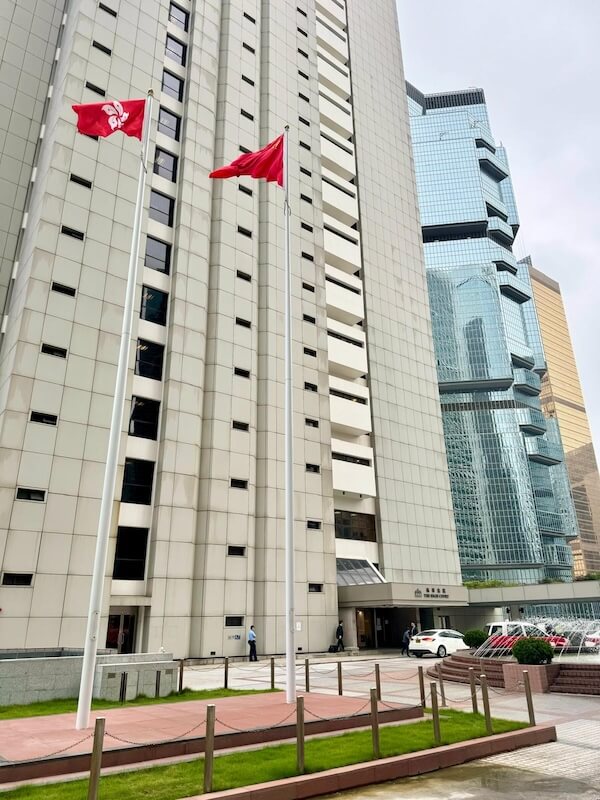
The regional flag of the HKSAR and the national flag of the People’s Republic of China outside the High Court

Hong Kong barristers entering the High Court before a trial
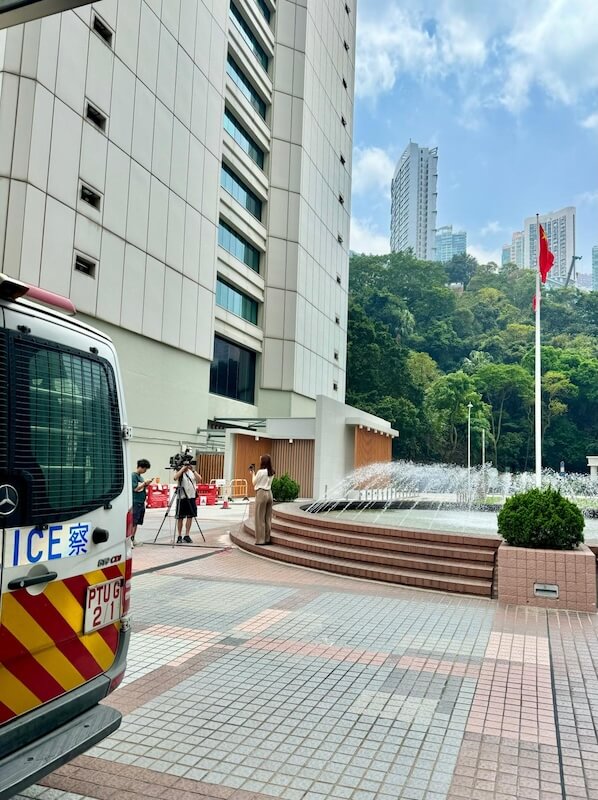
Reporters giving media interviews outside the High Court in respect of ongoing high profile cases
Due to their shared common law heritage, colonial past, and close geographical proximity, it is perhaps no surprise that strong legal ties exist between Singapore and Hong Kong. Earlier this year, memorandums of understanding were signed respectively between the Judiciary of the HKSAR and the Judiciary of Singapore to promote the efficient administration of family justice, and between the Law Society of Singapore and the HKBA to promote cross-cultural learning between the two professions. Active judicial dialogue also takes place between both legal systems on a jurisprudential level, with Hong Kong court decisions frequently cited in Singaporean court decisions and vice versa.

The Hong Kong Court of Final Appeal in Central, Hong Kong

Hong Kong’s legal system, however, differs from Singapore in one key respect: it maintains a split profession between barristers and solicitors. It was particularly interesting for me to observe how barristers and solicitors collaborate by leveraging their respective areas of expertise within and outside of the courtroom. I was also encouraged by the strong and lively camaraderie amongst barristers, especially given the frequency with which barristers act as opposing counsel vis-a-vis each other (including those who are members of the same set of barristers’ chambers) and the stringent demands of working life at the Bar.

Lunch gatherings with barristers at Temple Chambers hosted by Mr Victor Dawes SC and Ms Eva Sit SC

and the Hon. Geoffrey Ma
My Six-week Itinerary on the Programme
For the duration of the Programme, I was attached to Temple Chambers, one of the leading sets of barristers’ chambers in Hong Kong specialising in commercial, arbitration and public law. Currently, close to 30 out of its 60 over members are Senior Counsel or King’s Counsel. Temple’s members have argued numerous landmark cases in Hong Kong and many of its former members have gone on to accept appointments in the Hong Kong judiciary.
There was never a dull day during my six weeks in Temple. I enjoyed getting to know barristers at Temple, learning about Hong Kong laws and the conventions of the Hong Kong Bar, and supporting barristers in ongoing legal cases. Memorably, I also attended court hearings before the Competition Tribunal, Court of First Instance and the Court of Appeal, which covered a wide range of practice areas such as arbitration, contract, banking, employment, tax, competition and public law.

Ms Sheena Wong, a barrister at Temple, and I

Temple Chambers’ members’ library
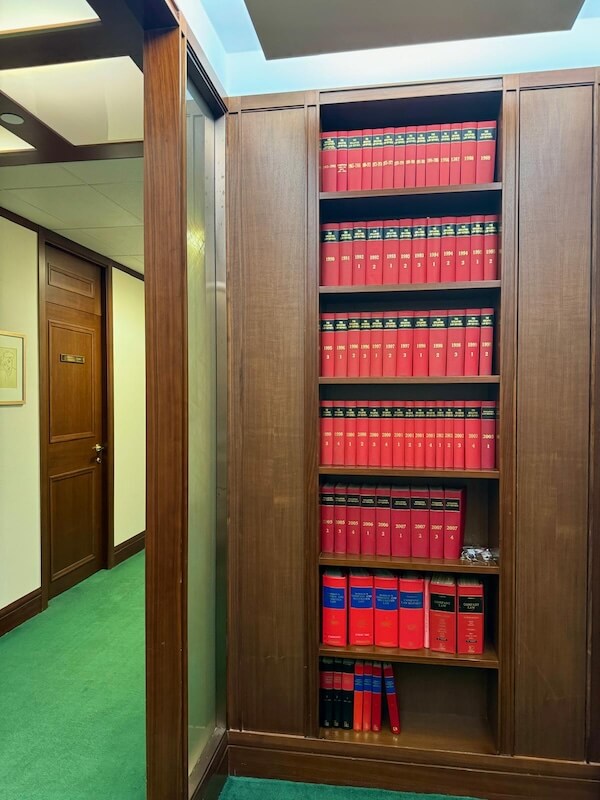
A bookshelf along Chambers’ corridor housing a collection of Singapore Law Reports
Beyond spending time in Chambers and in Court, I also had the chance to explore other aspects of the dynamic legal scene in Hong Kong. On the generous invitation of Mr Victor Dawes SC, Chairman of the HKBA, I attended the 26th Congress of the International Council for Commercial Arbitration (ICCA) held at the Hong Kong Convention Centre. ICCA provided a fantastic platform for me to hear perspectives on contemporary issues in arbitration from leading arbitrators, practitioners, legal counsel and members of the international arbitration community. Another highlight was attending the HKU-Temple Chambers’ Inaugural Lecture, delivered by Lord Briggs of Westbourne of the Supreme Court of the United Kingdom, titled “Never say Never: Equity’s Reach in the Modern Age”.

Lord Briggs of Westbourne delivering the HKU-Temple Chambers’ Inaugural Lecture (chaired by The Hon. Geoffrey Ma)
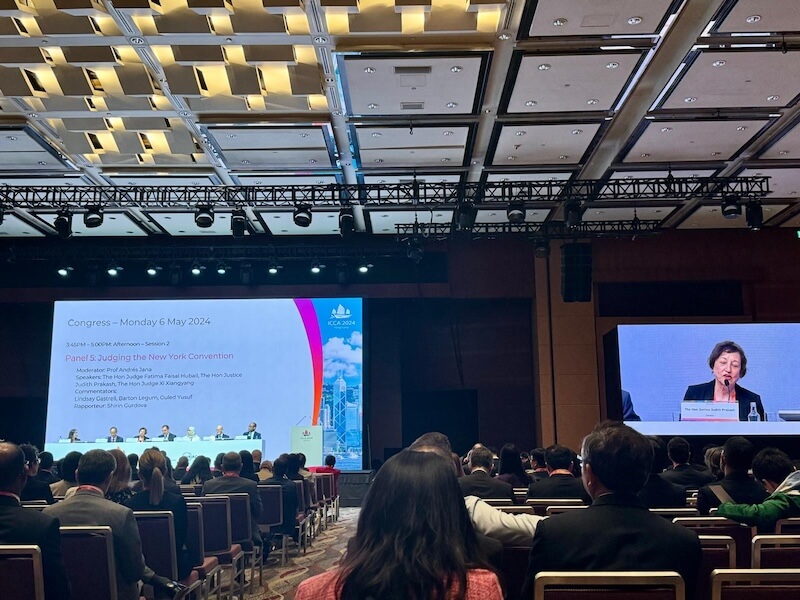
Senior Judge of the Supreme Court of Singapore, Justice Judith Prakash speaking at a panel on “Judging the New York Convention” at the 26th ICCA Congress 2024.
Three Valuable Lessons on Advocacy
What I valued most about the Programme was not merely the insights I gained into how barristers tackle legal problems, craft submissions and formulate case strategies, but also the exposure I had to a wide variety of advocacy styles. This experience prompted me to reflect on my existing views and practices on advocacy and develop fresh perspectives at the same time. In this section, I elaborate on three interrelated learning points about advocacy which I gleaned from this experience.
1. A good advocate engages closely with the decision maker
We are all familiar with the primary goal of advocacy: to persuade. However, we sometimes overlook that we aren’t merely aiming to persuade for persuasion’s sake, but to convince the specific decision maker hearing the case. I gained a deeper appreciation of this critical facet of advocacy while observing the advocacy process through the renewed lens of a neutral bystander, rather than counsel advocating for a particular side. Through the many hearings I attended, I found that advocates were more effective in persuading the Court (whether through written or oral advocacy) when they were able to pre-empt and answer the specific questions a Judge may have, and not merely to advance the submissions of the party they represent.
That said, reading a Judge’s mind is certainly easier said than done. An advocate who has worked tirelessly on a case is naturally anxious, above all, to ensure he has advanced the most compelling arguments for his client. Yet, it is equally crucial for an advocate to present his arguments in a manner that resonates with the specific Judge presiding over the matter. Otherwise, this gives rise to the risk – which may prove fatal to his client’s case – that the Judge might not appreciate the significance of the arguments he seeks to advance.
This experience underscored the contrasting views inherent in the advocacy process: this comprises, on one hand, the views of the parties, who are eager to guard their interests and resolve the dispute in their favour, and on the other, the view of the Judge, who is keen to achieve a just outcome that is consistent with the ideals of the legal system. A strong and effective advocate is cognisant of these different perspectives and closely engages not only with his client or adversary but the decision maker as well.
2. A good advocate is also a good listener
“People often forget that a vital part of advocacy is not talking. It’s listening. Listening to what the other side says, listening to what the judge is saying… Forgotten by far too many advocates who are concentrating only on what they are saying”. (Lord David Pannick KC)4Extracts from an interview with Lord David Pannick KC by Advocates The Podcast, available on YouTube at <https://www.youtube.com/watch?v=RwOmeLRAs10> (last accessed on 13 August 2024)
Before each hearing, I would typically receive counsel’s submissions to review a day in advance. However, it was not always feasible, especially for complex applications, for me to gain mastery of all issues within reading time. To fully grasp the key contentions in each case and the views of both the Court and counsel, I found it essential to listen attentively during the hearing itself.
Listening, as I came to realise, is both an exhausting yet rewarding affair! More significantly, the experience also taught me how active listening was an important yet underappreciated pillar of effective advocacy.
In proceedings I attended before the Hong Kong Court of Appeal (HKCA), strict time limits were imposed on oral submissions. This meant that counsel needed to listen carefully to the Court’s questions and use their allotted time judiciously. To illustrate this, I set out below a brief extract of the opening remarks from the HKCA (Coram: Hon Kwan VP, Au and Chow JJA) and the Appellant’s counsel, Mr Eugene Fung SC in John Wiley & Sons UK2 LLP and anor v The Collector of Stamp Revenue [2024] HKCA 578.
CA: The issue before us is narrow. Written submissions taken as read. It does not help us to repeat any part of your submissions. As far as we can see, we don’t find anything unclear. It would be more helpful to us, Mr Fung, if you could deal with the opposing counsel’s submissions.
Appellant’s Counsel (“AC”): My Lady, I propose to simply reply to four key points made by my learned friend in his skeletal submissions. Perhaps I could go highlight these points and Your Honour could let me know if there are any points you do not require me to canvass.
CA: Yes, please go ahead.
AC: My 1st point concerns why the term “body corporate” came into HK legislation in 1981. I propose to respond to my learned friend’s point about inferring legislative purpose regarding this term.
For the 2nd point, I will address the Ramsay approach and whether it should be applied in this appeal.
On the 3rd point, I will respond to my learned friend’s point about the abolition of nominal value concept in the new Cap 622 and whether it has any bearing in this appeal.
My last point deals with my learned friend’s submission that the term “share capital” is analogous to participation interests.
I have various responses to those points above.
That is all I wish to say, my Lady.
CA: Yes, please proceed with these points.5This extract is based on the author’s own notes and has not been obtained from any official transcript of the proceedings. Accordingly, this extract should not be regarded or relied on as an accurate transcript of the proceedings.
What stands out in the above exchange is how the Appellant’s counsel had carefully heeded the Court’s remarks. Instead of succumbing to the urge to deliver a lengthy opening, counsel provided a concise roadmap that set the stage for the Court to highlight their key concerns in the appeal. This approach not only shows respect for the Court’s limited time but also reflects the Appellant counsel’s sound judgment in focussing his oral submissions on the crucial and decisive points of the dispute.
In trial proceedings, a good advocate is not just a skilful cross-examiner but a keen listener.
Pertinently, in handling witnesses, an advocate needs to listen attentively to and closely observe witnesses to understand their testimony and ensure clarity in their evidence. To illustrate, I set out below an extract in which the Defendant’s lead counsel, Ms Eva Sit SC, had posed a question to one of the Defendant’s witnesses during re-examination.
Defendant’s counsel: Ms T, this morning you were shown a written warning given to Mr H. You were first asked to look at item 1 … You were then asked to look at the 2nd paragraph which provides Mr H’s explanation for why he had arranged the meeting. Then you said it doesn’t matter. Then you were interrupted.
Could you explain to the court why it doesn’t matter?
Witness: I meant that it doesn’t matter whether he arranged the meeting as head of China or chairman of investment banking. His license with the SFC was as an investment banker. Whether he has an additional public side role does not matter – even if he is REI or above the wall he still has to follow compliance requirements and to perceive conflicts.6This extract is based on the author’s own notes and has not been obtained from any official transcript of the proceedings. While the trial was conducted in open court, the identities of the witnesses have been anonymised for privacy reasons. Accordingly, this extract should not be regarded or relied on as an accurate transcript of the proceedings.
As demonstrated by the above extract, the Defendant’s counsel had closely observed the witness’ reactions throughout her cross-examination to fully grasp the evidence she was seeking to give. Through keen perception and close listening, the Defendant’s counsel noticed the specific moment where the witness may not have fully explained her response and adeptly invited her to clarify her evidence at the appropriate juncture.
3. A good advocate recognises the crucial role of oral advocacy and uses it wisely
While much has been written about the importance of written advocacy, especially in modern-day adversarial proceedings, I wish to emphasise that my aim is not to undermine those views or suggest that oral advocacy surpasses written advocacy in significance. Rather, my focus is on how oral advocacy can serve as a powerful complement to written advocacy.
During court proceedings, I observed how counsel’s oral submissions could play a vital role in crystallising key issues and bringing the deficiencies of a case to light, even where the parties’ written submissions had already outlined the issues and arguments clearly. The oral hearing also provided a golden opportunity for advocates to shape and guide the thought processes of the decision maker.
By way of example, below is an excerpt from the oral closing arguments by the Respondent’s lead counsel, Mr Daniel Beard KC, in a trial before the Competition Tribunal. Mr Beard KC was addressing the Court on the significance of the entry of the 2015 Competition Ordinance in Hong Kong, a landmark event that had overhauled Hong Kong competition law. He argued that following this event, one of the crucial issues that the Claimant, the Competition Commission had to address was whether the Respondents’ conduct would still be deemed anti-competitive even after the 2015 Ordinance had entered into force.
Respondent’s counsel: What is important for your Lordship’s judgment in this case is the watershed event in 2015, considered in the context of competition law. We have 110 pages from the Commission in written closing arguments, but only 1 page on the watershed event in 2015. What this shows is that the Commission continues to be in living denial throughout these proceedings about this one critical factual issue which impacts the way we deal with competition law today.7This extract is based on the author’s own notes and has not been obtained from any official transcript of the proceedings. Accordingly, it should not be regarded or relied on as an accurate transcript of the proceedings.
In just four lines, counsel impactfully advances his client’s central submission that the Commission had not only omitted to address the 2015 watershed event but failed to recognise its pivotal importance to the entire case throughout the protracted proceedings (which lasted more than three years) and voluminous closing submissions. Further, he makes it abundantly clear to the decision maker why the Respondent had considered this issue to be fundamentally fatal to the Commission’s case and why it was important for the Court to address this issue in its judgment.
Concluding Remarks
Ultimately, all three learning points I have described above stem from the same principle: knowing and engaging your audience. Mastering this skill is arguably the most powerful weapon in an advocate’s arsenal.
In closing, I would like to express my sincere gratitude to the Law Society of Singapore for funding and supporting my participation in the Programme. I also extend my special thanks to the teams from the Law Society of Singapore and the Hong Kong Bar Association, as well as to Mr Victor Dawes SC and Ms Sheena Wong from Temple Chambers, for making arrangements for my time in Hong Kong. Finally, I am also deeply grateful to the barristers at Temple Chambers who graciously invited me to observe their cases and shared with me their invaluable knowledge and insights on Hong Kong’s laws and legal system.
Leo Zhi Wei8The author had participated in this Programme before she joined the Singapore Judicial Service and was appointed an Assistant Registrar of the Supreme Court of Singapore and District Judge. She is also an Adjunct Lecturer at the Yong Pung How School of Law, Singapore Management University. All views expressed in this essay are the author’s personal views and do not represent those of the organisations she is part of.
Law Society of Singapore’s selected delegate in the 2024 LSS x HKBA Exchange Programme
Endnotes
| ↑1 | All pictures published in this article were taken by the author or her contacts during the Programme and should not be reproduced or reused without the author’s permission. |
|---|---|
| ↑2 | Hong Kong Department of Justice, “Our Legal System”, <https://www.legalhub.gov.hk/details.php?a=1&v=our-legal-system# (last accessed: 1 September 2024)> |
| ↑3 | The Government of the HKSAR Press Release, “CJ’s Speech at Ceremonial Opening of the Legal Year 2018” (8 January 2018), <https://www.info.gov.hk/gia/general/201801/08/P2018010800491.htm (last accessed: 1 September 2024)> |
| ↑4 | Extracts from an interview with Lord David Pannick KC by Advocates The Podcast, available on YouTube at <https://www.youtube.com/watch?v=RwOmeLRAs10> (last accessed on 13 August 2024) |
| ↑5 | This extract is based on the author’s own notes and has not been obtained from any official transcript of the proceedings. Accordingly, this extract should not be regarded or relied on as an accurate transcript of the proceedings. |
| ↑6 | This extract is based on the author’s own notes and has not been obtained from any official transcript of the proceedings. While the trial was conducted in open court, the identities of the witnesses have been anonymised for privacy reasons. Accordingly, this extract should not be regarded or relied on as an accurate transcript of the proceedings. |
| ↑7 | This extract is based on the author’s own notes and has not been obtained from any official transcript of the proceedings. Accordingly, it should not be regarded or relied on as an accurate transcript of the proceedings. |
| ↑8 | The author had participated in this Programme before she joined the Singapore Judicial Service and was appointed an Assistant Registrar of the Supreme Court of Singapore and District Judge. She is also an Adjunct Lecturer at the Yong Pung How School of Law, Singapore Management University. All views expressed in this essay are the author’s personal views and do not represent those of the organisations she is part of. |