


Breakfast, Eventually: Why Lawyers Should Build Their Own Tools
Keeping up with legal developments is a discipline that rarely survives a working morning. This article recounts building a fix (an AI agent that reads the day’s legal news and delivers a short briefing before the inbox is opened) and argues the hard part was never engineering but drafting: defining “relevant to my practice”, telling the assistant what to do with uncertainty, treating every wrong output as an unstated assumption. Software for a market of one now takes an evening, which makes a lawyer’s judgement the durable advantage that bought tools cannot supply.
I am, on paper, a reasonably competent lawyer. Part of that job is keeping up with legal developments relevant to my practice. In the version of my mornings that I like to imagine, I settle into my comfortable office chair, open the email client on my phone, and become learned as I flick through the day’s updates. The reality is muddier: skim law firm updates I do not remember signing up for, open Singapore Law Watch1Singapore Law Watch is Singapore’s foremost daily legal news syndication site from the Singapore Academy of Law <https://www.singaporelawwatch.sg> (accessed 27 July 2026). Its RSS feed is at <https://www.singaporelawwatch.sg/Portals/0/RSS/SuperFeed.xml> (accessed 27 July 2026)., stare at the page, move on. What should be a daily discipline devolves into the bottom of a to-do list.
I refuse to cower before such obstacles to being a more competent lawyer. For years, doing something about it required dogged persistence, and solving it with software meant serious engineering, which was beyond me. Fixing my mornings now, it turned out, did not call for engineering. It called for lawyering.

Permission to Build
What stops most lawyers from building is the belief that software is engineers’ work. For the software you buy, it is. The correct number of users for some software, however, is one. A tool with one user can also change as fast as its owner notices what is wrong: no release, no rollout, nobody to warn. Being wrong is cheap, so you can be wrong often, and the tool improves at the speed you notice its faults.
Building at that scope has a name: agentic coding. You delegate a bounded task and an AI agent runs a loop — planning, writing, running and revising the code until the task is done. AI researcher Andrej Karpathy calls it “programming via LLM agents”, now a default workflow for professionals, “except with more oversight and scrutiny”2Andrej Karpathy, post on X (February 2026) <https://x.com/karpathy/status/2019137879310836075> (accessed 24 August 2026). In the same post Karpathy proposes “agentic engineering” as the better name for the practice: “you are not writing the code directly 99% of the time, you are orchestrating agents who do and acting as oversight”.. When AI agents become proficient at producing code effectively based on a user’s requirements, the bar for anyone, including lawyers, to create software is significantly lowered. With stronger models being released regularly, the speed at which software is created is also accelerated.
When software takes an evening instead of months, the peculiar corners of a practice become viable. No technology company will ever build software tuned to one client, because one lawyer’s morning ritual is nobody’s market.
Getting started requires less than the word “software” suggests: today’s AI coding assistants take a plain-language description of a task and write, run, and correct the program themselves. Even a locked-down firm laptop holds workable options3At the frontier, Claude Code < https://claude.com/product/claude-code> (accessed 27 July 2026) and OpenAI’s Codex < https://openai.com/codex/> (accessed 27 July 2026); within many firm or enterprise environments using Microsoft infrastructure, Copilot Cowork < https://www.microsoft.com/en-us/microsoft-365-copilot/cowork> (accessed 27 July 2026) is available. Even ChatGPT will produce working tools on request through Canvas or Code Interpreter.. What a lawyer needs is not a new machine or a team but a task worth automating, and the willingness to state precisely what done looks like.
Making Breakfast
So here is breakfast, made from scratch: a tool that reads the morning’s legal news and delivers a short briefing before the email is opened. No code appears in what follows: only a document, and the drafting will feel familiar.
Start where lawyers always start: precedents. Survey what’s available and suitable first. The Singapore Law Watch publishes the day’s headlines, free, with an RSS feed.4Open Singapore legal data remains scarcer than it should be: LawNet <https://www.lawnet.com/openlaw/singapore/judgments/supreme-court> (accessed 27 July 2026) has no public interface to build against, and the Singapore Open Legal Informatics Database (SOLID) project at SMU’s Centre for Digital Law targets full launch only in Q1 2028, see “SMU to Build Open Legal Database with Support from Ministry of Law” < https://news.smu.edu.sg/news/2025/11/18/smu-build-open-legal-database-support-ministry-law> (accessed 27 July 2026). The author’s spare-time contribution is Zeeker <https://data.zeeker.sg> (accessed 26 July 2026): an open, free database of Singapore legal news and judgments, queryable by humans at the site and by AI assistants via its MCP server <https://mcp.zeeker.sg/mcp> (accessed 26 July 2026). An RSS feed, stripped of mystique, is a list a machine can read reliably. Read what the feed actually delivers. It carries everything at once — judgments, consultation papers, the odd job advertisement — and its category field names who is speaking (“Straits Times”, or a firm syndicating its client update), not what the item is about. Spending time reading the source does half the build.
Next, the instructions. The vehicle is a “skill”: a plain-text file the AI assistant reads before it acts, written in ordinary numbered prose5The complete skill file described in this section is published at https://gist.github.com/houfu/6f7b197ff3f5b9fbc267bcf5e748f017 (accessed 26 July 2026). Readers are invited to copy it exactly, then amend the Definitions clause to suit their own practice. For more information on how to write skills, resources such as its format home are available <https://agentskills.io/skill-creation/quickstart> (accessed 26 July 2026). More examples of skills for a legal domain can be found at Lawve <https://lawve.ai/> (accessed 26 July 2026) and LQ Skills <https://github.com/LegalQuants/lq-skills> (accessed 26 July 2026).. Mine reads like a short contract with a literal-minded counterparty, and three parts of it do real work. First, the definitions — “relevant to my practice”. Unexplained, it is useless, so criminal law is out, but white-collar matters stay in. The working instructions are short: fetch, filter, rank, stop at eight items. The lines that matter most say how the work must be done: every item must come from today’s feed, never from the assistant’s memory; if the feed is unavailable, say exactly that and stop.
Then run it — and watch it fail.6The skill file can be installed and then run in environments such as Claude Code, Codex or Cowork by asking the agent to install it as a skill. The first outputs will be wrong, and wrong in ways that are, on review, entirely the drafter’s fault. The first version was vague — “flag what is material” — and it flagged everything. The subtler failure came later. The filter clause read: “Include only items relevant to my practice and discard the rest.” The assistant construed silence as discard and quietly dropped an opinion piece worth reading.
The decisive fix told the assistant what to do with uncertainty instead of leaving it to guess: if genuinely uncertain, include the item on a “Possibly relevant” line with one sentence of doubt; never silently discard. One line, and the failure changed from invisible omission, which can never be audited, to visible hedging, which can be corrected over coffee. When you cannot make an assistant infallible, make its doubts inspectable.
The version that finally worked was also the shortest7Xiangyi Li et al, “SkillsBench: Benchmarking How Well Agent Skills Work Across Diverse Tasks”< https://arxiv.org/abs/2602.12670> (accessed 26 January 2026): across 7,308 agent runs, curated skills improved task performance by 16.6 percentage points on average, with compact instructions delivering roughly 27 times the improvement of comprehensive ones (19 percentage points against 0.7).. The system was not getting smarter; the brief was getting clearer. Every wrong output exposed an assumption that had never been written down: how information is structured, what counts as urgent, where a deadline appears. The failures were not obstacles to the process. They were the process.
Notice what has not happened yet. All of that is a text file. Nothing has been programmed, nothing built; an agent has been editing prose on instruction, and the prose happened to be instructions of its own. The loop does not change from here. What changes is that it now runs past the edge of what a lawyer can do.
One morning the briefing arrived full of yesterday’s items. Every failure until then had been the drafter’s, and every fix had been to write more clearly. Not this one. The feed stamps its items in one time zone; the morning happens in another; the boundary between them fell in the wrong place. No amount of redrafting would have found that, because it was machinery rather than instruction. What I could do was notice that Tuesday’s news was Monday’s, and say so in those words. The agent went hunting, found the fault, changed the program, ran it again and showed the result.
The tool earns its keep regardless: each morning, a short document arrives before the email does. A handful of items, each with a summary, a materiality flag, a suggested next action. The code is the agent’s problem. The brief, and what comes out of it, are mine.
The Signature Dish
The morning briefing was built for a market of one. Taken seriously, it is how a practice becomes distinct. Many lawyers are handed a library of approved prompts: a good start, but everyone in the building has the same library, and so does the building across the road. The lawyer who knows what is peculiar about their own practice (the clients nobody else has, the questions nobody else asks) can now take action to exploit that peculiarity, at the cost of a few evenings.
In LegalQuants, a community of practising lawyers who build, co-founder Jamie Tso asks the uncomfortable question8Jamie Tso, “The Origin Story of a Legal Quant” (1 March 2026) <https://tsojamie.substack.com/p/the-origin-story-of-a-legal-quant> and Jamie Tso, “The Jane Street of Law: The Rise of the Legal Quant” (15 January 2026) <https://tsojamie.substack.com/p/the-jane-street-of-law-the-rise-of>. Both posts verified publicly accessible as at 24 July 2026.: if every firm buys roughly the same tools, what is the source of durable advantage? His answer, borrowed from quantitative trading, is excellence above market standard, that is the alpha. The questions the old workflow made too expensive to ask, like finding every deviation from a standard position across five thousand provisions in a hundred and fifty documents. A lawyer who builds does not merely do the old work faster; they can afford questions nobody else can.
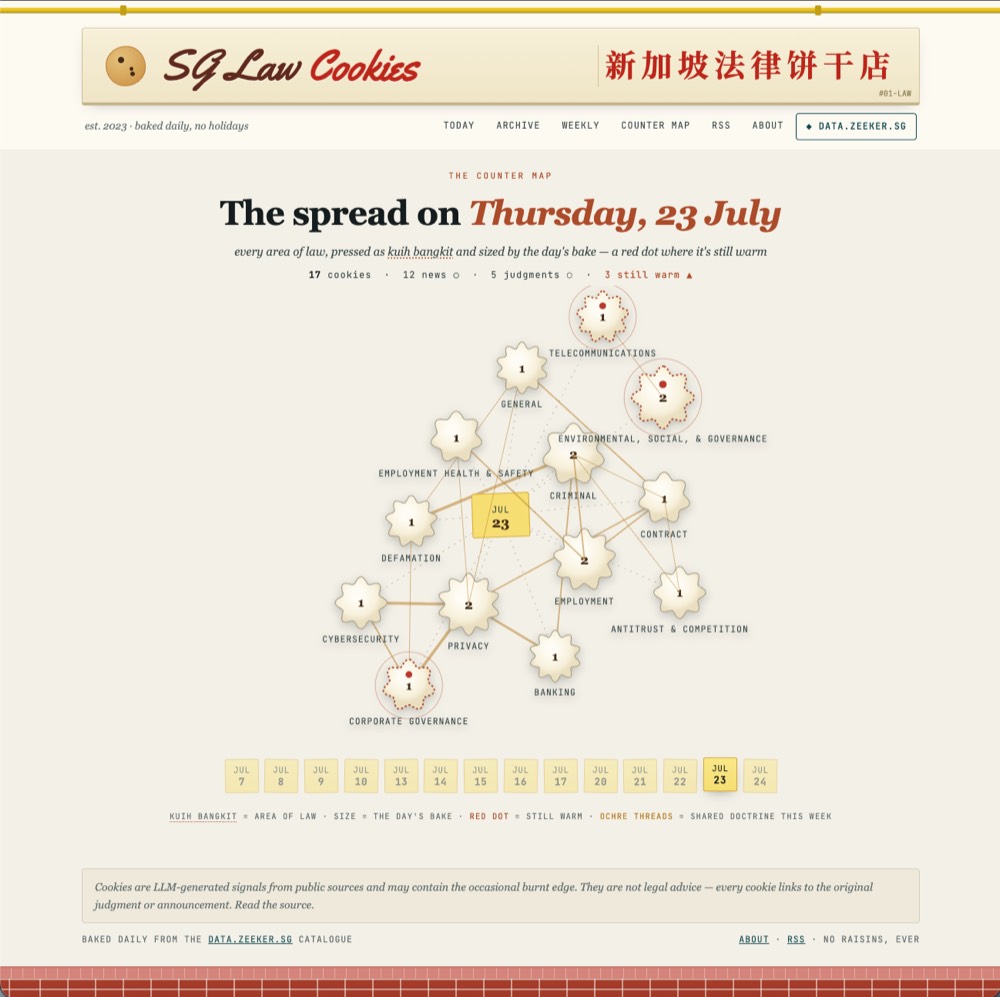
The uniqueness need not stop at analysis; it can reach how law is served at all. SG Law Cookies9The author’s SG Law Cookies <https://cookies.zeeker.sg> (accessed 26 July 2026) takes the same appetite that built the morning briefing and bakes the day’s headlines into a small, highly stylised daily digest — a neighbourhood bakery, in effect; the smell of kuih bangkit drifting out the door tells you what is happening in the legal scene.
Where the Stakes Are Breakfast
The objections are obvious enough. The Law Society’s advisory of 2 April 2026 rightly warns against feeding client information into publicly available AI tools10Law Society of Singapore, “Law Society’s Advisory on the Use of Publicly Available AI Tools” (2 April 2026) <https://www.lawsociety.org.sg/wp-content/uploads/2026/04/Law-Societys-Advisory-on-the-Use-of-Publicly-Available-AI-Tools-2-April-2026.pdf>. See also Ministry of Law, Guide for Using Generative AI in the Legal Sector (6 March 2026) <https://www.mlaw.gov.sg/files/Guide_for_using_Generative_AI_in_the_Legal_Sector_Published_on_6_Mar_2026.pdf>.. But the safeguard that matters is the lawyer’s judgement, and it does more than observe prohibitions. It sets the scope. A lawyer decided where the skill was allowed to look, what it must never do silently, and what counts as done. That is not a compliance function bolted onto the build; it is the build.
The reason this is an opportunity now, for any lawyer rather than the technically blessed few, is that today’s AI agents can already execute a brief drafted with that care. The judgement was always ours. The tools have finally caught up to it.
So here is the invitation. Find one thing you do every week that you hate, not only because it might be difficult, repetitive or draining, but because you can make it better. Then treat it as a matter. Look for precedents. Ask what the sources promise. Write the brief, as if for a new paralegal: that document is most of the build. Let the AI do the rest. Let it be wrong. Fix it. Let it be wrong again. Fix it again. The result will be a tool nobody sells, and a first-hand understanding of what these systems can and cannot be trusted to do. You will have been present for every decision that made it work. That presence is the practice.
The bakery keeps baking. And breakfast, eventually, gets served.
Endnotes
| ↑1 | Singapore Law Watch is Singapore’s foremost daily legal news syndication site from the Singapore Academy of Law <https://www.singaporelawwatch.sg> (accessed 27 July 2026). Its RSS feed is at <https://www.singaporelawwatch.sg/Portals/0/RSS/SuperFeed.xml> (accessed 27 July 2026). |
|---|---|
| ↑2 | Andrej Karpathy, post on X (February 2026) <https://x.com/karpathy/status/2019137879310836075> (accessed 24 August 2026). In the same post Karpathy proposes “agentic engineering” as the better name for the practice: “you are not writing the code directly 99% of the time, you are orchestrating agents who do and acting as oversight”. |
| ↑3 | At the frontier, Claude Code < https://claude.com/product/claude-code> (accessed 27 July 2026) and OpenAI’s Codex < https://openai.com/codex/> (accessed 27 July 2026); within many firm or enterprise environments using Microsoft infrastructure, Copilot Cowork < https://www.microsoft.com/en-us/microsoft-365-copilot/cowork> (accessed 27 July 2026) is available. Even ChatGPT will produce working tools on request through Canvas or Code Interpreter. |
| ↑4 | Open Singapore legal data remains scarcer than it should be: LawNet <https://www.lawnet.com/openlaw/singapore/judgments/supreme-court> (accessed 27 July 2026) has no public interface to build against, and the Singapore Open Legal Informatics Database (SOLID) project at SMU’s Centre for Digital Law targets full launch only in Q1 2028, see “SMU to Build Open Legal Database with Support from Ministry of Law” < https://news.smu.edu.sg/news/2025/11/18/smu-build-open-legal-database-support-ministry-law> (accessed 27 July 2026). The author’s spare-time contribution is Zeeker <https://data.zeeker.sg> (accessed 26 July 2026): an open, free database of Singapore legal news and judgments, queryable by humans at the site and by AI assistants via its MCP server <https://mcp.zeeker.sg/mcp> (accessed 26 July 2026). |
| ↑5 | The complete skill file described in this section is published at https://gist.github.com/houfu/6f7b197ff3f5b9fbc267bcf5e748f017 (accessed 26 July 2026). Readers are invited to copy it exactly, then amend the Definitions clause to suit their own practice. For more information on how to write skills, resources such as its format home are available <https://agentskills.io/skill-creation/quickstart> (accessed 26 July 2026). More examples of skills for a legal domain can be found at Lawve <https://lawve.ai/> (accessed 26 July 2026) and LQ Skills <https://github.com/LegalQuants/lq-skills> (accessed 26 July 2026). |
| ↑6 | The skill file can be installed and then run in environments such as Claude Code, Codex or Cowork by asking the agent to install it as a skill. |
| ↑7 | Xiangyi Li et al, “SkillsBench: Benchmarking How Well Agent Skills Work Across Diverse Tasks”< https://arxiv.org/abs/2602.12670> (accessed 26 January 2026): across 7,308 agent runs, curated skills improved task performance by 16.6 percentage points on average, with compact instructions delivering roughly 27 times the improvement of comprehensive ones (19 percentage points against 0.7). |
| ↑8 | Jamie Tso, “The Origin Story of a Legal Quant” (1 March 2026) <https://tsojamie.substack.com/p/the-origin-story-of-a-legal-quant> and Jamie Tso, “The Jane Street of Law: The Rise of the Legal Quant” (15 January 2026) <https://tsojamie.substack.com/p/the-jane-street-of-law-the-rise-of>. Both posts verified publicly accessible as at 24 July 2026. |
| ↑9 | The author’s SG Law Cookies <https://cookies.zeeker.sg> (accessed 26 July 2026) |
| ↑10 | Law Society of Singapore, “Law Society’s Advisory on the Use of Publicly Available AI Tools” (2 April 2026) <https://www.lawsociety.org.sg/wp-content/uploads/2026/04/Law-Societys-Advisory-on-the-Use-of-Publicly-Available-AI-Tools-2-April-2026.pdf>. See also Ministry of Law, Guide for Using Generative AI in the Legal Sector (6 March 2026) <https://www.mlaw.gov.sg/files/Guide_for_using_Generative_AI_in_the_Legal_Sector_Published_on_6_Mar_2026.pdf>. |