

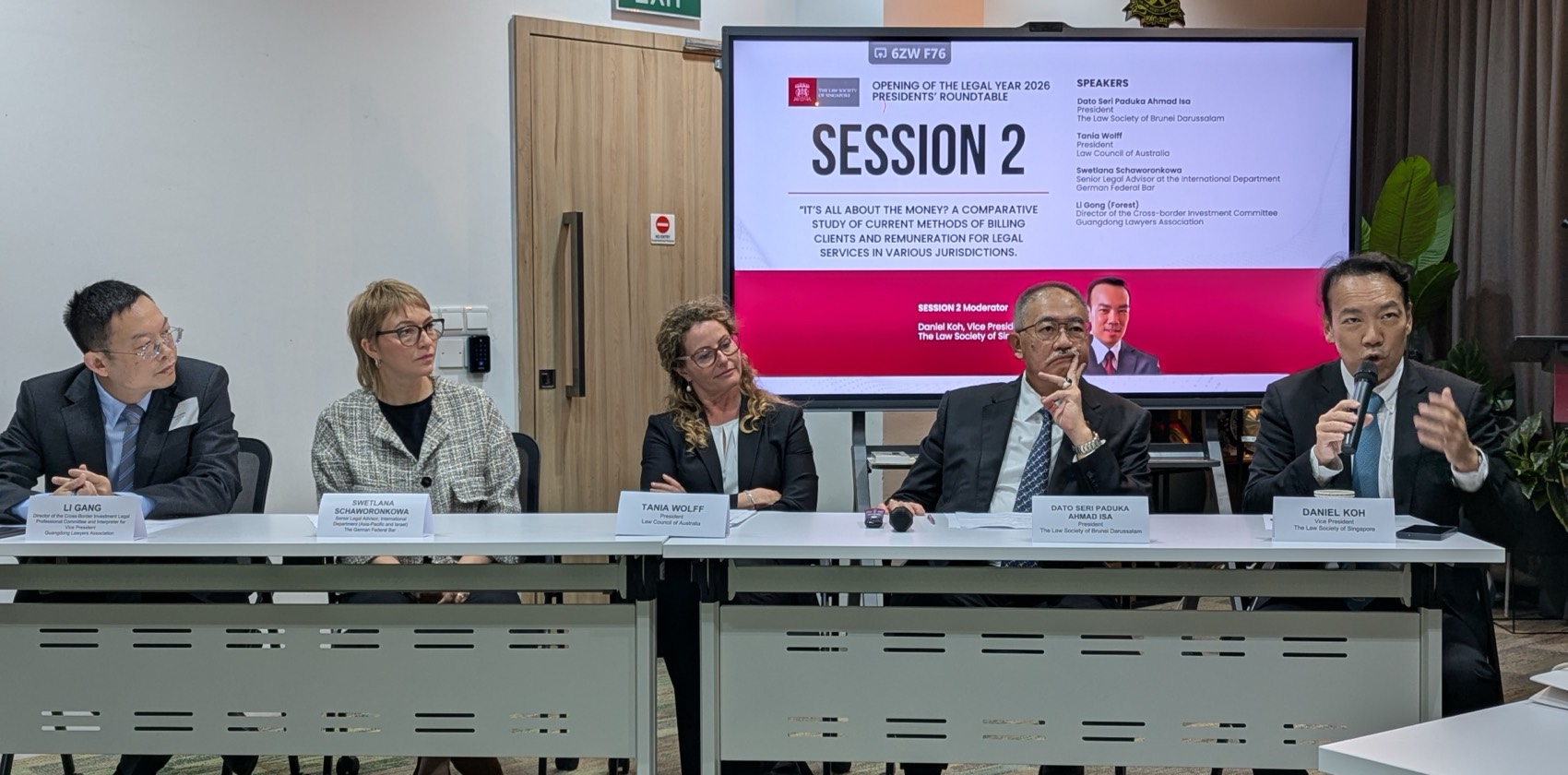
2026 OLY Presidents’ Roundtable
Session 2 – It’s all about the money? A comparative study of current methods of billing clients and remuneration for legal services in various jurisdictions.
Moderator –
- Mr Daniel Koh, Vice-President, The Law Society of Singapore
Speakers –
- Mr Dato Seri Paduka Ahmad Isa, President, The Law Society of Brunei Darussalam
- Ms Tania Wolff, President, Law Council of Australia
- Ms Swetlana Schaworonkowa, Senior Legal Advisor at the International Department
(Asia-Pacific and Israel), The German Federal Bar - Mr Li Gang, Director of the Cross-border Investment Committee, Guangdong Lawyers Association


When I first framed the Issue for discussion ahead of the Roundtable session, I had deliberately posed it as a question. While it at first seemed obvious that the discussion concerned how the legal profession in various jurisdictions was exploring different ways to collect fees or compensation for their legal services (not limited to fiat currency), there was a parallel discussion as to how and to what extent legal services could be provided without payment or done pro bono. Hence, is it all about the money?
The purpose of the discussion was to explore whether there is only one model of legal billing and, if not, how lawyers might approach billing more creatively. I invited the panellists to consider how public interest considerations should be managed and regulated within alternative billing models, and whether the lawyer-client relationship should be viewed solely through a commercial lens.
I also raised the question of whether clients asking lawyers to have “skin in the game,” including by accepting shares or equity in client companies, is appropriate and what ethical or regulatory concerns such arrangements might raise. These questions were deliberately provocative and intended to encourage reflection and discussion on evolving billing practices.
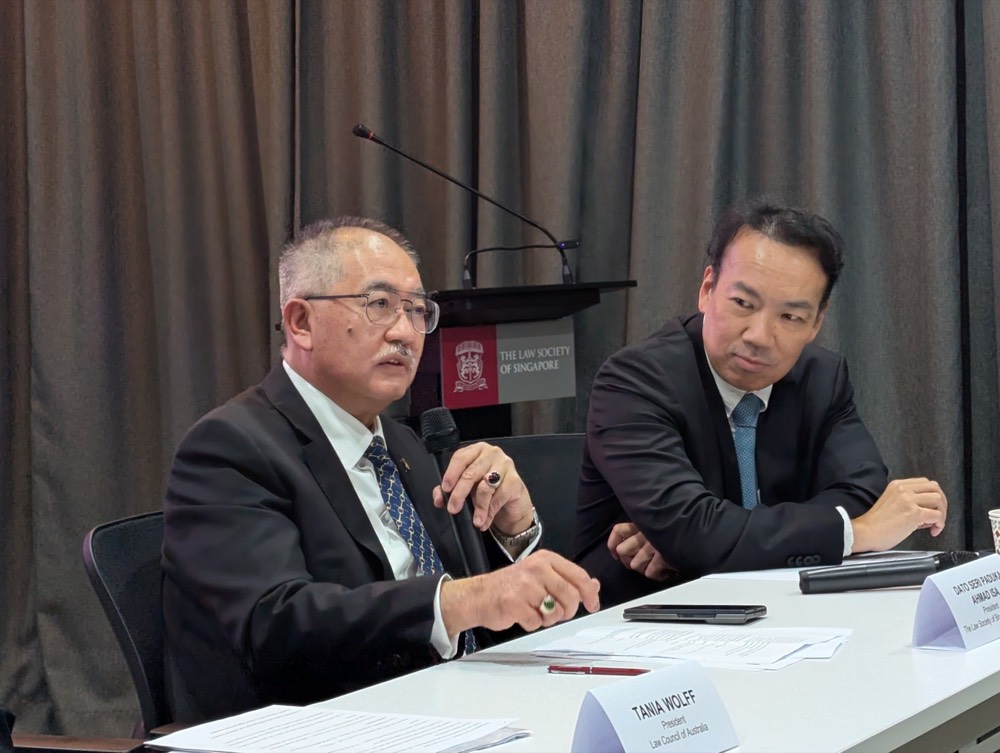
Mr Dato Seri Paduka Ahmad Isa (President, The Law Society of Brunei Darussalam) began by providing context about the legal profession in Brunei, noting that it is a small jurisdiction with fewer than 175 practitioners holding practising certificates. He explained that this limited size shapes both the nature of legal practice and fee arrangements within the jurisdiction.
He then outlined the primary billing methods used by lawyers in Brunei. The first method is fee arrangements agreed between the lawyer and the client, which may take the form of fixed fees, hourly billing, or retainer-based arrangements.
Mr Ahmad next explained that Brunei also has a remuneration scale for non-contentious work, regulated by specific rules. He noted that non-contentious matters such as conveyancing, sales, and purchases are subject to these remuneration rules, providing a structured framework for fees on such matters.
He went on to comment on the use of contingency fees in Brunei. Mr Ahmad explained that contingency fee arrangements are permitted, provided they are agreed upon in advance between the advocate and the client, but the areas in which contingency fees may apply are regulated. He noted that contingency fees are allowed in matters such as personal injury claims, defamation cases, and certain commercial actions. In contrast, contingency fees are expressly excluded in criminal matters, family and matrimonial proceedings, and cases where legal aid is available to the client. He further elaborated that statutory limits provide limits on contingency fees which must not exceed 30% of the sum awarded, or 40% where the agreement covers both trial and appeal. These limits are provided for under statute and regulated through subsidiary legislation.
I then shared the position in Singapore, explaining that under the Legal Profession Act, conditional fee arrangements are permitted in certain areas, such as international arbitration, but contingency fees are not allowed. I highlighted the important distinction between conditional fee arrangements and contingency fees, citing the Law Society of Singapore’s guidance notes. While lawyers and clients in Singapore may agree on an uplift to the hourly rate payable upon a successful outcome, the lawyers are not permitted to take a percentage of the damages awarded.
Ms Tania Wolff (President, Law Council of Australia) noted that while money and sustainability matter, legal practice is not driven solely by financial considerations. She observed that many lawyers working in legal aid, regional practice, and pro bono would not remain in the profession if remuneration was the primary motivator.
Ms Wolff explained that lawyers’ conduct in Australia is closely tied to ethical considerations, including professional independence, access to justice, and public confidence in the legal system. She noted that Australia operates within a mixed legal services economy, combining government-funded legal aid with private practice. She highlighted that more than 70% of legally aided matters are handled by private practitioners, amounting to over 100,000 cases annually. She observed that this work is often financially unsustainable, particularly in regional and rural areas, but it continues due to a strong sense of professional commitment. She noted that this ethos is reinforced through pro bono practice, with approximately 845,000 hours contributed by Australian legal practitioners. This broader context informs mainstream billing practices.
She also observed that many firms are moving away from time-based billing due to client expectations, technological developments, and other pressures. At the same time, courts, particularly at the federal level, apply cost scales that limit recoverable amounts, creating a growing gap between recoverable costs and actual fees incurred.
She then addressed contingency fees, explaining that arrangements involving a percentage of the recovery are generally prohibited in Australia due to concerns about conflicts of interest, compromised independence, and duties owed to the court. She noted that the Law Council of Australia has historically opposed such arrangements, with a limited and controversial exception in Victoria through group costs orders in class actions. She explained that, while intended to improve access to justice and reduce reliance on litigation funders, the regime has sparked ongoing debate and concerns about forum shopping.
Ms Wolff also addressed alternative funding mechanisms, noting that crowdfunding may improve access to justice but raises concerns regarding confidentiality, donor influence, and client control. She added that payments in shares or equity raise conflict-of-interest concerns, while cryptocurrency payments present issues related to volatility, valuation, and trust accounting. She emphasised that innovation should not compromise independence, professional judgment, or duties to the court.
Turning to AI, Ms Wolff stated that AI is already influencing billing practices in Australia. She noted that professional guidelines clarify that licence costs are practice overheads and that efficiency gains from AI belong to the client. She observed the tension between AI-driven efficiency and time-based billing, emphasising that billing remains closely connected to ethics and access to justice.
Ms Wolff explained that various schemes encourage firms to commit to approximately 35 to 40 pro bono hours per lawyer, sometimes linked to eligibility for government panels or contracts. Ms Wolff also observed that pro bono practice benefits firms by improving lawyer motivation and retention, particularly among younger practitioners seeking meaningful work.
Ms Swetlana Schaworonkowa [Senior Legal Advisor at the International Department (Asia-Pacific and Israel), The German Federal Bar] explained that in Germany, lawyers’ remuneration is determined either by statutory fees under the Lawyers’ Remuneration Act or by individual agreement between lawyer and client. Statutory fees apply only to court services in civil and administrative matters, while out-of-court services are not subject to statutory fee requirements. Fee agreements are generally permitted, provided they comply with statutory standards.
She noted that statutory fees are calculated based on the value of the matter in dispute and are designed to ensure cross-subsidisation. High-value cases may require less time but generate higher fees, while lower-value cases may involve greater complexity but yield lower remuneration. This structure enables higher-value matters to subsidise more complex or lower-value cases, ensuring that lawyers continue to take them on. She explained that the statutory system provides for fixed fees and framework fees, with the latter operating within prescribed minimum and maximum ranges. The appropriate fee must be determined on a case-by-case basis, considering the scope and complexity of the work, its significance, and the client’s financial circumstances.
She noted that individual fee agreements were introduced only in the early 2000s and have since become increasingly important, as statutory fees often provide relatively low remuneration and are not commercially viable, particularly for larger firms. Their introduction coincided with the liberalisation of the German legal market and the entry of foreign law firms.
In practice, she observed that lawyers initially adhered to the statutory system but sometimes applied multipliers through agreements, such as charging double the statutory fee or adjusting the value of the subject matter. Hourly rates and flat-fee arrangements are also used. Generally, agreed fees may exceed statutory fees but must not be unreasonable or disproportionate to the work performed, responsibility assumed, or liability risk. In practice, lawyers often use a multiplier of five to six times the statutory fee to remain within acceptable limits.
Addressing alternative forms of payment, she noted that payment in assets, shares, or cryptocurrencies is not prohibited in principle, provided the value can be clearly determined and assessed for reasonableness. However, such arrangements are uncommon in practice due to valuation difficulties, contestability, and strict anti-money laundering requirements.
Speaker – Mr Li Gang (Director of the Cross-border Investment Committee, Guangdong Lawyers Association)
Mr Li Gang (“Mr Li”) explained that legal fees in China were historically subject to strict government regulation. Prior to the 1980s, under China’s planned economy, fees across many sectors, including legal services, were fixed by the government and could not be negotiated between lawyers and clients. As a result, legal fees at the time were relatively low compared to jurisdictions such as Singapore. He noted that this position changed significantly in 2014, when the government deregulated legal fees, allowing lawyers and clients to negotiate remuneration freely. Since then, common billing models such as hourly rates, fixed fees, and contingency fees have all been permitted, subject to certain conditions.
Mr Li observed that, in practice, Chinese clients tend to prefer contingency fee arrangements, as they do not require upfront payment and allow the lawyer to share in the outcome of the case. Such arrangements are also perceived as incentivising lawyers to achieve results more efficiently. By contrast, time-based billing models are less popular among Chinese clients, which has posed challenges in cross-border matters involving foreign lawyers, particularly from jurisdictions where time-cost billing is the norm.
He explained that in international cases, Chinese lawyers often need to explain time-based billing practices to Chinese clients, which can sometimes create tension in coordinating with foreign counsel. Even when Chinese clients accept time-cost billing for foreign lawyers, they typically seek to impose a fee cap, reflecting concerns over uncertainty and internal approval constraints. He noted that clients are wary of situations where legal fees could exceed the value of the dispute, as has occurred in some overseas cases.
In response to a question on cryptocurrency, Mr Li stated that payment of legal fees using cryptocurrency is prohibited in China. Cryptocurrency mining and trading have been banned since 2017, and Chinese lawyers are therefore unable to accept such forms of payment. He suggested that, in cross-border matters, a possible workaround could involve cooperation with foreign law firms in jurisdictions where cryptocurrency is permitted, although this would fall outside China’s domestic legal framework.
Mr Li concluded by observing that many Chinese enterprises are increasingly relocating or expanding their headquarters to ASEAN jurisdictions, including Singapore and Hong Kong, particularly in light of recent geopolitical and trade tensions. As Chinese businesses become more internationalised, he expressed the view that Chinese clients may gradually become more receptive to time-based billing models, which he sees as better reflecting the value of legal services.
Conclusion
Drawing the various strands of the conversations together, it appears that lawyers in various jurisdictions recognise that the fees billed cannot be disproportionate to the quantum of the claim. There is also a desire by clients to have fees capped. The nuanced and balanced solution may be for lawyers to consider quoting their fees in stages with each stage of fees capped.