
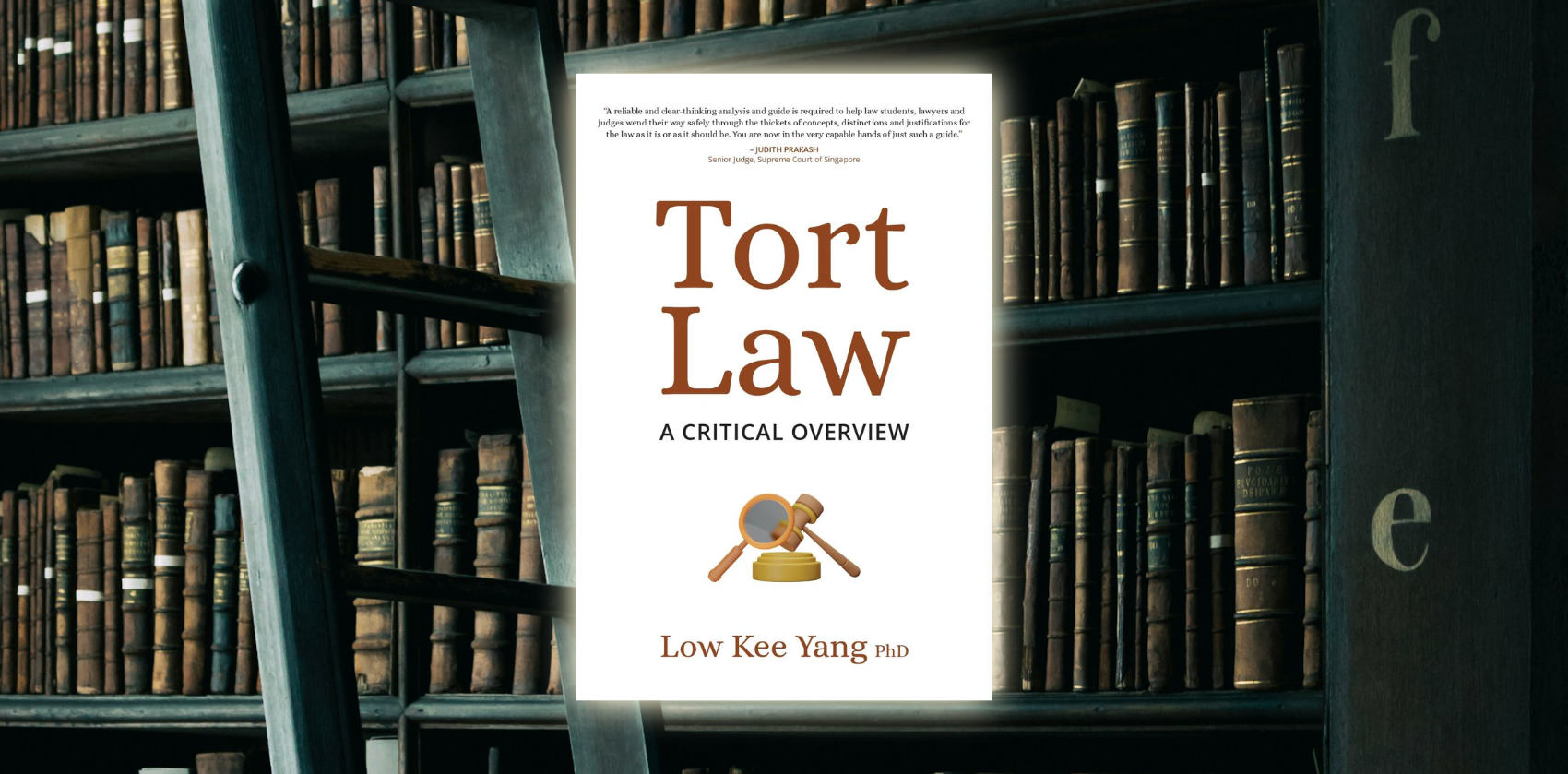
Tort Law: A Critical Overview – By Low Kee Yang
When my old friend from Law School, Dr. Low Kee Yang, asked me to read the manuscript of his new book –Tort Law: A Critical Overview – I was unsure how I could help. My practice had gravitated to commercial work over the years and my involvement with tort cases and knowledge of tort law was patchy to say the least. However, I am happy I took up the challenge. I found it enlightening and refreshing to be given a very quick yet precise overview of Singapore tort law. In the process I learnt that in almost every area, there have been developments, sometimes novel or ground-breaking, which every general practitioner and anyone else interested in law, will appreciate the insights received.
Most practitioners are familiar with the likes of Clerk & Lindsell on Torts, and law students, Salmond on Torts. These are excellent texts to go deep into an area of the law when one has particular issues to grapple with; however, they are too detailed to be read as a whole. However, this book, as its name states, is a critical overview of Singapore tort law, and can indeed be read that way.
The writer seeks to:-

- give a quick precise overview of Singapore tort law and each individual tort;
- point out imperfections due to complexity, unfairness or error; and
- by pointing out such imperfections, help to point out how it might be possible to arrive at correct or desirable positions.
This is the sort of book one needs when requiring help to construct good arguments as to why the current state of the law is not as it should be, and how it could be changed by Parliament, or perhaps in your client’s favour by the Court of Appeal.
Dr Low has been in academia for four decades, the bulk of which time was spent in the Singapore Management University and he spent the last 15 years teaching almost exclusively tort law. Researching and teaching over that period of great change, coupled with his numerous engagements with probing law students, has sharpened his thoughts on almost every area of tort law.
As Senior Judge Judith Prakash in her hearty foreword, referring to rapid developments in society since she read law, and their impact, said:
“ Since those days, the law of tort has only grown more complex and diverse. Indeed, this growth has been engendered by the ways in which human societies have been impacted by technological developments and the waves of globalisation we have been through over the past few decades. Torts like negligence, nuisance and defamation have been used to obtain redress by claimants whose injuries have arisen from situations that could not have been contemplated by the courts, legal practitioners and scholars all those years ago. For instance, the development of methods to help couples have babies or, on the other hand, to prevent unwanted pregnancies, has led to claims when the methods failed or were administered negligently. The courts have then had to grapple with philosophical questions dealing with the right to life or what is the right basis on which to assess the compensation payable when a baby is born due to the failure of sterilisation procedures or with health conditions caused by the negligence. And when it comes to defamation, the ease and speed with which statements now spread over the world and are passed along from one internet user to another through impersonal platforms offers great challenges to persons seeking to vindicate their reputations through legal action.”
The Judge thus welcomed Dr. Low’s book as she felt judges, lawyers and law students alike need guidance on how to think through ever new questions arising in tort law.
The writer has eschewed giving full citations of cases cited. Only the case name and the acronym of the Court are given, coupled with a glossary of Court Information at the start of all the courts of various countries where the decisions are drawn from. This avoids needless detail as today almost all know how to find the case citation online. There is also a glossary of all judges mentioned in the book. Then, at the rear there is an Index of Cases, an Index of Statutes, and an Index of Terms used.
Size wise the book is smaller (23cm x 15cm x 1.5cm) but with the smaller font used the book covers a lot of ground over 227 pages, and still allows for easy reading through the use of good layout.
An interesting tool is the writer’s use of diagrams and flow charts to convey points pictorially. For e.g. in his introduction, and in classifying torts, he has helpfully pointed out something not readily apparent, i.e. torts where intention is relevant, and where it is not :
| Intentional | Negligent | Strict Liability |
|---|---|---|
| Trespass
Deceit Inducing breach of contract Trade libel Passing off |
Negligence | Defamation
Breach of statutory duty Rule in Rylands v. Fletcher Nuisance Liability for animals |
Figure 1.1 Classification of main torts
In another list he shows the categorization of torts by who they affect:
| Affecting persons | Assault, battery, false imprisonment, the rule in Wilkinson v. Downton, harassment, defamation |
| Affecting property | Trespass to goods, conversion, detinue |
| Affecting land | Trespass to land, nuisance, rule in Rylands v.
Fletcher, occupier’s liability |
| Affecting business | Inducing breach of contract, other business torts |
Figure 1.2 Categorisation of torts
With these and many other diagrams and charts in the book, one quickly grasps the big picture of what is being shared.
At the end of his introduction in Chapter 1, the writer says candidly:
THE IMPERFECT PICTURE OF TORT LAW
1.38
For all the reasons explained so far, the expectation of a legal framework of tort law which is clear, concise, systematic, coherent and fair is an unrealistic one. Instead, the picture of the tort law framework is an imperfect one – with parts which are clear and logical and other parts which are complicated or controversial, and with occasional unfairness along the way. All in all, tort law, as earlier mentioned, is largely work-in-progress. Overall, it does a reasonably satisfactory job of delineating and enforcing rights within a society.
APPROACH TOWARDS TORT LAW
1.39
Hence, as you approach tort law, it is best to keep an open mind and not presume that the law is perfect or is always right. Lower your expectations. Also, exercise independent thinking and analysis. Quite often, in order to understand the law, it is necessary to realise that the legal position on a particular issue is wrong or unfair and to figure out what the correct or fair position should be. The good news is you will get better at it over time.
Interesting advice from a book on law which most expect to be black and white!
In Chapter 3, Wilkinson v. Downton and Harassment, the writer makes some interesting observations about developments in the law of harassment which may have escaped us. As most know, the categories of torts are not closed and are left to the common law to develop.
He reminds that Singapore introduced its common law tort of harassment through the case of Malcomson v Mehta. There, Justice Lee Seiu Kin in 2001 in granting an injunction against an ex-employee who had harassed his former employer, defined harassment as:
… a course of conduct by a person, whether by words or action, directly or through third parties, sufficiently repetitive in nature as would cause, and which he ought reasonably to know would cause, worry, emotional distress or annoyance to another person.
Dr. Low points out that Justice Lee’s formulation had three requirements:
- a course of conduct ( ie. a repetitiveness which makes it intolerable);
- that the defendant ought reasonably to have known (ie. a minimum threshold of mental fault, ie. constructive knowledge); and
- which would cause worry, emotional distress or annoyance.
He says this formulation was followed in a Hong Kong High Court decision. However, the usefulness of this formulation was doubted by Lee J.’s fellow High Court Judge, Choo Han Teck J. in Axa Insurance v Chandran two years later.
Then in 2014, Parliament passed the Protection from Harassment Act which abolished the abovementioned common law tort of harassment and replaced it with a statutorily defined and considerably expanded concept of harassment. The writer sets out the sections of the statute to show how the definition of harassment had expanded and raises some incisive questions. I quote two of them:
“Firstly, and most notably, the section does not require that the defendant had engaged in a “course of conduct”. (The UK counterpart statute retains the “course of conduct” element.) This is puzzling as judicial formulations in Singapore and elsewhere make course of conduct a requirement. The idea, and one which makes sense psychologically and socially, is that what is tolerable as an isolated incident may become intolerable when repeated.
Secondly, the section uses the terms “cause” and “causing” harassment, alarm or distress, thus utilising the word “harassment” to describe the injury rather than the conduct, which is linguistically inaccurate. One harasses by causing “alarm” or “distress” or, to borrow from Justice Lee’s categories, “disturbance” or “annoyance”. It would have been less confusing to use the term “harassment” to refer to the conduct …”
This is an example of what the writer referred to as a challenge at the start of the book when he respectfully said:
“The third challenge, may it be softly said, has to do with the finite ability of those who craft the law, whether as judges or legislators. Now and then, legal reasoning falls prey to undue complexity, illogicality or unfairness.
So, for a variety of reasons, complexity and controversy abound in tort law. Quite often, the student is perplexed. I hope to help the student see tort law as it really is, and to figure out how to redress the imperfections.”
Other chapters of the book cover very interesting topics like
- understanding the development of the duty of care in negligence law from 1.Neighbour principle (Donoghue):Foreseeability, to 2. Two-stage test (Anns) Forseeability & Policy, to 3. Three-stage test (Caparo) Forseeability & Proximity & Policy
- what is the difference between Material Contribution to Injury ( Bonnington) and Material Contribution to Risk of Injury (McGhee) and are these robust concepts to prove causation?
- because of wrong diagnosis of a malignant tumour as non-malignant, patient lost the chance of going for an operation. What is the doctor’s extent of liability for the loss of chance of a good outcome if patient had undergone the operation?
- An entire part on Attributive Liability. This is an analysis and comparison of how claims might be made against a person other than the person who actually committed the tortious act, using the differing approaches of 1. Vicarious liability 2.Non-delegable duty, or 3. Agency. It also critiques the Court’s approach in allowing the defence of independent contractor in cases when it appears plainly unjust that the party that is enjoying the commercial benefit in a transaction is allowed to hide behind the appointment of the independent contractor who is uninsured and eventually unable to satisfy the claim.
Overall, Dr. Low has produced a clear and thought provoking book which will sharpen one’s forensic skills, and also be a worthy quick reference book on the current tort law of Singapore.
Tort Law: A Critical Overview is available here.