


Legal Academia: An Academic Question?
For most law students, the option “Law Professor” is not necessarily high on the menu of dream careers. Depending on your vintage and cultural reference points, the high-flying legal eagle is usually associated with the iconic image of Perry Mason (of the eponymous series), the irrepressible Elle Woods (of Legally Blonde fame), or the charismatic and uber-confident Harvey Specter (Suits). It does not help the cause of the legal academic that their one enduring representative on the silver screen, Professor Kingsfield of The Paper Chase, is the tweed-clad arch-villain responsible for terrifying newbie law students through that cruel and inhuman method of interrogation: the Socratic Method.
Moreover, the question “Do you want to be a Law Professor?” usually elicits a couple of standard responses. First, the sceptical side-eye: “Academia is for the geeks … I’m a normal person.” Second, even among those possibly partial to the idea – incredulity: “That’s delusional … I could barely understand what was going on in law school! You mean I now have to teach this stuff?” Third – and quite commonly – a sense of impatience or boredom: “My job is to keep on writing more research papers? Or worse, those books and articles no one actually reads? I want to get out of the ivory tower and into the real world of deals/disputes (pick your poison)!”
I speak partially in jest, of course. If you think about it, there are many legal academics on and beyond our shores that have made a deep impact both in the profession and more generally. Elder statesmen like Professor Tommy Koh, Professor Jayakumar (former Deputy PM), Senior Judge (and Professor) Andrew Phang, are all names that come to mind of academics who have translated their expertise into policy, diplomacy, international law, and judicial decision-making on significant issues of constitutional and private law.

But I agree that the job of the law professor remains quite mysterious, perhaps mystified by some of these misconceptions mentioned above. Permit me to disabuse you of these myths by way of sharing my own experience, constituting a journey (now beyond a decade) from being a junior legal academic to presently an Associate Professor at NUS Faculty of Law.
What is your experience of academia?
I first joined NUS Law as a Sheridan Fellow in 2014, after a couple of years in litigation practice. As a student at NUS Law, my grades were not spectacular, but I had shown some indications of progress over the years, as well as passion for intellectual questions, such that I finished my final year with the Montrose Memorial Prize in Jurisprudence and the Prize for Best Directed Research Paper.
I was a member of the inaugural batch of Sheridan Fellows, and the Fellowship had just been launched as an exciting new programme for local (Singaporean or PR) law graduates interested in academia. Named after NUS Law founding Dean Lionel Astor Sheridan, the programme was intended as a bridge for those just finishing their undergraduate or masters’ degrees, or those who had spent a few years in practice (like myself), to explore the academic path, with the ultimate aim of achieving a tenure-track academic position at NUS Law.
I was very grateful for the opportunity to be a Sheridan Fellow. For two years, I had the opportunity to teach half the standard faculty load, with considerable time freed up for research and writing, under the guidance of various mentors. As a Fellow, I taught contract law to first-year students. As a young-ish tutor, I did not have the knowledge or experience of my learned colleagues. But I had great encouragement from my mentors and also from my students, who I find are very appreciative when they know that the tutor is responsive and genuinely trying to help, even if she or he does not have all the answers at their fingertips.
I was subsequently sponsored by NUS Law to pursue my postgraduate studies (LLM and SJD) at Harvard Law School. I had a terrific time at Harvard, given my interest in both theory and doctrine. The American legal academy is more overtly ideological, in the sense of self-consciously identifying with various methodological approaches or schools of thought. Harvard has some of the best professors who are able to connect their interdisciplinary work with the practice of academic law. I was fortunate to have Professor John Goldberg, Professor Henry Smith, and Professor Charles Fried (the undisputed leading lights in torts, property, and contracts, respectively) guide me through my doctoral dissertation, which focused on the big idea of “interpersonal justice” as it plays out in different spheres of the law of obligations.
From 2018 to 2024, I was an Assistant Professor at the law school, partly teaching, researching, and completing my dissertation, and promoted to Associate Professor thereafter.
Does a legal academic need to be a geek?
What I tell students and prospective academics is that you must have a deep interest in the intellectual life of the law. To have such an interest is neither weird, nor by any means boring – it is a natural continuation of one’s interest in the many deep and difficult questions encountered in the law school syllabus. How we read the constitution (literally or purposively), whether we should retain capital punishment (balancing interests in freedom and security), how we draw the limits of freedom of contract (trading off individualism against altruism), are all simultaneously doctrinal and jurisprudential questions. There are, of course, more and less abstract questions: “pure” philosophers are happy to contemplate “What is Law?” whereas others may be more concerned with the fine-grain of legal reality, or the coherence of a particular field (e.g. equity and trusts, or restitution).
Yet it is true that the legal academic has to geek out on her preferred subject – in the sense that she has to acquire new knowledge about an area that can be seen as quite specialist or niche. That knowledge can be collated or presented as a textbook, casebook, monograph, or series of articles and notes. The intended audience can be other legal scholars, judges and lawyers, policy-makers or the wider public. But even in its most niche form, it is never legal esoterica for its own sake. My own work in contract and private law speaks to different constituencies: some issues are more doctrinal, such as good faith, illegality, and interpretation, whereas others like ideas of relational contracting and distributive justice straddle moral and political philosophy.
That doesn’t mean I wish to speak on these issues all the time! I am very happy to talk about other interests and hobbies, including what’s on Netflix or Apple TV, good reads on the latest books circuit, and newfangled racket sports (pickleball and padel, in particular).
What does a law professor actually do, and how does it compare with legal practice?
It certainly is quite different. I remember that my first day in the ivory tower: a morning went by without a single call. I thought there must have been something wrong with my phone. This was a stark contrast to practice when scarcely an hour goes by without a couple of calls from one’s bosses or clients.
In a sense the law professor has unparalleled autonomy, compared with lawyers in practice. There is no “micro-managing” of a professor’s day-to-day schedule by the university administration. But as you know, with great power comes great responsibility. The law professor is responsible and accountable across three professional dimensions: teaching, research, and administration. These targets are not necessarily calculated in billable hours. But there are nonetheless specifiable and measurable goals that one must set within the horizon of a year or few years, such as producing a commentary on the latest appellate court decision, an article on a misguided line of cases, or a monograph that makes a breakthrough on a messy or unresolved area of law. In refining one’s research, the law professor often has good opportunities to test her ideas by attending conferences, workshops, and other discussion fora. For any academic this is one of the most exciting parts of the job: I have had the chance to present work in Rome, London, Durham, Boston, San Franciso, Hong Kong, Rotterdam and Amsterdam, among other places.
In respect of teaching, I currently convene the Law of Contracts course and also Introduction to Legal Theory (a first-year course in jurisprudence). I also come from a family of educators, which I believe makes me somewhat more conscious of how I am communicating and whether I am adding value to the recipients’ process of learning. For example, instead of the Socratic Method, I try to present some basic scaffolding on which a student can construct her understanding of the subject matter, with room for the individual to fill in the gaps. I continue to enjoy teaching, which is in a very tangible sense one of the most meaningful and rewarding aspects of being a professor.
I also help out on Dean Andrew Simester’s Leadership Team, with the portfolio of Director of the Sheridan Fellowship. The fellowship has been one of the jewels in the crown of NUS Law’s hiring policy, offering a unique opportunity to the best and brightest in Singapore to kickstart their academic career. I am very happy to remain connected with our younger colleagues, who are doing super interesting work in environmental law, artificial intelligence and technology, medical law, disability and discrimination law, and the like. We are always on the lookout for talented individuals who might want to explore academia!
What are the favourite and least favourite parts of the job?
It is true that as with any job, one will enjoy certain bits and others less so. Luckily, I enjoy teaching and writing. At times, various other administrative and committee responsibilities take time away from the core activities, but they are necessary as part of our governance structure to keep the faculty going. I am also fortunate to be involved in various other initiatives, including as Secretary-General of Asian Law Schools Association, certain advisory panels and committees of the Singapore Academy of Law, invited consultation work from time to time from top law firms, and some pro bono activities with community leaders, all of which tend to add up to a pretty full schedule during the academic year. In fact, I would say I enjoy most of what I am doing; it is only because there isn’t enough time to “enjoy” them all fully that often stresses me out!
What is the career progression of a legal academic, and what does a flourishing academic career look like to you?
It is a common trope in academia: first you assist with the professing, then you associate with the professors, and then finally, one is permitted to profess. But I think a flourishing academic life goes beyond the professorial ranks. One way to visualise this is to imagine one’s contribution – say, teaching, research, and service – in a series of ever-widening concentric circles. One’s research should develop over time in a coherent body of work that presents, describes, critiques or reinvigorates a field of law; one’s teaching should have an impact on successive generations of law students, one’s service should have increasing positive impact on the legal community.
A related aspect of this is giving back by paying it forward. I have had many senior colleagues to thank for their time and wisdom, not least the three last Deans of NUS Law: Professor Tan Cheng Han, Professor Simon Chesterman, and Professor Andrew Simester. They gave me the opportunities, resources, and sometimes benefit of doubt at important points in my career. Other mentors include Arif Jamal, David Tan and Ernest Lim, who in different ways have supported me beyond what is expected of professional duty. I think it important for academics to have this sort of support, as the nature of the work can be quite individual-centred, unlike the work on a brief or a deal done by a team of lawyers in professional practice.
Lastly, as another mentor of mine, Justice Phang, has often mentioned, the theme of an integrated life comes to the fore. The academic’s job is not simply a means to a personal ends (in which case, practice is probably a more lucrative and preferable option!) The various activities of a law professor are often not cashed out in profits and losses, or in revenue for the university. But they have intrinsic value in being pursued faithfully. Indeed, for persons of faith like myself, the saying “to act justly, love mercy, and walk humbly” remains an important injunction underpinning not only what ones does, but also why and how we carry on a life in the law.
I hope this gives one snapshot of the academic life – not one of boredom, esoterica or activities pursued by Einsteins in their ivory towers – but a rich, intellectually-stimulating, connected, and deeply meaningful pursuit.
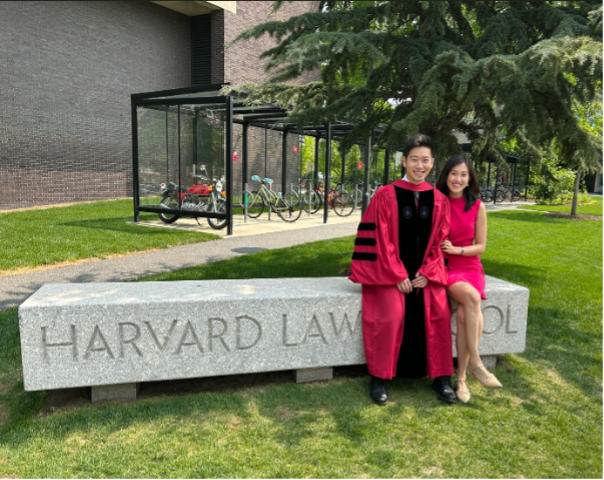
Zhong Xing (with wife, Evelyn) at his SJD graduation ceremony, Harvard Law School, May 2023