

Opening of the Legal Year 2026 – Speech by the President of the Law Society
2.28k
Professor Tan Cheng Han, SC
INTRODUCTION
- May it please your Honour, the Chief Justice, the Attorney-General, Justices of Appeal, Judges and Judicial Commissioners.
- I first extend a warm welcome to our overseas Bar leaders and representatives:
- President Tania Wolff from Law Council of Australia;
- President Dato Seri Paduka Ahmad Isa from The Law Society of Brunei Darussalam;
- Vice President Wu Xingyin from Guangdong Lawyers Association;
- President Roden M. L. Tong from The Law Society of Hong Kong;
- Chairman José Antiono Maurellet SC from Hong Kong Bar Association;
- Senior Executive Committee Member, Nitin Thakker from Bar Association of India;
- Member of International Committee, Tatsuya Morita from Daini Tokyo Bar Association;
- Vice President Ryan Soo from Sabah Law Society;
- Senior Legal Advisor, Swetlana Schaworonkowa from The German Federal Bar; and
- President Yap Teong Liang from LAWASIA.
APPOINTMENTS AND DEPARTURES
- 2025 was an eventful year for the Judiciary, the Attorney-General’s Chambers and the Ministry of Law.
- Last year witnessed significant movements within the Judiciary and the Attorney-General’s Chambers, reflecting the continued renewal and strengthening of our legal institutions:
- Justice Ang Cheng Hock and Justice Hri Kumar Nair were appointed as Justices of the Court of Appeal, while Justice Steven Chong Horng Siong was reappointed as Justice of the Court of Appeal;
- The High Court welcomed three new Judges, Justice Alex Wong Li Kok, Justice Christopher Tan Pheng Wee, and Justice Kristy Tan, and two new Judicial Commissioners, Mr Sushil Sukumaran Nair and Ms Low Siew Ling;
- Justice Christopher Tan has succeeded Justice Vincent Hoong as Presiding Judge of the State Courts, and we wish Justice Hoong all the best in his future endeavours;
- The Singapore Judiciary also welcomed two new International Judges, Justice David John Goddard and Justice Sir Nigel Teare.
On behalf of the Law Society, I extend our warmest congratulations to your Honours.
- Likewise, I extend my warm congratulations to Mr Lucien Wong on his re- appointment as Attorney-General, alongside Mr Lionel Yee, who continues as Deputy Attorney-General together with Mr Goh Yihan.
- I wish all of you, as well as Mr Edwin Tong, who was appointed Minister for Law on 23 May 2025, and Mr Murali Pillai, appointed as Senior Minister of State also on 23 May 2025, the very best in your well-deserved appointments and re- appointments, and every success in your important roles of service.
- On a more sombre note, last year also saw the passing of former High Court Judge Warren Khoo Leang Huat at the age of 91. On behalf of the Law Society, I pay tribute to a gentleman who has been described as a Judge who navigated law, logic, and emotion with calm authority, wisdom, courage, and compassion.1‘被誉”侠骨柔情” 前高庭法官邱良发 91 岁过世’ (Zaobao, 3 October 2025) (accessed 10 December 2025) His contributions to the Bench and Bar will long be remembered.
REFLECTIONS ON 2025
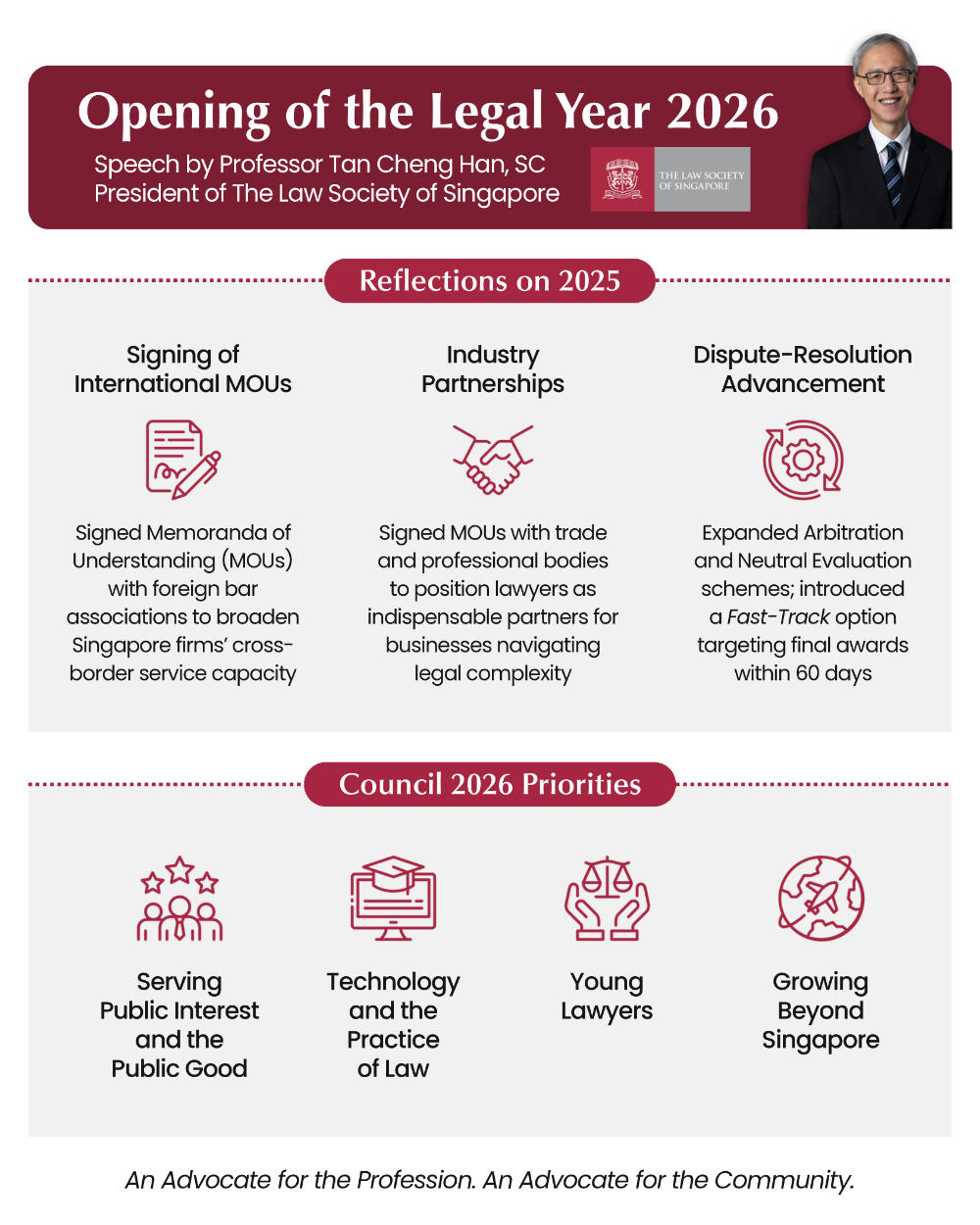
- I would like to pay tribute to Immediate Past President, Ms Lisa Sam, and Council 2025 for guiding the work of the Society in the past year. Much has been achieved of which I will mention three. First, Council 2025 has done much to connect the Singapore legal profession to other bar associations so as to promote Singapore law and encourage partnerships within Asia. This is an important building block to expanding the scope of legal services that Singapore law firms can provide.
- Second, the Society has signed MOUs with other professional bodies and trade associations such as the Association of Small and Medium Enterprises, Institute of Singapore Chartered Accountants, the Tax Academy, and the Singapore Manufacturing Federation. This will facilitate lawyers’ understanding of their clients’ businesses and industries to uncover the most pressing and strategic industry issues, the aim being to position lawyers as indispensable partners in helping businesses navigate legal complexities and achieve sustainable growth.
- Third, Council 2025 also advanced the role of the profession in facilitating dispute resolution through the Society’s Arbitration Scheme and Neutral Evaluation Scheme, the latter of which provides cost-effective ways to resolve lower quantum disputes. As regards the former, the Alternative Dispute Resolution Committee co- chaired by Mr Samuel Chacko and Mr Paul Tan have strengthened access to swift, cost-effective justice through amended Rules that enhance the arbitral process, including offering a new Fast-Track option that targets final awards in as little as 60 days. The new Rules deliver greater efficiency, clearer procedures and better case-management choices for practitioners and clients alike – supporting proportionate, business-friendly resolution of disputes and reinforcing confidence in Singapore’s arbitration ecosystem. With these amended Rules, we anticipate greater opportunities for our members to serve as arbitrators and counsel in arbitrations initiated under the Scheme that will be of great utility to Small and Medium enterprises.
- Council 2026 will build on the work of Council 2025 and previous Councils to advance the interests of the legal profession for the public good.
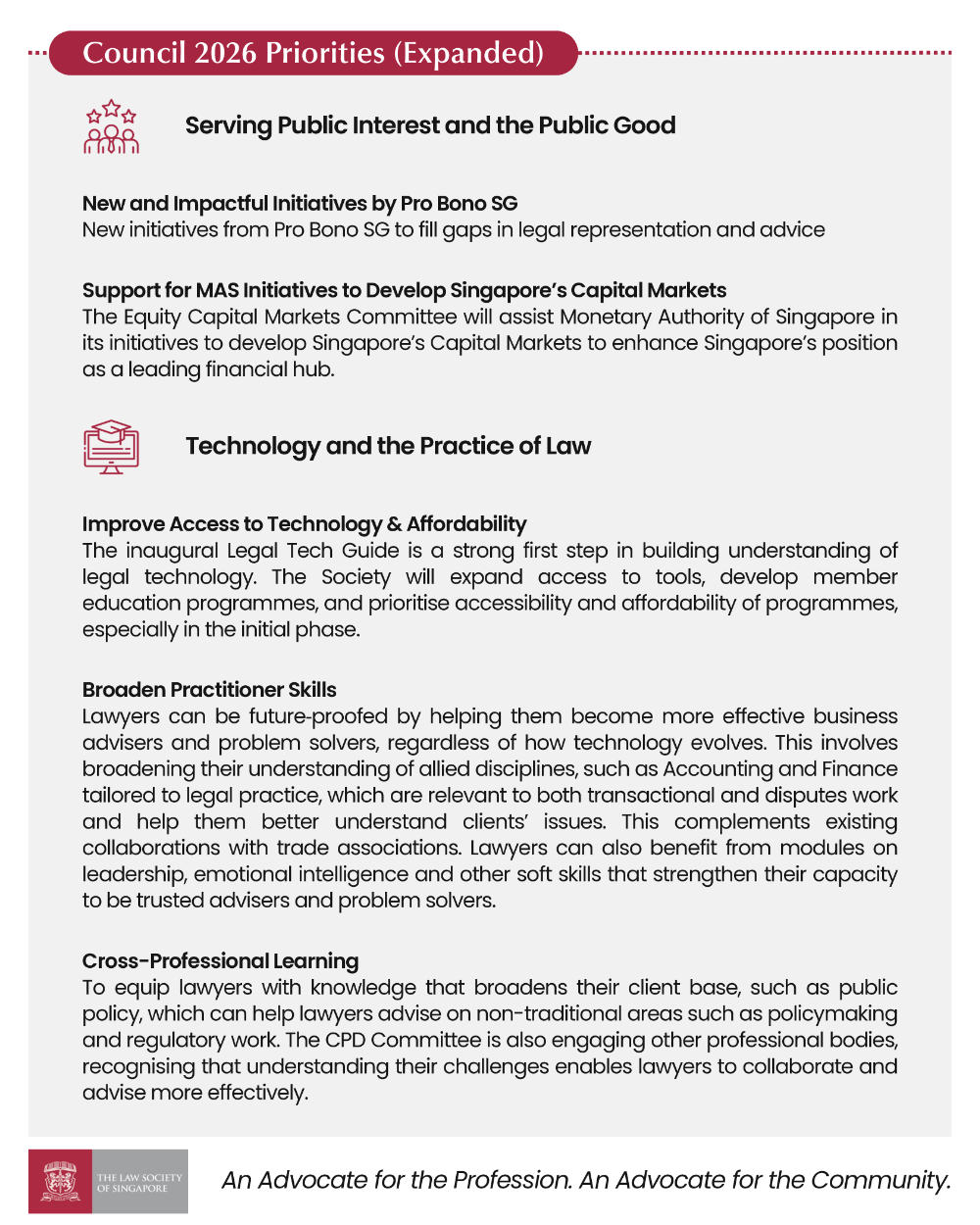
- In addition, I must pay tribute to the continued good work done in 2025 by Pro Bono SG, the Law Society’s charity arm under the strong leadership of the Society’s Vice-President, Mr Dinesh Dhillon. It is a testament to the work of Pro Bono SG that in the inaugural Social Service Professional Awards in July 2025, two of the thirteen individual awards were received by its lawyers, Ms Sadhana Rai and Ms Cai Chengying. These awards both affirm the work of Pro Bono SG and that lawyers provide an essential social service. Looking forward, I have been briefed on new initiatives by Pro Bono SG that are exciting and impactful, reflecting a legal profession that has a strong sense of social responsibility, a profession mindful of her duty to serve the public good. We in Council are proud of the work that our colleagues in Pro Bono SG do and they will continue to receive our heartfelt support.
COUNCIL 2026
- Let me now turn to Council 2026 and what I see as the priorities for the legal profession in the next 12 months and beyond. While there is much to be done, wisdom dictates that we identify the most pressing and focus on meaningful measures even as other work continues.
Technology and its Impact on Lawyering
- This is a topic of great significance as well as concern that has been addressed by many, and in Singapore we are fortunate to have the benefit of Chief Justice Menon’s views.2For example, see Chief Justice Sundaresh Menon, “The Future of the Legal Profession: A Shared Vision”, online: https://journalsonline.academypublishing.org.sg/e-First/Singapore-Academy-of-Law-Journal/ctl/efirstCurrentArticleList/mid/568/ArticleId/2566 (accessed 28 December 2025). I will not repeat much of what has been said, the essence of which is that technology will have a significant impact on how legal work will be done in future and this in turn has wider implications for the legal profession in Singapore and elsewhere.
- What is of the greatest concern to me (and others) is that technology is likely to shrink the need for the type of work that many lawyers, particularly junior lawyers, do today. Another concern is the ability of the profession as a whole to access, utilize and apply technology effectively, including the ability to understand their ethical obligations when doing so.
- I turn to this second concern first. If many lawyers do not understand or are unable to have reasonable access to technological tools, this affects their clients’ access to justice. The inaugural annual Legal Tech-Guide issued by the Information Technology (IT) Committee is a good start towards fostering greater understanding. To build on this, I have spoken to the Chair of the Society’s Generative AI Committee, Mr Jeremy Lua, and the Co-Chairs of our IT Committee, Ms Rachel Wong and Mr Dharma Sadasivan, to ask them to propose solutions on how access to relevant technological tools can be enhanced. In addition, I have requested that the committees develop some programmes to better educate members on how these tools can be used. Mindful of the financial demands that continuing education can impose, the Society is exploring ways to make some of these programmes more accessible and affordable, particularly in the initial phase.
- As for the disruption that technology will have on legal practice, it seems probable that some of the work that lawyers are needed for today will not require legally trained persons or at least the same number of legally trained persons. While lawyers provide an essential service, the question is whether the profession is destined to shrink substantially with serious ramifications on, for example, the careers of lawyers, the pipeline for more senior roles within the profession, and Singapore’s law schools.
- While one cannot entirely predict the future, and there are dangers to being too early an adopter of solutions, I am personally confident that the learned, pragmatic and adaptable fraternity that we are will be more than able to overcome the challenges of the future, as we have the challenges of the past. I believe that one sensible thing we can do today is help lawyers become more effective business advisers and problem solvers, which will future-proof us regardless of the impact or otherwise of technology. This can be done by broadening lawyers’ understanding of allied disciplines. I have therefore spoken to the Co-Chairs of the Continuing Professional Development Committee, Mr Malcolm Tan and Ms Rachel Wong, to develop modules on Accounting and Finance tailored to the needs of legal professionals. These areas of knowledge are important to both transactional and disputes lawyers. They will equip lawyers to better understand the issues many of their clients face so as to advise them more effectively and will complement the MOUs already entered into with trade associations. In addition, lawyers can also benefit from modules that focus on leadership, emotional intelligence and other ‘soft’ practitioner capabilities that strengthen their capacity to be trusted advisers and problem solvers.
- Beyond these initial areas, the next phase may be to equip lawyers with knowledge in other areas that can potentially broaden the client base for legal work. An example is public policy, which will facilitate lawyers in Singapore providing legal advice in non-traditional areas such as policy making and regulatory work. Malcolm and Rachel have also informed me that their committee is engaging other professional bodies given how the law affects and shapes all professions. With greater knowledge of the issues faced by other professionals, lawyers can be more effective in working with them and assisting them.
Younger Lawyers
- The issues relating to our younger brethren are often raised. These include burnout leading to attrition, the need for better support, mentoring and upskilling, and workplace culture. Although most lawyers who leave law firms remain in the legal profession as in-house counsel and continue to make valuable contributions to the law, we must remain vigilant of how significant attrition can affect the pipeline of talent through the legal profession and hence her future.
- Often, when the issue of attrition is raised, some senior lawyers will tell me that the younger generation does not have the same degree of tenacity and industriousness as earlier generations. This has always struck me as too simple an explanation even if it is true for some. What is true is that there may be more opportunities today than during my time, and this means that the legal profession needs to be competing harder to retain talent.
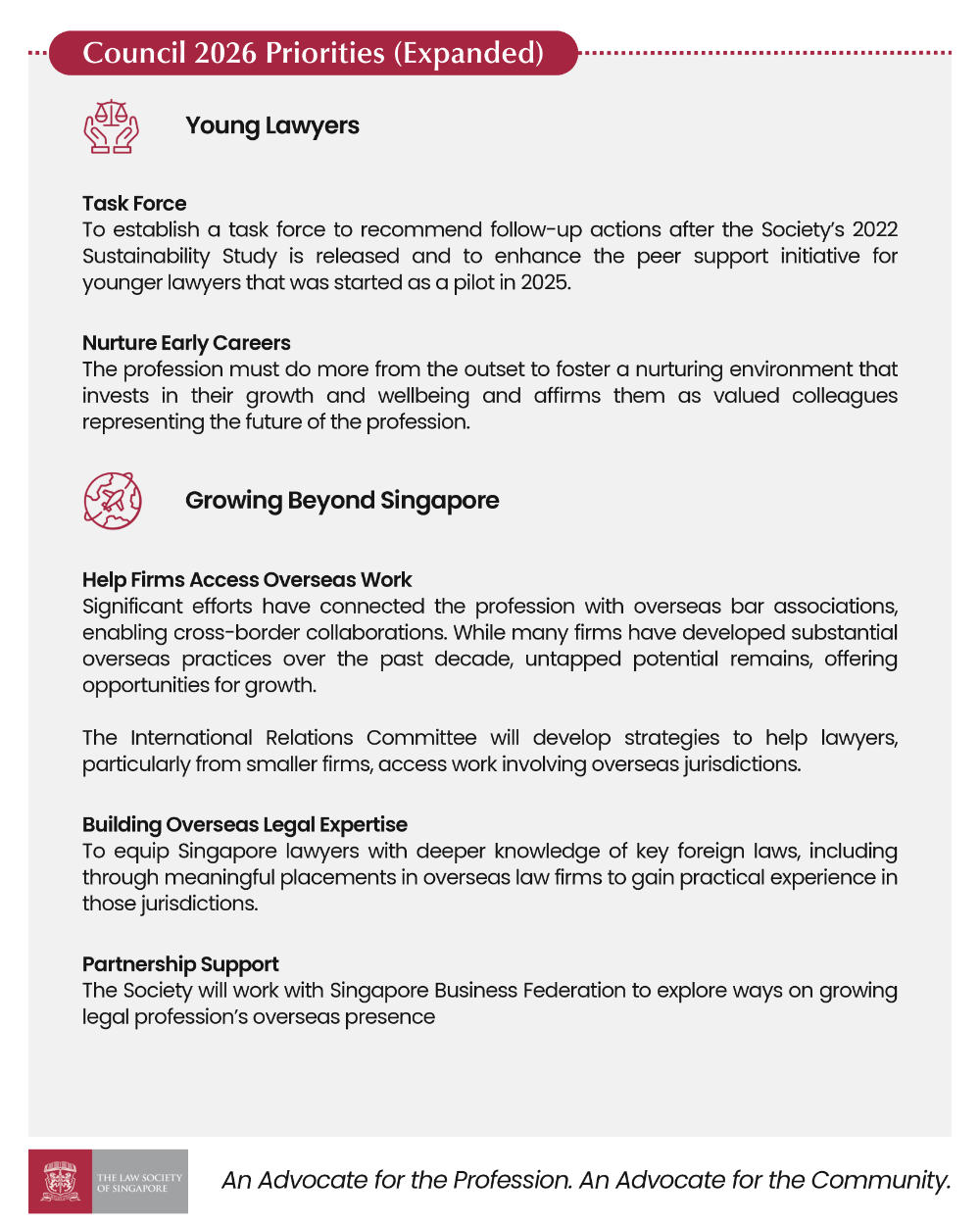
- The reality is that all of us, lawyers or not, stay in our industries because of a variety of factors. One important factor is remuneration, which the legal profession continues to do relatively well in. But we know this is insufficient and must be coupled with a sense of satisfaction and fulfillment that comes from work that is meaningful to us and for which we feel valued. It is in this area that I think we can do better. The fact is that many lawyers who leave legal practice cite workplace culture and their wellbeing as significant matters. While there are now increased opportunities for younger lawyers to seek help through counselling and peer support, and this is an excellent development, more can be done from the outset by the profession to provide a nurturing and supportive environment, one that tells our younger lawyers we are invested in their growth and wellbeing, and that they are valued colleagues who represent the future of our profession.
- To this end, I have asked Mr Darryl Chew and Ms Charmaine Yap, the Co- Chairs of the Young Lawyers Committee, to help Council establish a Task Force to look into further steps that can be taken to create a more fulfilling environment for younger lawyers. I have asked them to consider a number of issues including what possible interventions may be needed when the Sustainability Study commenced by the Society in 2022 is released and how to enhance the peer support initiative for younger lawyers that was started as a pilot in 2025. This exercise will involve lawyers in the senior and middle categories whose views and support will be invaluable.
Growing Beyond Singapore
- Much work has been done in connecting the profession to overseas bar associations. This will facilitate cross-border collaborations to the benefit of lawyers in Singapore. Indeed, over the last 10 years, many lawyers and firms have developed significant overseas practices. Yet, the untapped potential remains large and provides an avenue for Singapore firms and lawyers to expand and thrive, together with our overseas friends and partners. In the next phase of the Society’s international strategy, I have asked the International Relations Committee chaired by Immediate Past President, Ms Lisa Sam, to develop strategies that will more easily assist lawyers, particularly those from smaller firms, to access work involving overseas jurisdictions.
- Such strategies may for instance involve Singapore lawyers having more understanding of key areas of law in an overseas jurisdiction. It may require placements of a reasonable period in law firms in overseas jurisdictions so as to develop a good, working understanding of such jurisdictions, not to mention the personal connections that are important to developing long-term collaborations that mutually benefit our overseas friends and us. These are matters that the Society can facilitate. In addition, I have spoken to Mr Kok Ping Soon, the CEO of the Singapore Business Federation (SBF), and he has agreed to have SBF assist the Society to grow the profession’s overseas presence. I am grateful to him and the SBF Council and look forward to working with them.
Concluding Remarks
- This year we celebrate 200 years of the Second Charter of Justice which saw the establishment of Singapore’s legal system. It is a legal system that is widely respected internationally as evidenced by many factors such as Singapore’s attractiveness as an arbitration centre and the recent linkage between the Singapore International Commercial Court and the Kingdom of Bahrain. The fundamental reason for this is Singapore’s strong commitment to the rule of law. In our system underpinned by the strong rule of law, lawyers play a key role and it is widely acknowledged that this has enabled Singapore to develop strongly, both economically and socially. For, without the rule of law, we have the rule of the lawless jungle. Without the rule of law to which lawyers are her humble servants, fractures and contestation in societies cannot be healed and will fester. A responsible and ethical legal profession is crucial to a harmonious, balanced society. It is for this reason that section 38(1)(f) of the Legal Profession Act 1966 states that one of the purposes of the Society is “to protect and assist the public in Singapore in all matters touching on, or ancillary or incidental to the law.” In this bicentennial year, the Society repledges its commitment to the rule of law, to meeting any challenges to it, and to serving the public interest and the public good.
- In this regard and as an example, with the consent of Ms Gail Ong, who chairs the Society’s Equity Capital Markets Committee, I have offered the assistance of the Committee to the Monetary Authority of Singapore (MAS) as the MAS implements its plans to further develop Singapore’s capital markets. The profession stands ready, as she has always been, to lend her unique expertise for the good of the people of Singapore, another example being the pro bono work that the profession has been engaged in for decades.
- In this significant milestone year, it is also my hope that we, as a profession, reaffirm our bond of fraternity to each other and the profession as a whole. As a community, there is much we can do together. Council 2026, ably assisted by the Secretariat led by Executive Director, Mr Alvin Chen, is committed to serving the profession to the best of our ability and in turn I ask you to continue to work with the Council of the day. Many of you already give much of your valuable time and energy to the work of the Society and I want to acknowledge and thank you for this. I look forward in the year ahead to working with even more of you, all the better to live up to the Society’s official motto: “An Advocate for the Profession. An Advocate for the Community.”
- In this spirit of fraternity within the legal profession, may I also assure Your Honour, the Chief Justice, of the Bar’s full support and that we will work constructively with the Attorney-General’s Chambers in the administration of justice and the Ministry of Law to further develop the legal sector and Singapore law.
- In closing, on behalf of the members of our Bar, I extend our best wishes for good health, wisdom, and fortitude in the years ahead to Your Honour, the Chief Justice, the Minister for Law, the Attorney-General, and all members of the Judiciary. May it please the Court.
Endnotes
| ↑1 | ‘被誉”侠骨柔情” 前高庭法官邱良发 91 岁过世’ (Zaobao, 3 October 2025) (accessed 10 December 2025) |
|---|---|
| ↑2 | For example, see Chief Justice Sundaresh Menon, “The Future of the Legal Profession: A Shared Vision”, online: https://journalsonline.academypublishing.org.sg/e-First/Singapore-Academy-of-Law-Journal/ctl/efirstCurrentArticleList/mid/568/ArticleId/2566 (accessed 28 December 2025). |