


Redefining Winning
What Every Lawyer Needs to Know About Therapeutic Justice
- Family life is a highly private affair. Many families live their lives without the need for court intervention until serious troubles occur that lead parties to decide to terminate their marriage. However, unlike many other disputes, the relationships do not end simply with the issuance of the final judgment. In many cases, the parties must remain connected, not uncommonly as co-parents to young children, for years after the legal action comes to an end.
- This brings into sharp focus our family justice system – including the crucial question of how lawyers can best represent their clients during the court process, to minimise the prospect of future disputes as the parties reorganise their lives. There is growing recognition that the traditional adversarial process is not always helpful in preserving relationships. To “win” the case, the litigation tactics may sometimes devolve into unnecessary delays, multiple interlocutory applications, and incendiary affidavits and correspondence. In family cases, the adversarial process can intensify mistrust and escalate tension, entrenching positions and clouding the way towards viable solutions for the families in distress.
- As family law practitioner Ms Christine Low observes: “Under the traditional adversarial approach, parties can become increasingly entrenched in conflict and positional thinking – who should ‘win’ a particular issue. Quite often, it is the emotional issues that are driving the conflicts between the parties, and parties enter the room emotionally fixated on hurt and betrayal. I remember one matter where the parties were already close to settlement, but my client, who had been deeply hurt by the adultery, remained emotionally anchored to wanting an apology and some form of closure from his spouse. During a caucus, my client and I spoke about how forgiveness and healing are not necessarily dependent on the other party admitting fault in the way we hope for. Interestingly, the mediator-judge also thoughtfully encouraged my client to think about healing and moving forward, rather than remaining trapped in the need for vindication.”
- The parties eventually settled the matter. Ms Low, who is a director at Peter Low Chambers LLC, said: “That experience reinforced for me what is often seen in family practice – clients are seeking personal validation and acknowledgment, not just legal resolution.”
Approaching Family Disputes Differently
- In recognition of this, the courts have implemented various initiatives and programmes through the years to reform the family justice system.1For a detailed write up on the evolution of our family justice system over the years, refer to Kevin Ng, Yarni Loi, Sophia Ang and Sylvia Tan, “Family Justice Courts – Innovations, Initiatives and Programmes: An Evolution over Time”, (2018) 30 SAcLJ 617 (“SAL Article”) Since the mid-1990s, mediation and counselling programmes have been incrementally introduced into the family justice process. Building on these efforts, further waves of reform were introduced to transform the family justice system in recent years.2The family justice system has undergone two major waves of reform driven by two committees. The first, the Committee for Family Justice, was established in 2013 and delivered its recommendations in 2014. Its key recommendations included the establishment of a dedicated body of courts to hear all family-related cases, the implementation of differentiated tracks depending on the nature of the case, and a shift towards a judge-led model. These recommendations were accepted by the Government and resulted in the enactment of the Family Justice Act 2014 and the establishment of the FJC in 2014, with expanded jurisdiction over the entire spectrum of family disputes. The second, the Committee to Review and Enhance Reforms in the Family Justice System (RERF Committee), was established in November 2017 to build on the work of the Committee for Family Justice. Its recommendations were accepted by the Government in 2020 and have since been progressively implemented, including through the introduction of the Family Justice Rules 2024, which strengthened the judge-led approach by equipping family judges with a wider range of tools to ensure that cases are resolved effectively, proportionately and expeditiously, while reducing acrimony, costs and time.
- In his opening remarks at the 10th Anniversary of the Family Justice Courts (“the FJC”), The Honourable the Chief Justice Sundaresh Menon recalled that when he took office as Chief Justice in 2012, one key item on his agenda was the reform of the family justice system.
- Chief Justice Menon said: “I recall one of the first family cases I heard in the Court of Appeal. A stack of bundles arrived in my room, consisting of affidavits that were oozing with venom and vitriol. I recall thinking that there had to be a better way to conduct family proceedings. The dissolution of marriage is inevitably an emotionally distressing time for all the parties concerned, and this is especially so when there are children involved. To force the parties to “lawyer up” in the aftermath of a marriage that has broken down seemed to me to be both counter-intuitive and counter-productive. It dawned on me then that we had to adopt a new paradigm and a fundamentally different approach to how we resolve family disputes in Singapore, one that is tailored to the objectives, needs and nuances of family proceedings.”3Chief Justice Sundaresh Menon, Opening Remarks at the 10th Anniversary of the Family Justice Courts, 21 October 2024, paras 1 and 2 <https://www.judiciary.gov.sg/news-and-resources/news/news-details/chief-justice-sundaresh-menon–opening-remarks-at-the-10th-anniversary-of-the-family-justice-courts>
- While various reforms have been enacted over the years, we highlight the formal adoption in 2020 of Therapeutic Justice (“TJ”) as the overarching philosophy in the family justice system. The rest of the article will go on to explain: (i) the concept of TJ; (ii) launch of the TJ Model; (iii) reflections from the ground; and (iv) suggestions for counsel.
The Concept of TJ
- The philosophy of “Therapeutic Justice”, or “TJ”, is derived from “therapeutic jurisprudence”, which was developed by Professors David B. Wexler and Bruce Winick in the 1980s in the context of mental health law. Therapeutic Jurisprudence has been defined as:
“the study of the role of the law as a therapeutic agent. It looks at the law as a social force that … may produce therapeutic or antitherapeutic consequences. Such consequences may flow from substantive rules, legal procedures, or from the behaviour of legal actors (lawyers and judges). In other words, one may look at the law itself as being a therapist – or at least a therapeutic agent or tool.”4David B. Wexler, “Putting Mental Health into Mental Health Law: Therapeutic Jurisprudence”, 16 L. & Hum Behav. 27 (1992)
- In 2020, the concept of TJ was formally introduced by Justice Debbie Ong, who was then the Presiding Judge of the FJC. In her speech at the FJC’s workplan in May 2020, TJ was described as “a lens of ‘care’, … through which we can look at the extent to which substantive rules, laws, legal procedures, practices, as well as the roles of the legal participants, produce helpful or harmful consequences.”5Justice Debbie Ong, Family Justice Courts Workplan 2020 Speech, 21 May 2020, para 43 <https://www.judiciary.gov.sg/news-and-resources/news/news-details/justice-debbie-ong-speech-delivered-at-the-family-justice-courts-workplan-2020> (“Workplan Speech”)
- Viewed from this perspective, our family justice system should strive to develop laws and processes that enhance the helpful effects and reduce the harmful effects of family disputes. In turn, we can achieve this by:
- developing appropriate laws and procedures designed to facilitate the helpful effects; and
- the legal actors consciously applying practices and techniques that promote the helpful effects.
- The concept of TJ has been endorsed by the highest courts, with the Court of Appeal holding in VDZ v VEA6VDZ v VEA (2020) 2 SLR 858 (at [77]) that: “TJ is not merely an ideal; it is a necessity. It is not merely theoretical but is intensely practical. It is axiomatic that relationships constitute the very pith and marrow of a family. When familial relationships break down, those relationships (between spouses and between each spouse and the children) are damaged. Such damage cannot be repaired (completely at least) by way of material recompense; healing needs to take place. It is both logical and commonsensical that healing cannot even begin to take place if the parties (in particular, the former spouses) are in an antagonistic relationship – still less when one or both parties wage war against each other.”
- Given the relational nature of family disputes, the practice of TJ takes a multi-disciplinary approach, involving collaboration with social service professionals at appropriate stages in a family dispute. Simultaneously, effective TJ practice requires legal professionals such as judges and lawyers to also appreciate the social science aspects of a family dispute and approach legal disputes in ways that address the underlying non-legal problems.
- Indeed, our family justice system strives to be a “problem-solving system”7Workplan Speech, paras 33, 48 and 52. Unlike a traditional adversarial system that focuses on the vindication and enforcement of rights, the nature of a TJ system is problem-solving and forward-looking. To adopt a problem-solving approach requires looking beyond the legal issues to identify any underlying non-legal issues and exploring durable and practical solutions to address the root of the problem.
Launch of the TJ Model
- In a milestone in the development of TJ, the TJ Model was launched as part of the FJC’s 10th anniversary celebrations in October 2024.8SG Courts, Media Release, “Family Justice Courts Celebrate 10th Anniversary and Launch of Therapeutic Justice Model”, 21 October 2024, para 7 <https://www.judiciary.gov.sg/news-and-resources/news/news-details/media-release–family-justice-courts-celebrate-10th-anniversary-and-launch-of-therapeutic-justice-model> (“Media Release”) The FJC also introduced Part 7I to the FJC Practice Directions 2024.9The equivalent directions were added to FJC Practice Directions 2015 in Part IIIA. With the TJ Model, TJ was no longer just an aspiration or a mere collection of best practices, but a clear, concrete and actionable framework guiding how all stakeholders should work together in applying TJ in our family justice system.
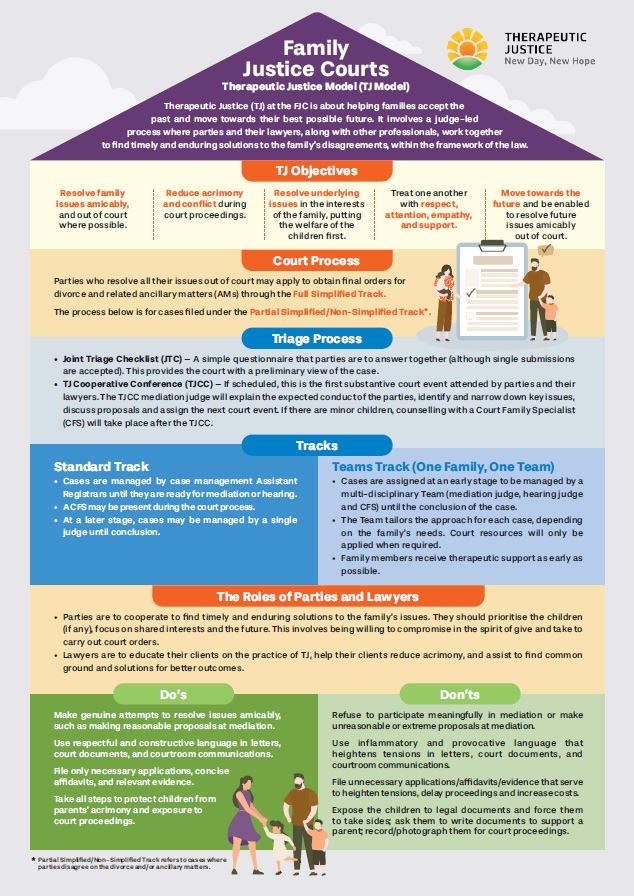
- In her keynote address delivered at that occasion, Justice Teh Hwee Hwee, the Presiding Judge of the FJC, explained: “The FJC TJ Model is about helping families accept the past and move towards their best possible futures. It involves a judge-led process where parties and their lawyers, along with other professionals, work together to find timely and enduring solutions within the framework of the law. Conceived with Singapore’s unique socio-cultural context in mind, the model will contribute to establishing our common understanding of what TJ means in practical terms.”10Justice Teh Hwee Hwee, Speech delivered at the 10th Anniversary Celebration of the Family Justice Courts, 21 October 2024, para 11 <https://www.judiciary.gov.sg/news-and-resources/news/news-details/justice-teh-hwee-hwee–speech-delivered-at-10th-anniversary-celebration-of-the-family-justice-courts>
- At its core, the TJ Model provides a shared language and structure for all participants in the family justice process. It also explains the court process that is applicable to matrimonial applications under Part 10 of the Women’s Charter, including the TJ Objectives at each stage of the court process. It further elaborates on the role of each participant (both parties and lawyers), including setting out the “Do’s and Don’ts” expected of the parties in dispute. Critically, a failure to adhere to TJ conduct may attract cost orders against the offending party.
- The TJ Model should be read together with Part 8 of the Family Justice (General) Rules 2024, which expressly empowers the court to adopt a judge-led approach in the management of cases in the Family Justice Courts.11The judge-led approach was first introduced along with the implementation of the new family justice system framework in 2014, and has been enhanced by recent amendments to the rules. As examples, the court is expressly empowered to: impose any condition on the filing of applications;12Part 8, rule 2(2)(c) of Family Justice (General) Rules 2024 (“FJ(G)R”) limit the evidence given by any party including the number of affidavits and the length of each affidavit;13Part 8, rule 2(2)(j) of FJ(G)R hear any issues jointly or separately;14Part 8, rule 2(2)(i) of FJ(G)R or even consolidate separate actions or stay any action where appropriate to do so.15Part 8, rule 3 of FJ(G)R It should however be highlighted that a judge-led approach does not mean that counsel and parties will not be permitted to apply for orders/directions. The judge will still rely on counsel and parties to communicate their needs, interests and proposals to the court so that appropriate directions or orders may be made.
- Taken together, how the structured process in the TJ Model differs from the traditional adversarial process may be summarised as follows:
- Provision of simplified track: to encourage parties to resolve issues amicably out of court, parties who can resolve all their matrimonial issues before the matrimonial application is filed in court may apply for final orders for divorce and ancillary matters through simplified proceedings. This is known as the simplified track.
- Triaging and tone-setting: For cases that proceed further, the FJC uses innovative tools such as the Joint Triage Checklist (“JTC”) and TJ Cooperative Conference (“TJCC”).16Family Justice Courts, Family Justice Courts Therapeutic Justice Model (Revised Edition 2026), para 5 <https://www.judiciary.gov.sg/who-we-are/therapeutic-justice> (“TJ Model”)
- The JTC is a simple questionnaire that parties are required to submit at an early stage. This provides the court with a preliminary view of the family’s needs, so that the case may be managed on the appropriate track (standard or Teams track, to be elaborated on below).
- A TJCC may thereafter be scheduled for the case. Unlike a typical case conference, which is typically administrative and attended only by counsel, the TJCC is a substantive court event that requires parties to attend in person, together with their lawyers. This presence of the parties and lawyers at this early stage enables the mediation judge presiding over the TJCC to set the tone of cooperation and problem-solving at the outset. The TJCC offers several benefits: the TJCC judge explains the expected conduct of parties; distils key issues; discusses parties’ proposals; and considers referring parties to external agencies for therapeutic support services. For cases involving children under 14 years old, a Court Family Specialist (“CFS”), who may be a counsellor or psychologist, also attends the TJCC and conducts intake and assessment / counselling sessions with the parties after the TJCC.
- Use of mediation and counselling: before undergoing a process of formal adjudication, cases involving minor children typically enter a mediation and counselling stage, providing parties the opportunity to resolve their disputes amicably even after court proceedings have commenced, and reach their own solutions. Unlike civil disputes where mediation is often voluntary, mediation at the FJC is mandatory in prescribed cases.17Women’s Charter 1961, Part 10A; s 139I provides that mediation and counselling are mandatory for Part 10 proceedings where there is a child under 21. Mandatory mediation and counselling for selected cases has existed since 2011 and expanded in phases over the years.18See SAL Article, page 623, which states that the implementation of mandatory mediation and counselling for divorcing parties with minor children was rolled out at the FJC in three phases: (a) from 26 September 2011, it was extended to cases involving at least one child below the age of eight years; (b) from 1 July 2013, it was extended to cases with at least one child below the age of 14 years; and (c) from 1 October 2014, it was extended to cases with at least one child below the age of 21 years. Now, mediation is part and parcel of family practice. Even in cases where mediation is not mandated by legislation, it is frequently utilised and directed with the consent of the parties. In today’s TJ landscape, all family practitioners are expected to be adept in family mediation skills.19TJ Model, Annex C, para 2(f) In the traditional adversarial system, the wellbeing of the opposing party is not always a relevant consideration. In a TJ system, however, there is a strong emphasis on the parties’ and children’s psychological and emotional wellbeing. The underlying non-legal concerns of the parties play a prominent role in proceedings. Therefore, where appropriate, the CFS will work with the parties and the children to provide therapeutic interventions and make the appropriate referrals to support services in the community.
- Use of Teams Track: Since March 2025, all cases filed involving contested child issues that proceed to hearing, as well as high-conflict non-child cases, are assigned to the Teams Track under the TJ Model (as opposed to the Standard Track).20Justice Teh Hwee Hwee, Opening Address at the Family Conference 2025, 24 September 2025, para 6 <https://www.judiciary.gov.sg/news-and-resources/news/news-details/justice-teh-hwee-hwee–opening-address-at-the-family-conference-2025> (“Opening Address at Family Conference 2025”) The Teams Track is a unique feature of the FJC, where a multi-disciplinary team (consisting of a mediation judge, hearing judge and CFS) is assigned to management of the case from start to end.21TJ Model, para 3(b)(ii) This allows for approaches including:22TJ Model, para 6
- a more flexible and customised use of mediation and counselling, as well as early referrals for parties and their children to attend therapeutic services and programmes;
- early interventions by the hearing judge to deal with matters such as pressing child issues, including their bifurcation or calling for child evaluative assessments at an earlier stage; and
- involving parties more directly in proceedings if the hearing judge deems appropriate to do so, such as directing that the parties personally attend court for the cases conferences or delivery of the court’s decision on child issues, depending on the needs of the case.
Reflections from the Ground
- The implementation of the TJ Model and its related processes have yielded encouraging results among members of the Bar. In a survey of 142 lawyers commissioned by the FJC and conducted by KPMG Advisory in June 2025, some 8 in 10 agreed that the TJ model increased awareness that clients should resolve matrimonial disputes more amicably; 7 in 10 agreed that clients were more open to receiving therapeutic interventions such as counselling; and 2 in 3 agreed that overall, the TJ model encouraged parties to come to terms with the past, focus on their long-term interests and move towards their best possible future. 23Opening Address at Family Conference 2025, para 12
- However, it is acknowledged that the practice of TJ is not always easy. Being able to persuade a client towards TJ can take time, especially when the client comes from a place of hurt and anger. We will have to work on establishing a strong rapport with the client, applying active listening and asking the right questions to understand the client’s underlying concerns, as well as reframing issues for the client.24The Family Therapeutic Justice Certification Programme run by Singapore Academy of Law provides training to enhance relevant interpersonal skills for the practice of TJ (https://sal.org.sg/learn/family-law/). Refer also to Lim Hui Min & Darren Chan, “Re-writing to Heal, Not Hurt – a Therapeutic Justice Language Guide for Family Litigants” Adopting reasonable positions in the face of combative opposing counsel can also be challenging. However, we will have to remain measured and calm for the sake of our clients and continue to manage the dispute in the most constructive manner possible.
- Ms Low suggested that “part of our role as lawyers is helping clients to think about which issues truly matter – whether pursuing every grievance will ultimately help them or simply deepen the conflict – and to counsel them to focus on practical solutions and co-parenting as they deal with setting aside the emotional hurt”.
- The practitioner recalls another matter that did not settle at mediation and was headed for contested hearings. She said:
“At that point, it would have been easy to conclude that the process had completely failed. But sometime later, the parties managed to broker a settlement directly between themselves without the lawyers’ involvement! …
… What was especially heartening was the feedback my client later gave, that aspects of the mediation process had actually stayed with them, in particular, the emphasis on co-parenting and protecting the children from emotional spillovers … Over time, they started trying to approach disagreements differently on their own. It did not make co-parenting easy overnight, but they became more functional as parents. To me, that really showed how the TJ approach can have positive effects.”
- For sceptics, the question often remains: what is the return on this investment of time, patience and mindset change? Perhaps the most compelling pay-off lies in outcomes that transcend legal victories – that your efforts are truly helping a broken family to heal, and the children to experience a more fulfilling life post-divorce. From a personal perspective, the parties emerge from the conflict more empowered and enabled in moving on with their lives. From a professional perspective, lawyers who effectively practise TJ will be known amongst the bench and bar as those who are reasonable to work with. From an institutional perspective, TJ promotes efficiency by reducing repeated litigation driven by unresolved emotional or relational issues. From a national perspective, TJ aligns with the recognition that strong families are the basic building block of Singapore society.
Suggestions for Counsel
- TJ approaches will continue to grow and deepen in the family justice system. In March 2026, Chief Justice Sundaresh Menon officially launched the Youth Courts Therapeutic Justice (“YC TJ”) Model at the FJC’s workplan. The YC TJ Model applies to matters in the Youth Courts. In the media release issued by the Singapore Courts, it was stated that the FJC will continue to explore how TJ can be applied to other areas “where family dynamics strongly shape behaviour and outcomes”.25Media Release, para 5 These developments have come hand in hand with initiatives to help lawyers increase their awareness of the TJ Model and discharge their roles accordingly. In his Response delivered at the Opening of The Legal Year 2026, Chief Justice Menon noted that the developments have created a corresponding need for the specialised training of family law practitioners. He announced that the sub-committee established to develop a specialist accreditation framework for family law practitioners had recommended a framework “that will recognise the essential role of family law practitioners and their vital contributions to family justice in Singapore.”26Chief Justice Sundaresh Menon, Response delivered at the Opening of the Legal Year 2026, 2 January 2026, para 33 <https://www.judiciary.gov.sg/news-and-resources/news/news-details/chief-justice-sundaresh-menon–response-delivered-at-the-opening-of-the-legal-year-2026>
- Given the progressive shift from an adversarial system to a TJ system, lawyers acting in family disputes may avail themselves of opportunities to increase their awareness and knowledge of TJ processes. For any lawyer entrusted with a family matter today, understanding TJ is no longer optional. It is part of competent, conscientious practice in Singapore’s evolving family justice system.
- In practice, some key areas shaped by the expectations of TJ include:
- Bringing the TJ Model to the client’s attention: One of the earliest and most critical expectations is that counsel must introduce the TJ approach to the clients. This goes beyond a cursory mention. Lawyers are expected to explain the purpose of TJ-oriented processes, prepare clients for what to expect at court events such as the TJCC, and help clients understand why cooperation and constructive engagement matter. This is in addition to the family lawyer’s basic duties under Rule 15A of the Legal Profession (Professional Conduct) Rules 2015.27Rule 15A requires the practitioner to advise the client of all available dispute resolution options, to resolve proceedings amicably, to be constructive and reasonable, that the welfare of the child takes precedence over the wishes of the parent and the child, and to consider the welfare of the child and the potentially adverse impact of family proceedings on the child.
- Preparation for court events: Under the TJ framework, court events now require a different kind of preparation, where the focus is not just on the client’s legal position. Rather, counsel are required to be thoroughly familiar with the client’s non-legal issues, anticipate emotional flashpoints, and consider and propose what interim arrangements may stabilise the family’s situation. Family lawyers have an important role to play in understanding the holistic needs of the client and the family, communicating those needs to the court in a measured way, and proposing reasonable and workable solutions. Court events should now be viewed not as combative processes, but collaborative processes.
- TJ Advocacy: Lawyers must make fundamental changes to their mindset and approach to advocacy. We need to re-define what “winning” means for our client. It is no longer just about the client’s individual legal gains. Instead, a “win” is one which supports the family’s long-term emotional and relational health, achieving workable and respectful future interactions and conflict management, and encourages stability and security for the children in the long run. Let’s illustrate this with the case of Sarah and Daniel, a couple undergoing divorce after 10 years of marriage, with an 8-year-old daughter Mia:
- Scenario 1 (anti-TJ): Sarah pushes for sole care and control with minimal access to Daniel, emphasising Daniel’s past inconsistency in caregiving and arguing that increased access to Daniel would be detrimental to Mia’s interest. If Sarah succeeds in her arguments, she may feel validated and secure in the short term. However, Daniel will likely feel insecure and excluded, leading to a deterioration in parental communication. Daniel’s anxiety over the child arrangements may manifest in more child-related interlocutory applications. In response, Sarah may become unwilling to co-parent, or worse, start engaging in gatekeeping behaviour. Mia is now caught in a loyalty conflict between both parents and becomes emotionally withdrawn. Sarah may have “won” at the hearing, but it is hardly a “win” in the long term.
- Scenario 2 (TJ): Instead of focusing on Daniel’s past conduct, Sarah is advised to try and understand Daniel’s inconsistency in parenting from his perspective. After the lawyers on both sides confer, it is discovered that Daniel was facing stress from Sarah’s parental expectations and felt that she was impossible to please. The parties acknowledge and understand the respective changes they must make, with an understanding that communication and compromises are key to moving forward with the co-parenting relationship. The parties, with the encouragement and help of their lawyers, develop a structured shared parenting plan. Mia benefits from a meaningful relationship with both parents. While neither parent gets everything they initially wanted, both parties have their needs addressed and emotional tension is managed constructively. Mia grows up showing emotional stability and confidence despite the divorce.
- For the avoidance of doubt, TJ does not equate to a “weak” practice. TJ does not ask lawyers to abandon advocacy. It does not require lawyers to concede or compromise their client’s positions where such concession or compromise is not reasonable. What lawyers have to work towards, though, is that any position taken should in the first place be one that is reasonable and realistic. Collaboration and mutual respect are key expectations in TJ advocacy. That said, any collaborative efforts should not merely be performative. For example, one ought not to call the opposing counsel to explore the settlement of a maintenance application, only to follow up with a strong letter that if there is no settlement of the maintenance, there shall be no access allowed. Rather, any collaborative effort should be accompanied by genuine desire to understand the other party’s interests and challenges, and enable sustainable solutions to be explored.
- We end this article with a case study that exemplifies the positive outcomes when all the stakeholders in the family justice ecosystem collaborate under the TJ Model. Ms Angelina Hing, the managing director of Integro Law Chambers, recalled a case where her client wanted to remain as the children’s primary caregiver despite facing accommodation issues. She felt pressured when the husband shared a draft agreement providing for the children to reside with him. However, the TJCC proved to be a turning point as the conference allowed the parties to go beyond legal correspondence, and exchange sentiments. Ms Hing said: “It was the first time the husband heard us explain the struggles his wife was going through. The husband explained that he merely was being practical and wanted the wife not to feel so burdened. She was free to see the children at his place of residence anytime. The expressed intent of the husband was very helpful to my client – we could then process it with her thereafter.”
- After the matter was resolved two mediation sessions later, Ms Hing saw the husband leaving the premises of the FJC. He approached her and extended his hand for a handshake – a memorable experience for Ms Hing, who reflected: “He thanked me and told me that his ex-wife had become a lot calmer over the past months and things at home with the kids have been a lot better than before the proceedings started. I do think that the TJCC/Mediation process, the Judge-Mediator, the counsellor and both parties’ lawyers played a part in making all of this happen. Any one of us not playing our respective parts could have possibly changed the outcome.”
This article is a product of a collaborative initiative by representatives from the Family Law Practice Committee of the Law Society, the academia and the Family Justice Courts to further increase awareness of therapeutic justice. The views expressed are the authors’ own.
Endnotes
| ↑1 | For a detailed write up on the evolution of our family justice system over the years, refer to Kevin Ng, Yarni Loi, Sophia Ang and Sylvia Tan, “Family Justice Courts – Innovations, Initiatives and Programmes: An Evolution over Time”, (2018) 30 SAcLJ 617 (“SAL Article”) |
|---|---|
| ↑2 | The family justice system has undergone two major waves of reform driven by two committees. The first, the Committee for Family Justice, was established in 2013 and delivered its recommendations in 2014. Its key recommendations included the establishment of a dedicated body of courts to hear all family-related cases, the implementation of differentiated tracks depending on the nature of the case, and a shift towards a judge-led model. These recommendations were accepted by the Government and resulted in the enactment of the Family Justice Act 2014 and the establishment of the FJC in 2014, with expanded jurisdiction over the entire spectrum of family disputes. The second, the Committee to Review and Enhance Reforms in the Family Justice System (RERF Committee), was established in November 2017 to build on the work of the Committee for Family Justice. Its recommendations were accepted by the Government in 2020 and have since been progressively implemented, including through the introduction of the Family Justice Rules 2024, which strengthened the judge-led approach by equipping family judges with a wider range of tools to ensure that cases are resolved effectively, proportionately and expeditiously, while reducing acrimony, costs and time. |
| ↑3 | Chief Justice Sundaresh Menon, Opening Remarks at the 10th Anniversary of the Family Justice Courts, 21 October 2024, paras 1 and 2 <https://www.judiciary.gov.sg/news-and-resources/news/news-details/chief-justice-sundaresh-menon–opening-remarks-at-the-10th-anniversary-of-the-family-justice-courts> |
| ↑4 | David B. Wexler, “Putting Mental Health into Mental Health Law: Therapeutic Jurisprudence”, 16 L. & Hum Behav. 27 (1992) |
| ↑5 | Justice Debbie Ong, Family Justice Courts Workplan 2020 Speech, 21 May 2020, para 43 <https://www.judiciary.gov.sg/news-and-resources/news/news-details/justice-debbie-ong-speech-delivered-at-the-family-justice-courts-workplan-2020> (“Workplan Speech”) |
| ↑6 | VDZ v VEA (2020) 2 SLR 858 |
| ↑7 | Workplan Speech, paras 33, 48 and 52 |
| ↑8 | SG Courts, Media Release, “Family Justice Courts Celebrate 10th Anniversary and Launch of Therapeutic Justice Model”, 21 October 2024, para 7 <https://www.judiciary.gov.sg/news-and-resources/news/news-details/media-release–family-justice-courts-celebrate-10th-anniversary-and-launch-of-therapeutic-justice-model> (“Media Release”) |
| ↑9 | The equivalent directions were added to FJC Practice Directions 2015 in Part IIIA. |
| ↑10 | Justice Teh Hwee Hwee, Speech delivered at the 10th Anniversary Celebration of the Family Justice Courts, 21 October 2024, para 11 <https://www.judiciary.gov.sg/news-and-resources/news/news-details/justice-teh-hwee-hwee–speech-delivered-at-10th-anniversary-celebration-of-the-family-justice-courts> |
| ↑11 | The judge-led approach was first introduced along with the implementation of the new family justice system framework in 2014, and has been enhanced by recent amendments to the rules. |
| ↑12 | Part 8, rule 2(2)(c) of Family Justice (General) Rules 2024 (“FJ(G)R”) |
| ↑13 | Part 8, rule 2(2)(j) of FJ(G)R |
| ↑14 | Part 8, rule 2(2)(i) of FJ(G)R |
| ↑15 | Part 8, rule 3 of FJ(G)R |
| ↑16 | Family Justice Courts, Family Justice Courts Therapeutic Justice Model (Revised Edition 2026), para 5 <https://www.judiciary.gov.sg/who-we-are/therapeutic-justice> (“TJ Model”) |
| ↑17 | Women’s Charter 1961, Part 10A; s 139I provides that mediation and counselling are mandatory for Part 10 proceedings where there is a child under 21. |
| ↑18 | See SAL Article, page 623, which states that the implementation of mandatory mediation and counselling for divorcing parties with minor children was rolled out at the FJC in three phases: (a) from 26 September 2011, it was extended to cases involving at least one child below the age of eight years; (b) from 1 July 2013, it was extended to cases with at least one child below the age of 14 years; and (c) from 1 October 2014, it was extended to cases with at least one child below the age of 21 years. |
| ↑19 | TJ Model, Annex C, para 2(f) |
| ↑20 | Justice Teh Hwee Hwee, Opening Address at the Family Conference 2025, 24 September 2025, para 6 <https://www.judiciary.gov.sg/news-and-resources/news/news-details/justice-teh-hwee-hwee–opening-address-at-the-family-conference-2025> (“Opening Address at Family Conference 2025”) |
| ↑21 | TJ Model, para 3(b)(ii) |
| ↑22 | TJ Model, para 6 |
| ↑23 | Opening Address at Family Conference 2025, para 12 |
| ↑24 | The Family Therapeutic Justice Certification Programme run by Singapore Academy of Law provides training to enhance relevant interpersonal skills for the practice of TJ (https://sal.org.sg/learn/family-law/). Refer also to Lim Hui Min & Darren Chan, “Re-writing to Heal, Not Hurt – a Therapeutic Justice Language Guide for Family Litigants” |
| ↑25 | Media Release, para 5 |
| ↑26 | Chief Justice Sundaresh Menon, Response delivered at the Opening of the Legal Year 2026, 2 January 2026, para 33 <https://www.judiciary.gov.sg/news-and-resources/news/news-details/chief-justice-sundaresh-menon–response-delivered-at-the-opening-of-the-legal-year-2026> |
| ↑27 | Rule 15A requires the practitioner to advise the client of all available dispute resolution options, to resolve proceedings amicably, to be constructive and reasonable, that the welfare of the child takes precedence over the wishes of the parent and the child, and to consider the welfare of the child and the potentially adverse impact of family proceedings on the child. |