


Professional Ethics Digest 2026
A Practical Resource for Everyday Ethical Issues
The landscape of legal practice is fraught with complex ethical dilemmas, requiring legal practitioners to balance their duties to the court, their clients, and the profession. To assist practitioners, the Law Society’s Knowledge Management & Professional Standards Department published the Professional Ethics Digest 2026 (“PED 2026”) on 24 July 2026.
The PED 2026 is the latest addition to the Professional Ethics Digest series and serves as a practical, day-to-day reference tool for practitioners facing ethical and professional responsibility issues.
What is the PED 2026?
The PED 2026 is a compilation of 82 anonymised summaries of non-binding ethical guidance issued by the Advisory Committee of the Professional Conduct Council (“Advisory Committee”) between 1 January 2020 and 15 April 2026. While all names and identifying details have been removed, the factual scenarios and ethical analyses have been preserved as far as possible. As a result, readers gain insight not only into the applicable ethics rules, but also into how they are applied in practice.

Structure and Organisation of the PED 2026
The PED 2026 includes several user-friendly elements.
-
General Editor’s Notes: At the beginning of each chapter, readers are greeted with a “General Editor’s Note”. This feature outlines the relevant rules in the Legal Profession (Professional Conduct) Rules 2015 (“PCR”) and provides context for the guidance summaries in the chapter.
-
Comprehensive Headnotes: Every guidance summary (termed “illustrations” in the PED 2026) is preceded by a bolded headnote. These headnotes highlight the relevant PCR rules, key facts, and ethical issues addressed in each illustration, allowing practitioners to quickly identify relevant guidance.
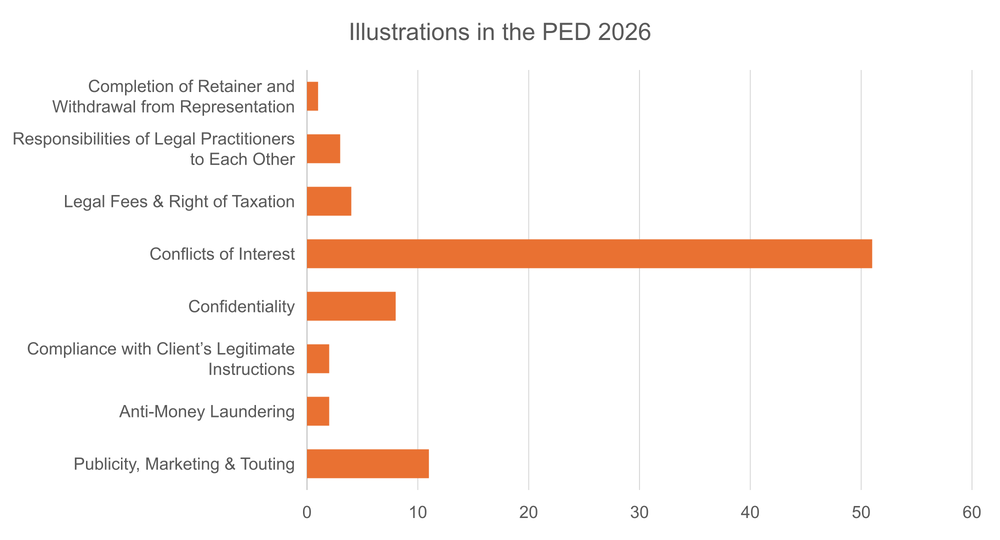
The illustrations are organised into eight thematic chapters covering:
-
Publicity, Marketing & Touting
-
Anti-Money Laundering (“AML”)
-
Compliance with Client’s Legitimate Instructions
-
Confidentiality
-
Conflicts of Interest
-
Legal Fees & Right of Taxation
-
Responsibilities of Legal Practitioners to Each Other
-
Completion of Retainer and Withdrawal from Representation
The diagram below provides a snapshot of the number of illustrations for each chapter, with the conflicts of interest chapter having the highest number of illustrations.
Spotlight on Conflicts of Interest
One clear theme emerging from the PED 2026 is that conflicts of interest remain one of the most challenging areas of legal practice. Chapter 5 of the PED 2026 explores this vast topic, categorising the guidance into:
-
conflicts between two or more clients;
-
conflicts between current and former clients; and
-
conflicts involving the legal practitioner/law practice’s personal interests.
The PED 2026 highlights several recurring scenarios that give rise to ethical concerns. These include the challenges of acting for multiple family members in conveyancing matters or contentious estate administrations. It also extensively covers the risks arising from the concurrent representation of multiple defendants in minority oppression suits, as well as the potential conflicts of interest that may arise when lawyers move from one law practice to another.
Given the high volume of illustrations dedicated to conflicts of interest, the PED 2026 provides practical reminders of how these issues must be managed, for example:
-
Legal interest divergence vs interpersonal harmony:1See Illustration 5.8 of the Professional Ethics Digest 2026 (“PED 2026”). A conflict of interest is not merely manifested by palpable discord or interpersonal friction between parties. Even if family members or business partners appear perfectly aligned and cooperative socially, a conflict exists if there is a divergence in their fundamental legal interests.
-
The use of limited retainers:2See Illustration 5.36 of the PED 2026. Legal practitioners cannot bypass conflict rules by relying on a limited retainer (e.g. by acting as an “instructing solicitor” only). A legal practitioner’s duty of unflinching loyalty to a client is indivisible. If the underlying interests are adverse, artificially narrowing the scope of the retainer does not cure the ethical conflict.
-
Information barriers are not absolute cures:3See Illustration 5.6 of the PED 2026. While information barriers (commonly known as “Chinese walls”) can address the risk of disclosing a former client’s confidential information, their effectiveness depends on the particular facts. Safeguards must be “iron-tight” and take into account factors such as the timing of the barrier’s creation, physical separation of departments, and the seniority of tainted legal practitioners.
-
Minority oppression disputes:4See Illustration 5.5 of the PED 2026. In minority oppression suits, even where the company is treated as a “nominal defendant”, questions may still arise as to whether the company’s interests diverge from those of the alleged oppressor. In such cases, concurrent representation may carry significant risks, particularly where there are allegations that the oppressor failed to act in the company’s best interests.
Top 10 Ethical Takeaways for Busy Practitioners
For practitioners who may not have time to work through the entirety of the PED 2026, the following are 10 key practical takeaways distilled from the illustrations and guidance. While not exhaustive, they highlight recurring ethical issues that legal practitioners are most likely to encounter in day-to-day practice.
-
Educational content and marketing:5See, inter alia, Illustration 1.1 of the PED 2026. Legal practitioners should ensure that educational content remains genuinely informational in nature and is not used as a means of soliciting business. Appropriate disclaimers should be used to clarify that all information provided during seminars or webinars do not constitute legal advice and do not give rise to a solicitor-client relationship.
-
Referral commissions by third parties to lawyers:6See Illustration 1.8 of the PED 2026. Legal practitioners should not accept referral commissions or other financial incentives from third parties in return for client referrals, as such arrangements may compromise the lawyer’s independence and give rise to concerns relating to touting and fee-sharing.
-
Clients arising from Criminal Legal Aid Scheme (“CLAS”) matters:7See Illustration 1.9 of the PED 2026. Legal practitioners should exercise caution before accepting a paid retainer from a client for whom they are concurrently acting under a CLAS assignment. Even where no prohibition applies, practitioners should avoid any actual or perceived use of the CLAS engagement as a means of generating private work.
-
Charging clients costs for AML and customer due diligence (“CDD”):8See Illustration 2.2 of the PED 2026. Legal practitioners may charge clients for AML and CDD costs, whether as professional fees or disbursements, provided that the charges are fair and reasonable, and the client has been informed of and agreed to such charges in advance.
-
Bank’s CDD/AML enquiries:9See Illustration 2.1 of the PED 2026. Legal practitioners should not disclose client information to a bank for the bank’s CDD/AML purposes, unless the client has provided written consent or the disclosure is otherwise authorised by law or required by a court order.
-
Client funds and instructions:10See Illustration 3.1 of the PED 2026. Legal practitioners should not assume that funds received on behalf of a client may be applied or transferred in accordance with the wishes of third parties. Client funds should be dealt with strictly in accordance with the client’s lawful instructions or a court order.
-
Confidentiality after death:11See Illustration 4.1 of the PED 2026. A legal practitioner’s duty of confidentiality does not end upon the client’s death. Information obtained during the retainer should not be disclosed unless there is a proper basis for disclosure.
-
Conflicts in joint representation:12See Illustration 5.36 of the PED 2026. Legal practitioners should carefully consider whether the interests of joint represented clients may diverge, even where no actual conflict has yet arisen. The scope of the retainer cannot be artificially characterised so as to avoid the application of conflict rules.
-
Lateral hiring and conflicts checks:13See, for example, Illustrations 5.15, 5.16 and 5.17 of the PED 2026. Legal practitioners should conduct thorough conflict checks before onboarding lateral hires. Early identification of potential conflicts helps to avoid situations where confidential information held by the incoming lawyer may adversely affect existing retainers or limit the law practice’s ability to continue acting.
-
Lawyer acting where a senior member of the law practice may be a witness:14See Illustration 5.49 of the PED 2026. Legal practitioners should consider not only whether the lawyer conducting the case will be called as a witness, but also whether the involvement of a senior member of the same law practice as a material witness may affect, or reasonably be perceived to affect, the independence of those acting in the matter.
Download the PED 2026
Practitioners are encouraged to consult the PED 2026 as a first point of reference. Given the breadth of issues covered, practitioners facing an ethical dilemma may find that a substantially similar scenario has already been considered by the Advisory Committee.
Members may download the PED 2026 here. Previous editions are also available for download: PED 2020 and PED 2019.
For enquiries, please contact the Knowledge Management & Professional Standards Department at [email protected].
Tune In: The PED 2026 Video Podcast Series
To complement the PED 2026, the Law Society has launched a video podcast series on LSS On-the-Go (paid subscription required) covering the various chapters in the PED 2026. The series discusses selected illustrations and key practical takeaways, providing an alternative and accessible way for practitioners to engage with the material.
LSS On-the-Go is a joint legal-accountancy e-learning platform, created by the Law Society of Singapore and the Institute of Singapore Chartered Accountants (ISCA), to help legal professionals build cross-disciplinary expertise in areas such as accounting, finance and governance while fostering greater collaboration between the legal and accountancy professions.
Endnotes
| ↑1 | See Illustration 5.8 of the Professional Ethics Digest 2026 (“PED 2026”). |
|---|---|
| ↑2 | See Illustration 5.36 of the PED 2026. |
| ↑3 | See Illustration 5.6 of the PED 2026. |
| ↑4 | See Illustration 5.5 of the PED 2026. |
| ↑5 | See, inter alia, Illustration 1.1 of the PED 2026. |
| ↑6 | See Illustration 1.8 of the PED 2026. |
| ↑7 | See Illustration 1.9 of the PED 2026. |
| ↑8 | See Illustration 2.2 of the PED 2026. |
| ↑9 | See Illustration 2.1 of the PED 2026. |
| ↑10 | See Illustration 3.1 of the PED 2026. |
| ↑11 | See Illustration 4.1 of the PED 2026. |
| ↑12 | See Illustration 5.36 of the PED 2026. |
| ↑13 | See, for example, Illustrations 5.15, 5.16 and 5.17 of the PED 2026. |
| ↑14 | See Illustration 5.49 of the PED 2026. |