

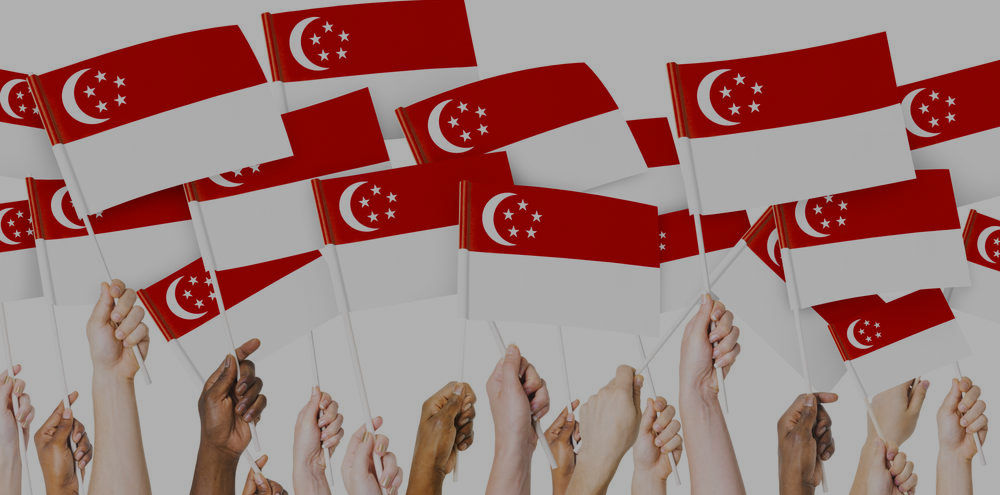
As One United People, Regardless of Race or Religion
Sixty Years of Ethnic Management Through the Constitution
Introduction
From the time of its establishment as a British trading post, Singapore had been an immigrant society. Since 1901, the ethnic demographics of Singapore have remained fairly stable. The Chinese population has hovered between 72.1% and 77.8%, the Malay population between 11.7% and 15.8%, while the Indian population has between between 6.4% and 9.2%. Even from colonial times, a key challenge for governments is how best to represent the different interests of these ethnic communities in the political sphere. Like many multi-ethnic societies, tensions and conflicts between the different ethnic communities would often emerge and had to be managed and resolved by the government. In colonial times, there were even intra-ethnic conflicts, as between the different Chinese groups. Two of the best-known of these were the Anti-Catholic Riots of 1851 and the Hokkien-Teochew Riots of 1854, sometimes referred to as the Great Riots. In each of these riots, hundreds lost their lives and many more lost their homes.
The British were keenly aware of the need to manage ethnic tensions and, for the most part, were quite successful in adopting a divide and rule strategy. Each ethnic community was allotted precincts in which to settle, and spatial geography minimised inter-ethnic interactions and confrontations. Communal violence was often sparked by seemingly minor incidents but exacerbated by criminal elements such as gangs and secret societies. Many of the immigrants to Singapore were sojourners rather than settlers and, as such, remained closely tied to and influenced by political developments and movements in their countries of origin, such as China and British India.
Ethnic Fault Lines
The world’s empires and colonies saw the rise of nationalism and independence movements from the 1920s, no doubt spurred by the establishment of the Chinese Republic in 1912 and the Russian Revolution of 1917. From 1867 to 1954, the colonial government utilised the device of elite co-option by appointing to the Legislative Council and Municipal Council, leading members of the various ethnic communities. However, with the introduction of competitive electoral contests, nomination to the legislative body was no longer an option. Significantly, nationalist groups and organisations in Malaya and Singapore tended to be organised along ethnic lines, such as the Kesatuan Melayu Muda (KMM) or Young Malays Union, which, when established in 1938, became Malaya’s first political party. After World War II, when political activity was revived, most political parties that emerged in Malaya were mainly race-centric: the United Malay Nationalist Organisation (UMNO); the Malayan Chinese Association (MCA); and the Malayan Indian Congress (MIC).

Things in Singapore developed differently. The first political party in Singapore – the Malayan Democratic Union, formed in 1945 – was multi-racial in its make-up and espoused an egalitarian, multi-ethnic ethos. The same could be said of the next 10 political parties to be established: Singapore Progressive Party (founded in 1947) and the Singapore Labour Party (1948); the People’s Action Party (1954); Democratic Party (1955); the Workers’ Party (1957); Singapore People’s Alliance (1958); Singapore Alliance Party (1961); United People’s Party (1961); and the Barisan Sosialis (1963). This set the tone for subsequent political contestation in Singapore. Whatever the battlelines were, they were not ethnic in nature.
Even the management of ethnicity had long been a concern, even in colonial times. Indeed, Singapore was totally left out of the 1946 Malayan Union plan – which absorbed the former Federated Malay States, the Unfederated Malay States and the former Straits Settlements territories of Penang and Malacca – because there were too many Chinese on the island. The British felt that adding the racial balance which favoured the Malays in Malaya would be upset if the large numbers of Chinese from Singapore were included in the Union.
Constitutionalising Minority Protection
In 1954, the Rendel Constitutional Commission also considered the question of discrimination of minorities and concluded that the management of such concerns should
“… depend on the good sense, fair-mindedness, and sense of responsibility of the legislative and administrative authorities of the State – qualities which are in any case necessary prerequisites of the success of any new constitution which may be adopted and which, if they do not exist already, cannot be produced by any recommendations which may be made by the Commission.”
However, as Singapore inched towards self-government and eventual independence, concerns about the rights of minorities became ever more important. In 1956, as Chief Marshall prepared to leave for the first constitutional talks he prepared a Memorandum to the Colonial Government, and under the “Heads of Agreement” wrote the following:
“That it shall be the duty of the Government of Singapore at all times to protect the political, economic, social and cultural interests of the Malays, Eurasians and other minorities domiciled in Singapore.
It should also be the deliberate and conscious policy of the Government of Singapore at all times to recognise the special position of the Malays, who are the indigenous people of the Island and are most in need of assistance, and within the framework of the general good of Singapore, to support, foster and promote their political, economic, social and cultural interests, and the Malay language.”
This working paragraphs became, as it is obvious, the genesis of our present Article 152. Following the Constitutional Talks of 1956, a preamble was worked into the 1958 Singapore (Constitution) Order in Council 1958, which stated that
“… shall be the responsibility of the Government of Singapore constantly to care for the interests of racial and religious minorities in Singapore, and in particular that it shall be the deliberate and conscious policy of the Government of Singapore at all times to recognise the special position of the Malays, who are the indigenous people of the Island and are in most need of assistance, and accordingly, that it shall be the responsibility of the Government of Singapore to protect, safeguard, support, foster and promote their political, educational, religious, economic, social and cultural interests and the Malay language.”
And in 1963, these preambular words were embedded into the Constitution as Article 89 of the Constitution of the State of Singapore 1963:
“89(1) It shall be the responsibility of the Government constantly to care for the interests of the racial and religious minorities in the State.
(2) The Government shall exercise its functions in such manner as to recognise the special position of the Malays, who are the indigenous people of the State, and accordingly it shall be the responsibility of the Government to protect, support, foster and promote their political, educational, religious, economic, social and cultural interests and the Malay language.”
This article was renumbered in the 1980 Reprint of the Constitution of the Republic of Singapore as the present Article 152. The Singapore Government’s approach to minorities and the position of the Malays was egalitarian in not privileging any one ethnic group over the rest and realistic in recognising that minority interests needed protection from the possible tyranny of the majority.
Minority Rights: A Post-Independence Priority
One of the first things Singapore Parliament did when it sat for the first time on 22 December 1965 was to establish a Constitutional Commission headed by Chief Justice Wee Chong Jin to consider how the rights of the racial, linguistic and religious minorities can be adequately safeguarded in the Constitution. By the time Singapore seceded from the Federation of Malaysia on 9 August 1965, race relations, especially between the Chinese and Malays, were fraught with tension. Just slightly over a year before, Singapore witnessed its worst post-war civil disturbance when the two communities turned on each other in riots triggered by incidents during the annual Prophet Muhammad Birthday procession in July 1964. The roots of these racial tensions may be traced to the time Singapore became part of the Federation of Malaysia in 1963 and the Alliance Party set its sights on contesting Singapore’s Legislative Assembly elections and Singaporeans found themselves being sucked into the vortex of the ethnic and religious politics of the Federation of Malaya.
As intimated above, politics in Malaya was race-based, and the new state had been founded on an UMNO-led consociational bargain under which every community recognised the primacy and dominance of the Malays. The leading communal parties in Malaya – UMNO, the MCA and MIC – organised themselves into the UMNO-led Alliance Party in October 1957 to formalise their erstwhile political coalition, which had won a crushing victory in the 1955 federal elections. In Singapore, local branches of UMNO, the MCA and MIC were already active in the 1955 general election. Indeed, the Labour Front’s David Marshall formed his coalition government by joining forces with the UMNO-MCA Alliance. The Malaysian Alliance Party contested elections in Singapore in 1963 through the Singapore Alliance Party (SAP) which was not a branch of the Alliance Party but was strongly supported by it. The SAP itself was only established in 1961 through the merger of the Singapore People’s Alliance (itself a merger of the old Labour Front and Liberal Socialist Party), the local branches of the MCA and MIC and UMNO’s Singapore branch (Singapore UMNO or SUMNO).
Members of SUMNO had in fact contested the 1959 general election and three of its members won seats in the Malay-dominated constituencies of Geylang Serai, Kampong Kembangan, and Southern Islands. In the 1963 general election, the SAP contested 41 out of the 51 seats and failed to win a single seat. More significantly, the three SUMNO candidates lost their seats. This loss proved to be a huge blow and shock to both UMNO and SUMNO who had expected the Singapore Malays to naturally vote along racial lines, in favour of SUMNO. The extremist nationalist UMNO Secretary-General, Syed Ja’afar Albar went on an all-out assault on Lee Kuan Yew, whom he accused of mistreating the Malays in Singapore. Using incendiary language in the press and publicly decrying the PAP and Lee, Albar and his SUMNO members succeeded in inflaming and riling up the Malay community against the PAP, and indirectly against the Chinese community from which the PAP drew its electoral strength.
Things got worse when the PAP announced in 1964 that it would contest the Federal elections on a non-communal platform of equal rights for all in a “Malaysian Malaysia”, and not a “Malay Malaysia”. This got the UMNO politicians even more anxious as this meant a direct threat to Malay dominance. Things got worse when UMNO opened five more branches in Singapore with to view to reorganising the Singapore Alliance to take on the PAP in the next general election. UMNO’s slander campaign against Lee and the PAP polarised the Malay and Chinese communities and ultimately led to the Prophet Muhammad’s Birthday procession riots in July 1964, and Singapore’s ultimate secession from the Federation just over a year later. The tensions eased after Separation but the UMNO agenda was not over. The Federal Government even proposed reserving land in Johore for Singapore Malays wishing to migrate and the Tunku, in his last-minute attempt to solve the problem offered Lee Kuan Yew a “people exchange” proposal where by Chinese in Malaysia who didn’t like UMNO rule could move to Singapore, and Singapore Malays who did not like living under the PAP regime could migrate to Malaysia.
Securing Minority Rights: The Wee Chong Jin Commission
Against this tense political backdrop, it is not surprising that one of the most important questions which the Government faced was the protection of minority rights and interests which was crucial to the survival of Singaporean society. To this end, a Constitutional Commission (only Singapore’s second), headed by then Chief Justice Wee Chong Jin was set up in December 1965 and immediately charged with the responsibility of seeing how these interests could be safeguarded. The terms of reference of the Commission were limited to:
- Receive and consider representations on how the rights of the racial, linguistic and religious minorities can be adequately safeguarded in the Constitution;
- Consider what provisions should be made to ensure that no legislation which by its practical application is considered likely to be discriminatory, against members of any racial, linguistic or religious group, should be enacted before adequate opportunities have been given for representation from parties likely to be aggrieved;
- Consider what remedies should be provided for any citizen or group of citizens who claim that he or they have been discriminated against by any act or decision of the government or the administration of any statutory board or public body constituted by law and to recommend the machinery for the redress of any complaints; and
- Consider how such provisions can be entrenched in the Constitution.
The Commission issued their Report in 1966 and made a number of important recommendations. The one most salient to our discussion was the recommendation to create a new body called the Council of State whose main function would be to “consider all proposed legislation, except all Supply Bills or a Bill presented on a Certificate of Urgency, and to report thereon to Parliament.” The council would be a purely advisory body and would not be part of the legislature. It would offer Parliament “serious and weighty advice” on impending legislation and their effects on racial, linguistic, religious or cultural minorities.
Following a brief debate in Parliament, a Parliamentary Select Committee was set up to study the proposals relating to the Council of State which was renamed the Presidential Council in the Constitution (Amendment) Bill 1969. The Bill was submitted to Select Committee which completed its deliberations in December and presented its Report to Parliament on 9 December 1969. Although the Select Committee did not recommend any major amendments to the Bill, the following proposals were rejected by the Government; they were that:
- Eminent persons be appointed to the Council by the President at his discretion;
- The Council not include politicians; and
- The Council holds its meetings in public.
Under the 1969 provisions, the Presidential Council comprised a Chairman, 10 Permanent Members and 10 non-permanent members appointed by the President on the advice of the Cabinet. Its general function was “to consider and report on such matters affecting any racial or religious communities in Singapore as may be referred to the Council by Government”, while its particular function is ”to draw attention to any Bill to any subsidiary legislation if that Bill or subsidiary legislation is in the opinion of the Council a differentiating measure or otherwise inconsistent with the fundamental liberties of the subject.” The detailed provisions concerning the composition, operation and remit of the Council is found in Part 7 of the Constitution.
Official Languages
Another matter which Parliament focused on in its first sitting the December 1965 was the question of official languages. In the run-up to Singapore’s 1963 independence, a significant debate over what the official language of the soon-to-be independent state should be. The SAP, being a local extension of the UMNO-led Alliance advocated that Malay should be the sole national language, as in the Federation, whereas the PAP proposed a policy of having four official languages – English, Malay, Mandarin Chinese and Tamil. And when the PAP advocated this policy when Singapore was part of the Federation of Malaysia, the UMNO leaders saw this as yet another attack on the supremacy of the Malays and their language. In December 1965, Parliament passed the Republic of Singapore Independence Act, section 7 of which states that “Malay, Mandarin, Tamil and English shall be the four official languages of Singapore” while the “national language shall be the Malay language and shall be in Roman script.” The decision to continue the use of English as the official language of administration diluted any attempt to use language to divide the communities.
Ethnic Symbolism in Parliament and at the Istana
Even with the participation of multi-ethnic parties in elections, it was impossible to ensure that ethnic minorities would be elected into Parliament. Between the 1960 and 1970s, many ethnic minority MPs were elected from constituencies which were predominantly inhabited by such minorities. However, with the success of the Housing and Development Board (HDB)’s public housing and resettlement programme, ethnic enclaves were slowly broken up and each public housing estate had a demographic mix that was a microcosm of Singapore’s overall ethnic distribution. The fear then, was that if Singaporeans voted along racial lines, there might come a time when no ethnic minority candidate would be returned to Parliament. There was, the PAP Government thought, “a voting trend which showed young voters preferring candidates who were best suited to their own needs without sufficiently aware of the need to return a racially-balanced party slate of candidates.”
There was nothing in the Constitution guaranteeing ethnic minority representation but this was achieved solely because of the PAP’s commitment to multi-racialism, and between 1968 and 1981, the PAP won every seat in Parliament, enabling the Party to effectively manifest its multi-ethnic policies. However, the small electoral defeats in the 1981 Anson by-election and the loss of Anson and Potong Pasir constituencies in the 1984 general election caused the Party’s leadership to reconsider how minority ethnic representation could be entrenched. While neither Anson nor Potong Pasir constituency were sufficiently ethnically distinct to have affected the vote, the PAP reasoned that if Singaporeans decided to vote on racial lines, they could well wake up one morning and find no ethnic minorities in Parliament and this would be deleterious to racial harmony.
To entrench minority ethnic representation in Parliament, the Government formulated the Group Representation Constituency (GRC) scheme. Article 39 of the Constitution was amended to provide that Parliament may make provision for “any constituency to be declared by the President … as a group representation constituency to enable any election in that constituency to be held on the basis of a group of 3 candidates.” Furthermore, “at least one of the three candidates in every group shall be a person belonging to the Malay” or “Indian or other minority communities.” Having eschewed the bicameral solution to minority representation back in 1966, the PAP now sought to entrench minority representation by ensuring that minority candidates would be included in every single election, and regardless of which political party won power, there would always be ethnic minorities in the House. In this way, the minority representatives would be elected, rather than appointed and thus carry the mandate of his constituency’s support. On its own, the GRC scheme looked like a good idea, even though criticisms could be made of the “coat-tails” effect of having relatively unknown candidates (be they minorities or otherwise), being elected into Parliament on the strength of prominent “team leaders”.
However, the GRC system was introduced in tandem with the Town Council proposal, which was designed to give residents in the public housing estates developed by the HDB a say in the running of their estates. The conflation of these two incongruous objects – that of ethnic minority representation in Parliament, and that of estate management – allowed the GRC scheme to be exploited to hamper the opposition parties competing in GRCs in two ways, through gerrymandering of electoral districts prior to each general election, and by averaging out the votes for each candidate such that unpopular candidates can still win when competing in a GRC team with popular teammates.
In another effort to guarantee ethnic minority representation in public life, the provisions relating to the election of the President were amended in 2016 to provide for what might be called a “reserved elected presidency” under which a particular presidential election may be reserved for one or more of the ethnic groups in Singapore. From 1965 to 1991, the office was filled by election by Parliament. This means that there is only one candidate presented by the Government of the day, in effect a nomination rather than an election. In this time, there was an informal understanding that the presidency would be rotated among the major ethnic groups in Singapore. The first President was Yusof Ishak, a Malay. He was succeeded by Benjamin Henry Sheares, a Eurasian, CV Devan Nair, a Malayali Indian, and the Wee Kim Wee, a Peranakan Chinese. However, when the presidential office transformed into an elected one, nomination was no longer possible and there was no guarantee that any ethnic minority candidate would be elected. Thus, while the Constitutional Commission recommended returning the office of presidency to its former nominated status, the Government was adamant in not doing so and amending the Constitution instead to provide for a reserved presential election.
Under the new Article 19B(i) “[a]n election for the office of President is reserved for a community if no person belonging to that community has held the office of President for any of the five most recent terms of office of the President.” A “community” is defined as “the Chinese community; the Malay community; or the Indian or other minority communities.” The stated purpose of these amendments was to secure racial representation in Singapore’s highest ceremonial office. Nevertheless, any candidate who stands in a reserve Presidential election must, on top of being a member of the requisite “community”, also meet the other ordinary qualifications for the Presidency under Art 19. Based on the electoral history of the presidency, the 2017 presidential election was reserved for candidates from the “Malay community” and Madam Halimah Yacob, former Speaker of Parliament was returned unopposed as Singapore’s eighth President.
Managing Ethnicity: Beyond the Constitution
In this article, I restricted my discussion of Singapore’s ethnic management through the Constitution. This is, however, only half the picture. Parliament has also been busy managing ethnic affairs through ordinary legislation and regulations. In this context, I will briefly only mention three: the Maintenance of Religious Harmony Act; the Maintenance of Racial Harmony Act, and the Housing and Development Board’s (HDB’s) Ethnic Integration Policy.
The Maintenance of Religious Harmony Act
The Maintenance of Religious Harmony Act (MRHA) was enacted in 1990 to empower the Minister of Home Affairs to issue restraining orders against individuals who incite religious hatred, promote feelings of ill-will between religious groups, or use religion for political ends. It also establishes an Advisory Council on the MRHA, comprising representatives from various religious groups, to advise the Minister. The Act also established a Presidential Council for Religious Harmony which exercises scrutiny on the Minister’s issue of restraining orders. In 2019, the act was amended to empower the Minister to offer a person who has caused religious disharmony an opportunity to under a Community Remedial Initiative (CRI) rather than face criminal prosecution. The object of this alternative measure is to promote reconciliation through educating and sensitising the offender.
The Maintenance of Racial Harmony Act
In many respects, the Maintenance of Racial Harmony Act – which was passed in February 2025 – mirrors the Maintenance of Religious Harmony Act. It empowers the Minister for Home Affairs to issue restraining orders against persons involved in communicating, producing or distributing content that prejudices racial harmony in Singapore. A new Presidential Council for Racial and Religious Harmony is to be established to subsume the functions of the Presidential Council for Religious Harmony as an oversight body over the issue of restraining orders under both Acts. The Act similarly empowers the Minister to offer offenders the option of undergoing a CRI. Finally, the Act consolidates and updates various race-related offences found previously in the Penal Code and incorporates these provisions therein.
The Ethnic Integration Policy (EIP)
Some 80% of Singaporeans live in public housing estates built by the HDB. In 1989, the HDB introduced the Ethnic Integration Policy, a regulation issued under its statutory powers to prevent the formation of racial enclaves and promote social cohesion. Under the scheme, a proportion of each block and precinct of HDB flats is reserved for each of the major ethnic groups. This proportional apportionment is based on maximum percentage of members of any ethnic community from buying and living in these flats. For example, Malays may occupy a maximum of 25% of each block while Chinese may occupy a maximum of 87% of the block and Indians and others 15%.
Conclusion
When Singapore became independent in 1965, it had a state, but not a nation. As an immigrant society with little commonality between the races, it had only trade and business opportunities to hold them together. The divide and rule policies of the colonialists reinforced the existing cleavages even further and thus presented the new state with a colossal challenge, which it met head-on by first establishing basic principles in the Constitution, and then operationalising multi-ethnicism through institutions like the Group Representation Constituency scheme. But the management of ethnic relations is an ongoing process that cannot rely on hard law alone. And here, the use of ordinary law and policy. The unique thing about these laws is that while they are both preventive and punitive, they are also conciliatory and redeeming. In the years to come, the management of ethnic relations will get more complicated especially since the whole of the current framework is premised on there being distinct ethnic groups to be managed. But with more inter-ethnic marriages, these categories will come under increasing stress that may well require a new paradigm – certainly a project for the next 60 years.