


Small Claims, Big Impact
Enhancing Justice through Affordability, Accessibility, Autonomy, and Affectiveness in the Small Claims Tribunals
Singapore’s Small Claims Tribunals (SCT), established in 1984, have become a cornerstone of accessible justice by providing swift, inexpensive, and user-friendly dispute resolution. Originally focused on consumer protection, their jurisdiction has expanded significantly while retaining their central mission of ensuring access to justice for ordinary individuals. This article introduces a “4A framework”—affordability, accessibility, autonomy, and affectiveness—as key features underpinning the SCT’s success. Beyond lowering financial and procedural barriers, the SCT enhances party autonomy by excluding legal representation and promotes affective justice by giving litigants voice, dignity, and recognition. These qualities strengthen both individual experiences and the legitimacy of the justice system. As the SCT marks its 40th year, this framework will hopefully help to guide its response to new challenges and sustain the SCT’s role as a model of inclusive, humane, and legitimate dispute resolution.
I. The Small Claims Tribunals (SCT) Over Time
Small claims tribunals are now an established feature of many legal systems, including Singapore’s.1Honourable the Chief Justice Sundaresh Menon, ‘Foreword’ in Thian Yee Sze and Sandra Looi Ai Lin (eds.), Small Claims Tribunals in Singapore: Accessible, Affordable, Empowering (Academy Publishing 2025) ix. They provide an alternative to traditional court processes, offering pathways for resolving civil disputes that are purposefully simpler, faster, and cheaper.2Note that the tribunals system in Singapore encompass more than just those hearing civil claims but also include administrative tribunals and disciplinary tribunals. For more, see Bala Reddy & Jill Tan (eds.), Law and Practice of Tribunals in Singapore (Academy Publishing 2019) 6. In Singapore, the establishment of the Small Claims Tribunals in 1984 was a milestone aimed at providing “an alternative, expedient tribunal within the judicial system” to allow “consumers with low-value contractual claims with an inexpensive and efficient dispute resolution forum to seek legal redress expeditiously against errant merchants.”3Thian Yee Sze and Sandra Looi Ai Lin (eds.), Small Claims Tribunals in Singapore: Accessible, Affordable, Empowering (Academy Publishing 2025) 1. Originally focused on consumer protection, which remains a major plank of its scope, the SCT’s jurisdiction has expanded incrementally over the years to include a wider range of disputes.
The establishment of the SCT was part of a broader global trend aimed at improving access to justice for lower-quantum claims. The first small claims courts appeared in the United States in the early 1900s, but the rise of the modern small claims mechanisms is closely linked to the consumer rights movements of the 1960s and 1970s.4See generally, Christopher J. Whelan (ed.), Small Claims Courts: A Comparative Study (Clarendon Press 1990). The United Kingdom introduced its current small claims scheme in April 1981, following years of experimentation.5Ho Peng Kee, ‘Small Claims Process: Some Reflections’ (1984) 26(1) Malaya Law Review 17. In other parts of the common law world, small claims tribunals were introduced in Hong Kong in 1975, New Zealand in 1976, and Singapore in 1984. Small claims tribunals were also established in Canada6Iain Ramsay, ‘Small Claims Courts in Canada: A Socio-Legal Appraisal’, in Christopher J. Whelan (ed.), Small Claims Courts: A Comparative Study (Clarendon Press 1990) 25. and Australia,7Chin Nyuk Yin and Ross Cranston, ‘Small Claims Tribunals in Australia’, in Christopher J. Whelan (ed.), Small Claims Courts: A Comparative Study (Clarendon Press 1990) 49. functioning within the respective state or provincial systems in response to localized demands for quicker and more efficient legal remedies.

The SCT offers a judge-led forum for dispute resolution in which adjudicators take the lead in identifying relevant issues and guide parties in adducing relevant evidence. Legal representation is not allowed and parties present their own cases in their own words. This obviates the need for parties to seek legal advice and ensures proceedings remain accessible to laypersons.8‘Written Answer by Minister for Law K Shanmugam to PQ on Effectiveness of Small Claims Tribunal in Resolving Contractual Disputes and Plans to Raise Claim Limits and Reduce Cost’, (Ministry of Law, 10 Sep 2024), <https://www.mlaw.gov.sg/written-answer-by-minister-for-law-k-shanmugam-pq-effectiveness-small-claims-tribunal/#:~:text=1.,deferment%20of%20the%20filing%20fees> (accessed 31 August 2025). This model marks a shift from the adversarial model, which relies heavily on lawyers to navigate more complex procedural requirements and substantive law. Such court processes make them less suitable for resolving smaller claims. While not fully inquisitorial, developments in the SCT render it closer to a community justice model where accessibility, speed, and informality are balanced against judicial oversight.
Since its establishment, the SCT has significantly expanded in both scope and volume. From its original limit of S$2,000 in consumer complaints, the tribunal now hears disputes of up to S$20,000 (or S$30,000 with mutual consent). Its jurisdiction now spans a “wide spectrum of economic activity”9See generally, Thian Yee Sze and Sandra Looi Ai Lin (eds.), Small Claims Tribunals in Singapore: Accessible, Affordable, Empowering (Academy Publishing 2025) 13. including tenancy agreement, service contracts, damage to property, unfair practices, and refund of motor vehicle deposits. The SCT’s relevance is evident in its workload:
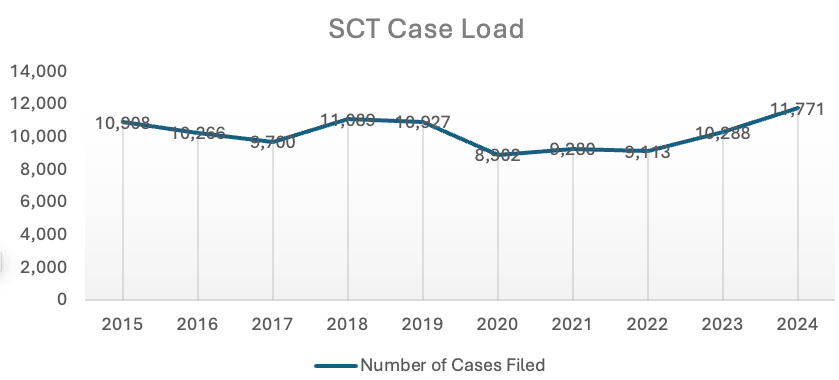 Figure 1. SCT’s Case Load Over the Past Ten Years10Data obtained from State Courts’ Annual Reports, One Judiciary Annual Reports, and SG Courts Annual Reports: ‘Publications’ (SG Courts), < https://www.judiciary.gov.sg/news-and-resources/publications> (accessed 31 August 2025); data on 2024 filings obtained from: ‘Justice Vincent Hoong’s Welcome address at the Small Claims Tribunals 40th Anniversary Symposium’ (SG Courts, 16 April 2025), <https://www.judiciary.gov.sg/news-and-resources/news/news-details/justice-vincent-hoong–welcome-address-at-the-small-claims-tribunals-40th-anniversary-symposium> (accessed 31 August 2025).
Its steady stream of filings, accounting for the majority of tribunals cases filed with the State Courts.11Aggregate data of number of cases filed under the community courts and tribunals can be found here: ‘Workload Statistics Of Supreme Court, State Courts And Family Justice Courts, Annual Data from Jan 2018 to Dec 2024’ (Data Gov, last updated 15 August 2025), <https://data.gov.sg/datasets/d_126d6f58c18f565242425800f88b34b8/view> accessed 30 August 2025. Its case load now amounts to roughly two-thirds of all civil claims filed in both the Magistrates’ and District Courts combined.12Honourable the Chief Justice Sundaresh Menon, ‘Foreword’ in Thian Yee Sze and Sandra Looi Ai Lin (eds.), Small Claims Tribunals in Singapore: Accessible, Affordable, Empowering (Academy Publishing 2025) footnote 3.
II. Access to Justice and the Rule of Law
The establishment and development of the SCT reflects Singapore’s deepening commitment to access to justice, recognised as a policy goal and as a judicially recognised public interest.13See Syed Suhail bin Syed Zin v PP (2021) 2 SLR 377. Access to justice extends beyond the removal of formal legal barriers to also encompass more substantive values that ensure practical and meaningful participation in legal processes.14United Nations Developmental Programme, Access to Justice: Practice Note, (20 Nov 2004) 6. Within Cappelletti and Garth’s framework of the three waves of access to justice, the SCT can be located in the third wave, which emphasises procedural innovation, particularly the development of simplified and user-friendly mechanisms, to create more accessible and efficient legal systems.15Mauro Cappelletti and Bryant Garth, ‘Access to Justice: The Newest Wave in the Worldwide Movement to Make Rights Effective’ (1978) 27 Buffalo Law Review 181.
From a more systemic point of view, broadening such access to justice is integral to the rule of law in the modern civilized state.16See e.g. Justice Valerie Thean’s opening statement in Loke Wei Sue v Paul Jeyasingham Edwards (2024) SGHC 45 (1); see also the Supreme Court of United Kingdom’s judgment in R (on the application of UNISON) v Lord Chancellor (2017) UKSC 51 (66). As has been observed, the “rule of law depends upon the existence and availability of courts and tribunals to which citizens may resort for the determination of differences between them which they cannot otherwise resolve.”17Per Long Bingham in Johnson v Gore Wood & Co (2002) 2 AC 1 22C-F, cited by the Singapore International Commercial Court in Beyonics Asia Pacific Ltd and others v Goh Chan Peng and another (2020) 4 SLR 215 (47). See also Lord Diplock’s judgment in Bremer Vulkan Schiffbau und Maschinenfabrik v South India Shipping Corporation Ltd (1981) AC 909 (977). The SCT’s structural innovations, designed to lower barriers and broaden participation in the legal system, tangibly advances access to justice in Singapore, strengthening the rule of law. Crucially, the SCT ensures that access to justice is not only nominal but practical, offering realistic avenues to resolve disputes swiftly, with relative informality, and before an official decision-maker. In this way, the SCT addresses the needs of individual litigants while strengthening the rule of law in Singapore.
III. Forty Years of the SCT: A 4A Framework for Analysis
As the SCT enters its fifth decade, it stands at a critical juncture in its institutional trajectory where questions of how to preserve its effectiveness for an increasingly complex future must be addressed. Here, it is proposed that four interrelated features, i.e. affordability, accessibility, autonomy, and affectiveness, underpin the SCT’s design and operation, and must remain central to sustaining its success in the decades ahead. While affordability and accessibility are frequently highlighted in both official discourse and scholarly commentary, they merit closer scrutiny given their evolving implications for litigants and for the justice system as a whole. By contrast, autonomy and affectiveness are less explicitly articulated but are nonetheless crucial to the SCT’s institutional practice and to its legitimacy and durability. Explicitly examining these latter features provides a more comprehensive account of the SCT’s success and offers critical guidance for its future development.
a. Affordability
First, on affordability, perhaps the most obvious yet central feature of the SCT. Filing fees for individuals range from just $10 to $300, amounting to at most 1% of a $30,000 claim. For businesses and other non-individual claimants, fees are set higher at between $50 and $900 but still modest (i.e. at most 3% of a $30,000 claim). Because legal representation is not allowed, these filing fees are usually the only external costs a party will incur in bringing or defending a claim. This stands in sharp contrast to ordinary civil proceedings, where fees are levied at multiple stages and legal costs can be substantial.
Affordable justice is not only a financial imperative but also a social one. In a small, densely populated society like Singapore, the availability of low-cost legal remedies ensures that meritorious claims are not abandoned for lack of resources. Without affordable avenues, many claimants would be deterred from pursuing their legal rights, however credible their cases might be, and may come to believe that justice is reserved only for those who can afford it. Over time, such perceptions would breed discontent and erode public trust in the legal system. The SCT’s affordable fee structure thus serves both individual and systemic ends: enabling practical access to justice while reinforcing the legitimacy of the system as a whole.
b. Accessibility
Secondly, on accessibility. The SCT has consistently prioritized accessibility by simplifying procedures to ensure that laypersons can navigate the system effectively without legal training or much legal knowledge. Section 12(4) of the Small Claims Tribunals Act empowers tribunal adjudicators to “determine the dispute among according to the substantial merits and justice of the case, and in doing so must have regard for the law but is not bound to give effect to strict legal forms or technicalities”. This statutory flexibility enables a pragmatic, substance-over-form approach where parties can focus on presenting key facts and documents, without having to navigate complex procedural rules like in an ordinary civil proceeding.
The claims process is deliberately kept simple. Commencing a claim requires filling out a brief form with basic information. Claimants unable to write or who face language or other disabilities may make oral claims in person. This significantly reduces barriers for vulnerable groups. Accessibility has also been greatly enhanced through the Community Justice and Tribunals System, which allows claimants to file, manage, and monitor their cases online. Hearings may also be conducted via video-conferencing, saving time and travel for claimants. More recently, new initiatives involving generative AI tools promise to further streamline the preparation of claims and defences, guide parties on the documents required, and clarify available remedies. Complimentary AI-based translation services would further help to bridge language gaps for parties appearing before the SCT.18‘Justice Vincent Hoong’s Welcome address at the Small Claims Tribunals 40th Anniversary Symposium’ (SG Courts, 16 April 2025), <https://www.judiciary.gov.sg/news-and-resources/news/news-details/justice-vincent-hoong–welcome-address-at-the-small-claims-tribunals-40th-anniversary-symposium> (accessed 31 August 2025).
c. Autonomy
Thirdly, on autonomy. While less often expressly articulated, the SCT also plays an important role in fostering party autonomy. It does so by prohibiting legal representatives, requiring litigants to engage in the process personally, and centering its process on resolution of disputes through party settlement.19Section 12(1), Small Claims Tribunals Act 1984 (2020 Revised Edition). Its two-stage process begins with a guided consultation, aimed at facilitating settlement. Only where parties are unable to resolve their dispute consensually does the case proceed to a hearing before a legally qualified referee.
By removing the intervening role of legal representatives, the SCT enhances party autonomy by giving litigants the forum to present their case in their own voice. This fosters a sense of ownership over the process and gives individuals a greater sense of control over how their disputes are framed and argued. This is particularly important in the context of smaller claims where legal issues tend to be more straightforward. Research on procedural justice confirms that litigants place high value on being heard and participating meaningfully in decisions that affect them. This means that even where outcomes are unfavourable, parties are more likely to accept them if they feel they have had a genuine voice in the proceedings.20See e.g. E. Allan Lind and Tom Tyler, The Social Psychology of Procedural Justice (Springer 1988); Tom Tyler, Why People Obey the Law (Princeton University Press 2006). By supporting litigant autonomy in this way, the SCT not only promotes perceptions of fairness but also strengthens the legitimacy of the legal system as a whole.
d. Affectiveness
Finally, on affectiveness. The SCT’s relative informality allows it to perform a vital function that is often overlooked and undervalued in more formal legal settings. Beyond resolving disputes on their merits, it is important that the SCT gives individuals the opportunity to air grievances, tell their stories, and be treated with dignity in an official forum. For many Singaporeans, the SCT may be their first and only direct encounter with the courts.21Honourable the Chief Justice Sundaresh Menon, ‘Foreword’ in Thian Yee Sze and Sandra Looi Ai Lin (eds.), Small Claims Tribunals in Singapore: Accessible, Affordable, Empowering (Academy Publishing 2025) ix. The way they are heard and treated in this setting can therefore shape their long-term perception of the legal system’s fairness and responsiveness.
This affective dimension matters because justice is not experienced solely in monetary or legal terms. Litigants seek recognition, respect, and a sense that their concerns have been taken seriously. Formal courts, with their greater complexity and procedural rigidity, are not always well-suited to meeting these needs. By contrast, the SCT fills an important “affective justice” gap, complementing the physical, resource, and literacy gaps identified by Chief Justice Sundaresh Menon.22Chief Justice Sundaresh Menon, Supreme Court of Singapore, ‘Technology and the Changing Face of Justice,” Speech at the Negotiation and Conflict Management Group (NCMG) ADR Conference 2019 (14 Nov 2019) para 11. It provides a forum that is not only efficient and accessible but also just and humane in its treatment of parties, essential qualities for a justice system that aspires to legitimacy and public trust.
IV. Conclusion: Evolving Justice Through the SCT
United States Supreme Court Chief Justice Warren Burger once astutely remarked, albeit in rather dramatic terms:
“We do not need to call on psychiatrists or clinical psychologists to tell us that a sense of injustice rankles and festers in the human breast and the dollar value of the conflict is not always the measure of tension and irritation produced.”23Warren E. Burger, ‘Our Vicious Legal Spiral’ (1977) 16(4) Judges Journal 23, 48; see also Laura Nader, ‘Disputing Without the Force of Law’ (1979) 88(5) Yale Law Journal 1998, 1001.
Opening the doors of justice to small(er) claims can prevent such irritation and tension from festering in society. The SCT’s framework built on affordability, accessibility, autonomy, and affectiveness ensures that it remains a model of efficient, user-friendly, and inclusive dispute resolution, promoting access to justice and rule of law in Singapore. As the SCT marks its 40th year, its challenge is to maintain these essential features while adapting to serve a wider segment of the community. How it responds to emerging pressures in an increasingly complex society will shape its future and that of the broader legal ecosystem. Three challenges, in particular, lie ahead.
First, with increasing litigation costs, there will be pressure to expand its jurisdiction by raising the monetary limit and/or to introduce new categories of claims. Such an expansion could enhance access to justice by enabling more litigants to benefit from the SCT’s cost-efficient procedures, while also easing the burden on civil courts that are increasingly managing self-represented parties.24Neo and Whalen-Bridge have noted that the justice system operates as an interconnected ecosystem: see generally Jaclyn Neo & Helena Whalen-Bridge, Litigants in Person: Principles and Practice in Civil and Family Matters in Singapore (Academy Publishing 2021). Yet expansion carries risks. A larger caseload and broader jurisdiction may invite creeping legalism, where adjudicators increasingly adopt more complicated legal reasoning and evidentiary requirements. The pressure to do so is understandable as higher quantum claims may involve more complex legal issues. However, such creeping legalism would undermine the SCT’s core mission. While referees inevitably bring formal legal reasoning to bear, this should not displace the SCT’s defining strengths: an informal, accessible forum guided by substantive justice rather than technicalities.25Johan Ding Kar En, ‘Singapore’s Informal Justice Experience: Evaluating the Practice of the Small Claims Tribunals’ (2024) 41(1) Singapore Law Review 109 Informality and broader principles of justice would still need to govern the process, where referees exercise their discretion with a view of the law but not legalistically.
Secondly, the SCT must remain firmly centered on access to justice for individuals, particularly vulnerable individuals, while balancing the differential resources between individuals and corporations. A recurring concern is that the tribunal is used primarily as a debt-collection forum by corporations.26Louis D’ Souza, ‘An Experiment in Informal Justice: The Small Claims Tribunal of Singapore’ (1991) 3 SAcLJ 264; Soh Kee Bun, ‘Small Claims Jurisdiction’ 1996) Sing JLS 389. This is not, strictly speaking, an abuse of process; corporations have always been entitled to bring small claims, and similar mechanisms exist in many jurisdictions.27Soh Kee Bun, ‘Small Claims Jurisdiction’ (1996) Sing JLS 389, 393. Channelling such claims into the SCT even serves a systemic purpose: it keeps them out of the Magistrates’ and District Courts, where cost-shifting rules could otherwise impose heavier burdens on individual defendants. Yet, even if legitimate, corporate reliance on the SCT risks diverting its caseload away from its core mission of facilitating access to justice for ordinary individuals. The challenge is to ensure that corporate participation does not erode the tribunal’s accessibility or fairness. This would require, for instance, preserving the SCT’s informality and simplicity so that corporations cannot exploit hidden legal assistance to gain an unfair advantage. Indeed, the benchmark for future developments should be whether the SCT can continue to deliver justice on equitable terms, rather than allowing resource imbalances to distort outcomes, especially if its jurisdiction is expanded. Maintaining fee differentials between corporate and individual claimants could be one way to ensure that costs are more equitably distributed. Encouragingly, recent initiatives show a continued commitment to this goal. For example, the State Courts and the Consumer Association of Singapore (CASE) signed a Memorandum of Understanding at its 40th anniversary celebration to strengthen support for vulnerable consumers. Under this arrangement, CASE officers may represent consumers in SCT hearings, offering vital assistance to the elderly, persons with disabilities, and those unfamiliar with digital technologies.28Melvin Yong, ‘Vulnerable consumers to get greater assistance from CASE in resolving small claims disputes’ (Consumer Association of Singapore, 16 April 2025) <https://www.case.org.sg/wp-content/uploads/2025/04/Media-Release-Vulnerable-consumers-to-get-greater-assistance-from-CASE-in-resolving-small-claims-disputes.pdf> (accessed 1 September 2025).This initiative will mitigate barriers to participation for vulnerable litigants and reinforce the tribunal’s central mission to remain a simple, accessible, and fair forum for individuals seeking justice.
The signing of a Memorandum of Understanding between CASE and the State Courts during the SCT’s 40th anniversary event exemplifies this continued commitment to serve the community. Under this MOU CASE officers may support and represent vulnerable consumers in SCT hearings, an option that would significantly address the needs of the elderly, persons with disabilities and those unfamiliar with digital technologies.
Thirdly, technological advances, particularly artificial intelligence, promise greater efficiency and ease of use for SCT users. Online filing systems, AI-enabled document preparation, and translation tools can substantially reduce barriers for ordinary litigants. Yet efficiency must not come at the expense of autonomy and affectiveness. It is true that many cases would involve fairly detached relationships, where the core of the dispute is monetary. But in some cases, the monetary claim is enmeshed with personal grievances. An expedited technology-driven process may provide a quick detached resolution but may not give a party the sense that justice was realized, and therefore the closure they need. Accordingly, even while AI may promise a future of quick resolution, the SCT (and indeed the Community Disputes Tribunals Division in general) will need to maintain, and even strengthen, its human resources to ensure that adjudication retains its capacity for autonomy and affectiveness so as to preserve public confidence in the system.
In sum, the SCT is a vital institution that strengthens public trust, empowers individuals, and reinforces the legitimacy of Singapore’s justice system. Its enduring significance lies in how it modifies and humanises legal processes to better reflect the lived realities of ordinary people. The continued success of the SCT depends on remaining anchored to its original mission, centred on affordability, accessibility, autonomy, and affectiveness, while navigating new challenges with care.
This article was developed from the author’s remarks as a panelist for the 40th anniversary of the Small Claims’ Tribunals symposium.
Endnotes
| ↑1 | Honourable the Chief Justice Sundaresh Menon, ‘Foreword’ in Thian Yee Sze and Sandra Looi Ai Lin (eds.), Small Claims Tribunals in Singapore: Accessible, Affordable, Empowering (Academy Publishing 2025) ix. |
|---|---|
| ↑2 | Note that the tribunals system in Singapore encompass more than just those hearing civil claims but also include administrative tribunals and disciplinary tribunals. For more, see Bala Reddy & Jill Tan (eds.), Law and Practice of Tribunals in Singapore (Academy Publishing 2019) 6. |
| ↑3 | Thian Yee Sze and Sandra Looi Ai Lin (eds.), Small Claims Tribunals in Singapore: Accessible, Affordable, Empowering (Academy Publishing 2025) 1. |
| ↑4 | See generally, Christopher J. Whelan (ed.), Small Claims Courts: A Comparative Study (Clarendon Press 1990). |
| ↑5 | Ho Peng Kee, ‘Small Claims Process: Some Reflections’ (1984) 26(1) Malaya Law Review 17. |
| ↑6 | Iain Ramsay, ‘Small Claims Courts in Canada: A Socio-Legal Appraisal’, in Christopher J. Whelan (ed.), Small Claims Courts: A Comparative Study (Clarendon Press 1990) 25. |
| ↑7 | Chin Nyuk Yin and Ross Cranston, ‘Small Claims Tribunals in Australia’, in Christopher J. Whelan (ed.), Small Claims Courts: A Comparative Study (Clarendon Press 1990) 49. |
| ↑8 | ‘Written Answer by Minister for Law K Shanmugam to PQ on Effectiveness of Small Claims Tribunal in Resolving Contractual Disputes and Plans to Raise Claim Limits and Reduce Cost’, (Ministry of Law, 10 Sep 2024), <https://www.mlaw.gov.sg/written-answer-by-minister-for-law-k-shanmugam-pq-effectiveness-small-claims-tribunal/#:~:text=1.,deferment%20of%20the%20filing%20fees> (accessed 31 August 2025). |
| ↑9 | See generally, Thian Yee Sze and Sandra Looi Ai Lin (eds.), Small Claims Tribunals in Singapore: Accessible, Affordable, Empowering (Academy Publishing 2025) 13. |
| ↑10 | Data obtained from State Courts’ Annual Reports, One Judiciary Annual Reports, and SG Courts Annual Reports: ‘Publications’ (SG Courts), < https://www.judiciary.gov.sg/news-and-resources/publications> (accessed 31 August 2025); data on 2024 filings obtained from: ‘Justice Vincent Hoong’s Welcome address at the Small Claims Tribunals 40th Anniversary Symposium’ (SG Courts, 16 April 2025), <https://www.judiciary.gov.sg/news-and-resources/news/news-details/justice-vincent-hoong–welcome-address-at-the-small-claims-tribunals-40th-anniversary-symposium> (accessed 31 August 2025). |
| ↑11 | Aggregate data of number of cases filed under the community courts and tribunals can be found here: ‘Workload Statistics Of Supreme Court, State Courts And Family Justice Courts, Annual Data from Jan 2018 to Dec 2024’ (Data Gov, last updated 15 August 2025), <https://data.gov.sg/datasets/d_126d6f58c18f565242425800f88b34b8/view> accessed 30 August 2025. |
| ↑12 | Honourable the Chief Justice Sundaresh Menon, ‘Foreword’ in Thian Yee Sze and Sandra Looi Ai Lin (eds.), Small Claims Tribunals in Singapore: Accessible, Affordable, Empowering (Academy Publishing 2025) footnote 3. |
| ↑13 | See Syed Suhail bin Syed Zin v PP (2021) 2 SLR 377. |
| ↑14 | United Nations Developmental Programme, Access to Justice: Practice Note, (20 Nov 2004) 6. |
| ↑15 | Mauro Cappelletti and Bryant Garth, ‘Access to Justice: The Newest Wave in the Worldwide Movement to Make Rights Effective’ (1978) 27 Buffalo Law Review 181. |
| ↑16 | See e.g. Justice Valerie Thean’s opening statement in Loke Wei Sue v Paul Jeyasingham Edwards (2024) SGHC 45 (1); see also the Supreme Court of United Kingdom’s judgment in R (on the application of UNISON) v Lord Chancellor (2017) UKSC 51 (66). |
| ↑17 | Per Long Bingham in Johnson v Gore Wood & Co (2002) 2 AC 1 22C-F, cited by the Singapore International Commercial Court in Beyonics Asia Pacific Ltd and others v Goh Chan Peng and another (2020) 4 SLR 215 (47). See also Lord Diplock’s judgment in Bremer Vulkan Schiffbau und Maschinenfabrik v South India Shipping Corporation Ltd (1981) AC 909 (977). |
| ↑18 | ‘Justice Vincent Hoong’s Welcome address at the Small Claims Tribunals 40th Anniversary Symposium’ (SG Courts, 16 April 2025), <https://www.judiciary.gov.sg/news-and-resources/news/news-details/justice-vincent-hoong–welcome-address-at-the-small-claims-tribunals-40th-anniversary-symposium> (accessed 31 August 2025). |
| ↑19 | Section 12(1), Small Claims Tribunals Act 1984 (2020 Revised Edition). |
| ↑20 | See e.g. E. Allan Lind and Tom Tyler, The Social Psychology of Procedural Justice (Springer 1988); Tom Tyler, Why People Obey the Law (Princeton University Press 2006). |
| ↑21 | Honourable the Chief Justice Sundaresh Menon, ‘Foreword’ in Thian Yee Sze and Sandra Looi Ai Lin (eds.), Small Claims Tribunals in Singapore: Accessible, Affordable, Empowering (Academy Publishing 2025) ix. |
| ↑22 | Chief Justice Sundaresh Menon, Supreme Court of Singapore, ‘Technology and the Changing Face of Justice,” Speech at the Negotiation and Conflict Management Group (NCMG) ADR Conference 2019 (14 Nov 2019) para 11. |
| ↑23 | Warren E. Burger, ‘Our Vicious Legal Spiral’ (1977) 16(4) Judges Journal 23, 48; see also Laura Nader, ‘Disputing Without the Force of Law’ (1979) 88(5) Yale Law Journal 1998, 1001. |
| ↑24 | Neo and Whalen-Bridge have noted that the justice system operates as an interconnected ecosystem: see generally Jaclyn Neo & Helena Whalen-Bridge, Litigants in Person: Principles and Practice in Civil and Family Matters in Singapore (Academy Publishing 2021). |
| ↑25 | Johan Ding Kar En, ‘Singapore’s Informal Justice Experience: Evaluating the Practice of the Small Claims Tribunals’ (2024) 41(1) Singapore Law Review 109 |
| ↑26 | Louis D’ Souza, ‘An Experiment in Informal Justice: The Small Claims Tribunal of Singapore’ (1991) 3 SAcLJ 264; Soh Kee Bun, ‘Small Claims Jurisdiction’ 1996) Sing JLS 389. |
| ↑27 | Soh Kee Bun, ‘Small Claims Jurisdiction’ (1996) Sing JLS 389, 393. |
| ↑28 | Melvin Yong, ‘Vulnerable consumers to get greater assistance from CASE in resolving small claims disputes’ (Consumer Association of Singapore, 16 April 2025) <https://www.case.org.sg/wp-content/uploads/2025/04/Media-Release-Vulnerable-consumers-to-get-greater-assistance-from-CASE-in-resolving-small-claims-disputes.pdf> (accessed 1 September 2025). |