


Don’t Skip the Boilerplate: A Guide to Review (Part 3)
This is part three of a four-part series on how to review boilerplate clauses, focusing generally on lesser-known risks. Part one covered confidentiality clauses, part two clauses from A to En, and this part three clauses from Ex to N. (A link to part four will be included when it is published.)
Contents
- Expenses
- Force majeure
- Further assurances
- Draft the agreement to cover any known post-contract concerns rather than rely on this clause
- Check what threshold is required before one party must take further action
- Consider whether the party’s obligation to act is absolute or best efforts
- Consider drafting who bears the cost of further requested actions
- Notices
- Future-proof the parties’ contact details for receiving notices
- Ensure safeguards for sending notices via email
- Replace the phrase “registered” or “tracked” post with a description of the type of post
- Ensure the listed service methods are mandatory, not permissive
- Draft the clause to apply to notices only
- Deem notices received outside office hours as received when business next opens
- Check how you define “business day” for a cross-border contract
- Consider defining “office hours”
Expenses
Consider omitting the clause if each party is paying its own expenses
Recall that under common law, if an agreement is silent on costs, each party bears its own costs by default. Hence if that is what you intend, it is not strictly necessary to include an expenses clause.
Including this clause becomes more important when parties intend for one party to pay the other’s expenses, since it gives a contractual basis for the party being reimbursed to claim this reimbursement.

Consider simplifying the list of expenses covered
When in doubt, lawyers tend to draft a more detailed clause to cover more risks. However longer clauses are not always safer: especially for expense clauses, excessive detail could cause a party to become liable for expenses which the parties did not intend it to bear.
Recall the rule of contractual interpretation that the more things a contract lists, the stronger the presumption that anything not listed is excluded (i.e. expressio unius est exclusio alterius). Thus the more categories of expenses a clause lists, the more likely that the court will presume that any category not listed is excluded.1See also Practical Law’s standard costs clause drafting notes, which gives similar advice that listing too many categories could trigger this rule of interpretation to adverse effect.
To illustrate, consider these two sample clauses below (both hypothetical). Does party A need to pay party B’s disbursements incurred in preparing the agreement? Neither clause specifically lists “disbursements”, however I suggest that the shorter clause is more likely to be interpreted broadly enough to cover disbursements.
Which clause is more likely to let party B recover disbursements from party A?
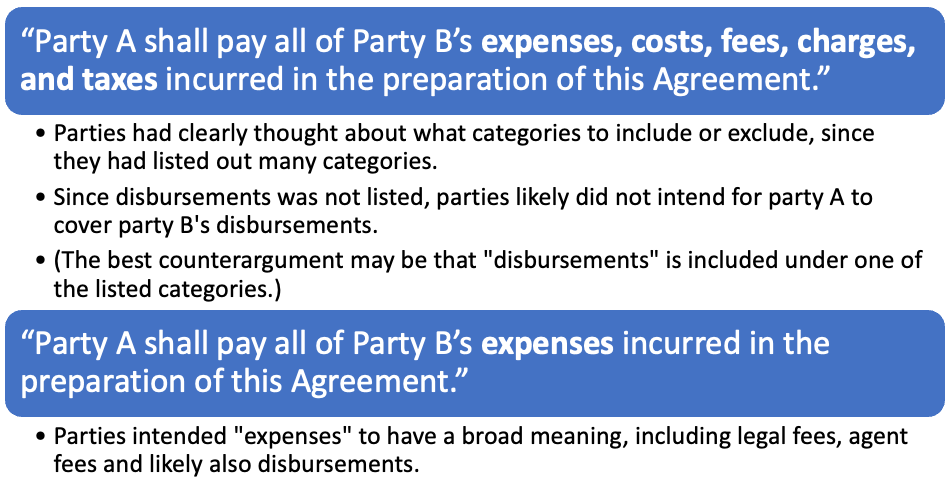
A quick look through common precedents (such as the LawNet precedents, VIMA precedents and Practical Law) shows that they all take this approach of keeping the listed expense categories short.
“[E]ach Party shall pay its own costs incurred…” (LawNet subscription agreement, Practical Law standard costs clause)
“[T]he Parties to this Agreement shall bear their own costs and disbursements…” (VIMA 2.0 Shareholders Agreement, substantially similar clause in VIMA 2.0 Subscription Agreement)
Hence consider simplifying the list of expenses in your expenses clause.
Consider what costs in relation to the agreement should be covered
Expenses clauses often describe the types of expenses covered by linking them to the agreement. For example, a clause might cover expenses in connection with “negotiating”, “preparing” and “performing” the agreement.
Consider what types of costs to include. For example, the cost of “performing” an agreement continues after the agreement has been signed. If a party must hire new staff or buy new goods to carry out the signed agreement, these are strictly speaking considered costs of “performing” the agreement. However, these are usually not the kinds of expenses parties intend to cover with the expenses clause; parties usually care more about legal or administrative expenses incurred while negotiating and preparing the agreement.
Hence I suggest including only the costs of “negotiating” or “preparing” the agreement. The table below analyses other common words and whether to include them.
| Cost in relation to agreement | Remarks |
|---|---|
| Completing (in LawNet subscription agreement) | Suggest avoiding.
It is unclear if “completing” means preparing the agreement until signing stage, or performing the agreement after signing. Clarify which you mean, and see the “preparing” or “performing” section accordingly. |
| Enforcing | Suggest avoiding if parties intend to bear their own enforcement costs.
The cost of enforcing an agreement, e.g. via litigation, can be substantial.2Practical Law’s costs clause supports this interpretation of costs of “enforcing” the agreement. Usually each party bears its own enforcement costs. If one party must bear the other’s costs of enforcement, this will likely need to be specifically negotiated first. |
| Executing (in VIMA subscription agreement) | Suggest avoiding. “Executing” the agreement is ambiguous – it could mean “signing” or “performing”.
If the former, consider replacing with “signing”; if the latter, see the problems under “performing”. While Practical Law’s standard expenses clause uses “executing”, I suggest avoiding it due to the above ambiguity. |
| Implementing (in VIMA subscription agreement) | Suggest avoiding – see problems with “performing”. |
| Negotiating, preparing (in LawNet and VIMA subscription agreements) | Include.
These are the expenses parties likely intend the expenses clause to cover, i.e costs of discussing and drafting the agreement. Practical Law’s standard expenses clause3 Practical Law’s costs clause uses these words. |
| Performing (in VIMA subscription agreement) | Suggest avoiding.
In most cases, parties would bear their own costs of carrying out the agreement – e.g. cost of hiring personnel, of transporting goods, etc. Since this is the default arrangement, you need not restate it.4Practical Law costs clause Even where one party pays the other’s expenses of preparing the agreement, parties likely still want each party to bear its own costs of performance. |
| Signing | Include if you want.
“Signing” is clearer than “executing”, however it is unclear what costs parties would incur from merely signing the agreement. Such costs should already be covered under the costs of “negotiating and preparing” the agreement. |
Check for consistency with other agreements’ expenses clauses
Sometimes the expenses clause may cover more than just the expenses relating to the current agreement. For example, VIMA’s subscription agreement’s clause covers the expenses relating to:
“this Agreement, each document referred to in it and other agreements forming part of the transaction”. (emphasis added)
In such cases, inconsistencies may arise if one document states each party will bear its own costs while another provides for one party to bear the other’s.
Where the expenses clause covers other agreements, you should consider either:
- checking that the other documents referred have consistent expenses clauses, or
- stating which agreement will prevail if the documents conflict.
Force Majeure
Consider adding obligations to notify the other party and to mitigate the event
As a safeguard against abuse of a force majeure clause, you could provide that a party relying on this clause must:
- notify the other party of the force majeure event, and
- mitigate the event’s effects.
You could consider adopting the relevant parts of Practical Law’s standard force majeure clause,5Practical Law, “Force majeure” standard clause (accessed 26 Dec 2023). as set out below. This states that in order to be excused from liability due to force majeure, the affected party must have complied with the notification and mitigation clauses.
“Provided it has complied with [clauses on notification and mitigation], if a party is prevented, hindered or delayed in or from performing any of its obligations under this agreement by a Force Majeure Event (Affected Party), the Affected Party shall not be … liable for any such failure or delay in the performance of such obligations. […]”
It next sets out the affected party’s obligations to notify the other, including what details must be notified, and that party’s obligation to use all reasonable endeavours to mitigate the force majeure event’s effects. (Note that “all reasonable endeavours” means the same as “best efforts” in Singapore law – see discussion under “further assurances”.)
“The Affected Party shall:
(a) as soon as reasonably practicable after the start of the Force Majeure Event[ but no later than [NUMBER] days from its start], notify the other party [in writing] of:
- the Force Majeure Event,
- the date on which it started,
- its likely or potential duration, and
- the effect of the Force Majeure Event on its ability to perform any of its obligations under the agreement; and
(b) use all reasonable endeavours to mitigate the effect of the Force Majeure Event on the performance of its obligations.” (emphases added)
These notification and mitigation obligations may be more suitable where both parties are equally likely to rely on force majeure. If your client is more likely to rely on it than the counterparty (e.g. you act for a service provider), consider whether to include these obligations. Regardless, it may still be good practice for your client to promptly notify its counterparty of any force majeure event and to mitigate their losses, since this would lower the risk of a dispute.
Further Assurances
Draft the agreement to cover any known post-contract concerns rather than rely on this clause
A further assurances clause seeks to ensure that even after signing, the parties take any additional action necessary to give effect to the contract, including procuring such action from third parties.6Practical Law, “Further assurances” standard clause. It is meant as a safeguard in case one party wants the other to do something which was not expressly stated in the contract.
However, this clause should not substitute for careful drafting. If a party already has in mind specific actions it wishes the other to take after the contract’s signing, it is better to expressly draft these into the contract.7Practical Law, “Further assurances” standard clause and LawNet boilerplate clause bank “Further assurances” clause (accessed 2 Sep 2024).
Check what threshold is required before one party must take further action
The clause may require a party to take any actions the other party requests, or only actions (reasonably) necessary to give full effect to the agreement. Practical Law’s standard clause8Practical Law, “Further assurances” standard clause. and the LawNet subscription agreement use the latter threshold. This is likely advisable, as the former threshold –acceding to any actions the other party requests – may be too broad.
| Threshold | Remarks |
|---|---|
| Any action the other party requests | Not advisable, may be too broad |
| Actions (reasonably) necessary to give full effect to the agreement | More advisable, limits the type of actions parties may request. Used in Practical Law and LawNet precedents |
Consider whether the party’s obligation to act is absolute or best efforts
A further assurances clause could frame the party’s obligation to act as an absolute one, or state only that a party must use its best efforts to cause something to happen. Consider using different standards based on whether the party itself must act or whether it must cause a third party to act, as shown below.
| Who is required to act? | Standard of contracting party’s obligation | Remarks |
|---|---|---|
| Contracting party itself | Absolute obligation to act | Absolute obligation since the party can control its own actions. |
| Third party | Use best efforts to cause the third party to act | Best efforts since the third party’s actions may not be within the party’s control. |
The Practical Law standard clause exemplifies the above approach, as shown below. A party has an absolute obligation (“shall”) regarding its own actions, but need only use “all reasonable endeavours” to procure a third party’s actions.
“Each party shall, and shall use all reasonable endeavours to procure that any necessary third party shall, [promptly] execute and deliver such documents and perform such acts as may [reasonably] be required for the purpose of giving full effect to this agreement.” (emphasis added, Practical Law standard clause)
Regarding “best efforts”, note that in Singapore law, case law suggests that “best efforts/endeavours” means the same thing as “all reasonable efforts/endeavours”,9Benjamin Wong YongQuan, “Endeavours clauses in Singapore contract law” (2019) 31 SAcLJ 1068 at (16). although both set a higher standard than “reasonable efforts”.10Wong, “Endeavours clauses in Singapore contract law” at (42)-(44).
 Consider drafting who bears the cost of further requested actions
Usually the party who asks the other to take further actions also bears the cost of such further actions.11Practical Law, “Further assurances” standard clause. Consider if this approach is suitable for your transaction, or if each party should bear its own costs for any further actions the other party requests. Precedents take different approaches to this: Practical Law provides for both options in its standard “further assurances” clause, whereas the LawNet subscription agreement provides for each party to bear its own costs.
Notices
Future-proof the parties’ contact details for receiving notices
Notice clauses usually state in the clause or in a schedule whom notices should be sent to. Rather than sending notices to named people at their specific email address, you could consider:
- identifying people by their position (e.g. “Director of Legal”), and
- giving an email address which is not tied to a specific person (e.g. [email protected]).
This protects the company from missing notices due to turnover.

You could also consider providing a procedure for parties to change their contact details, and that notices sent to a party’s old address – before it notified the others of a change – will still be valid. This encourages parties to promptly update their contact details and prevents parties from evading notices by claiming they have changed their contact details.
Ensure safeguards for sending notices via email
When should you deem a notice sent by email to be received? Deeming it received when sent could disadvantage the recipient, as they may not have received it due to technical issues or a full inbox.12Common reasons for email delivery failure https://support.microsoft.com/en-us/office/sent-email-in-outlook-com-comes-back-delivery-failed-45e048ac-f7b1-4c0f-b525-081cb34f1062. Conversely, requiring the recipient to acknowledge it could disadvantage the sender, as the recipient might intentionally ignore the email.
A fairer way to draft the notices clause might be to combine both approaches. Contract drafting expert Ken Adams recommends this approach, where an email is deemed to be received when sent so long as:
“(a) the recipient acknowledges its receipt, or
(b) the sender sends the notice by post with end-to-end tracking and all fees prepaid within [●] days of sending the email.”13This “notice by email” clause is based on the recommended approach in https://www.adamsdrafting.com/giving-notice-by-email-only/, which also extensively discusses what to consider when drafting such clauses.
The first limb ensures emails are deemed received if the recipient acknowledges them. Any reply by the recipient would count as acknowledgment. If the recipient does not acknowledge, the second condition allows the sender to send a postal notice, ensuring the original email is deemed received when sent. So the second limb prevents the recipient from ignoring the email.
The second limb deliberately favours the sender in that the recipient is deemed to have received the postal notice at the time the original email was sent, not the time the postal notice was sent or received. For example:
- if the sender sent an email on Monday (which the recipient did not acknowledge),
- then sent a follow-up postal notice on Wednesday,
- the email would still be deemed received on Monday rather than Wednesday.
This drafting encourages recipients to acknowledge emails promptly.
Hence consider using the above approach to balance the sender’s and the recipient’s interests. Other notices clauses may use different approaches to deem when emails are received (as shown below), however I suggest these do not balance both sides’ interests as well as the above approach.
| Approach to deeming when an email is received | Reason for not recommending |
|---|---|
| “at the time of transmission” (LawNet subscription agreement) |
|
| “when sent, so long as there is no notification of failed delivery” |
|
| “when the sender receives an automated message confirming delivery” (VIMA 2.0 subscription agreement) |
|
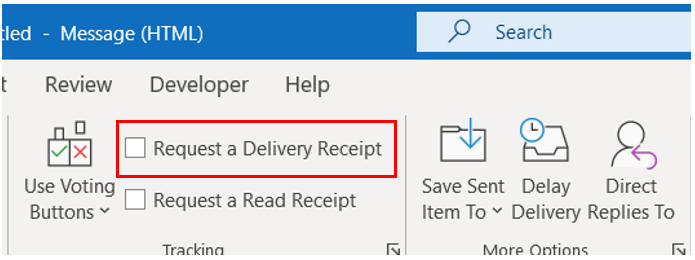
Avoid relying on the delivery receipt feature
Replace the phrase “registered” or “tracked” post with a description of the type of post
Notice clauses may refer to “registered” or “tracked” post. However “registered post” has no fixed definition; different countries or courier services may use different terms for “registered post”. Here are some examples:
- registered post (for local mail) or registered airmail (for international mail)15VIMA documents.
- certified mail
- express mail
- first class post16British Venture Capital Association subscription & shareholders’ agreement < https://www.bvca.co.uk/Policy/Industry-Guidance-Standardised-Documents/Model-documents-for-early-stage-investments> (accessed 10 Oct 2024).
To avoid a dispute about whether one country’s “registered post” is equivalent to another country’s “tracked post”, it may be safer to instead specify what features that mail must have. What the parties likely care about is that the sender can verify that the post has been delivered, and that the recipient does not bear any costs upon receiving the mail. Hence you could use:
“mail with end-to-end tracking and all fees prepaid”.
(This clause based on contract drafting expert Ken Adams’ recommendation,17Supra n 14. and also set out in the tip on email notices above.)
Ensure the listed service methods are mandatory, not permissive
Where parties list out methods for delivering notices (such as in person, by post or by email), they likely intend that these service methods are mandatory. That is, a notice not delivered by one of these methods should be considered invalid.
Note the difference between the following examples:
- “Notices may be delivered personally, by post or by email…”
- “Notices must be delivered personally, by post or by email…”
Which word you choose matters. In a case where the clause stated notices “may be served by delivering personally”, the court found that a different form of delivery (leaving the notice outside the recipient’s house) was valid, because personal service was not mandatory.18Ener-G Holdings v Hormell (2012) EWCA Civ 1059. Case and Ken Adams’ analysis available at https://www.adamsdrafting.com/an-english-case-involving-the-expectation-of-relevance/.
To avoid this, check that your clause says that notices “must” be delivered via the specified methods.
Draft the clause to apply to notices only
A notices clause could be drafted to apply to notices only, or to all communications in connection with the agreement:
| Applies to notices only | “All notices in connection with this agreement must be sent by [post, email etc]…” |
| Includes all communications in connection with agreement | “All notices or other communications in connection with this agreement must be sent by [post, email etc]…” |
It may be better to restrict the scope to notices only rather than all communications. Parties may use Whatsapp and other informal communication methods to discuss the agreement, but a notices clause covering “all communications in connection with this agreement” could be broad enough to prohibit that. Practical Law takes this approach, as applying the notices clause to “all communications” could hamper communication if the notice clause is strictly interpreted.19Practical Law, “Notice clauses” practice note at “Should the notices clause cover communications other than formal notices?”.
Deem notices received outside office hours as received when business next opens
Consider stating in the notice clause that a notice received:
- on a non-business day will be deemed received on the next business day, and
- outside office hours will be deemed received at the next opening of office hours.
If parties are based in different countries, you should state that these receipt times refer to the recipient’s location.
Check how you define “business day” for a cross-border contract
Contracts for cross-border transactions commonly define “business days” by referencing multiple countries. Practical Law suggests this approach in its sample notices clause:20Practical Law, “Notices” standard clause, “Define business day” 31 Jul 2024
“Business day” means a day on which banks are open in New York and Singapore.
However, the more countries included, the harder it is to find a common “business day” in all countries involved. To give an extreme example, if “business day” refers to ten countries, a period which constitutes “30 business days after receiving the notice” would be prolonged by public holidays in any of these countries.
Practical Law, the LawNet precedents and the LawNet boilerplate clause bank do not address this issue. However, one solution might be to limit the number of countries referred to when defining “business day”. Another is to compute business days based solely on the recipient’s location for the purpose of computing a period of time after the notice’s receipt.
Consider defining “office hours”
Consider defining “office hours” to minimise dispute. In one case, parties did not define “office hours” and thereafter disputed the validity of a notice received at 6.02pm.21Lehman Brothers International (Europe) v Exxonmobil (2016) EWHC 2699 (147)-(156) at https://www.judiciary.uk/wp-content/uploads/2016/11/lbie-v-exxonmobil-20161028.pdf. The court ruled that the lack of a contractual definition implied that they took a flexible approach to receiving notices where the precise receipt time did not matter. So the court upheld the notice as being received within office hours.
I am grateful to Deborah Joy Ong, James Wong Weiming, Lu Ouyuan, Lye Yuan Jun, and R Saravanan for their help reviewing this series of articles, and to adjunct associate professor Rachel Tan from NUS in whose class on mergers & acquisitions I first came across some of the materials cited. All errors remain my own.
Endnotes
| ↑1 | See also Practical Law’s standard costs clause drafting notes, which gives similar advice that listing too many categories could trigger this rule of interpretation to adverse effect. |
|---|---|
| ↑2 | Practical Law’s costs clause supports this interpretation of costs of “enforcing” the agreement. |
| ↑3 | Practical Law’s costs clause |
| ↑4 | Practical Law costs clause |
| ↑5 | Practical Law, “Force majeure” standard clause (accessed 26 Dec 2023). |
| ↑6 | Practical Law, “Further assurances” standard clause. |
| ↑7 | Practical Law, “Further assurances” standard clause and LawNet boilerplate clause bank “Further assurances” clause (accessed 2 Sep 2024). |
| ↑8 | Practical Law, “Further assurances” standard clause. |
| ↑9 | Benjamin Wong YongQuan, “Endeavours clauses in Singapore contract law” (2019) 31 SAcLJ 1068 at (16). |
| ↑10 | Wong, “Endeavours clauses in Singapore contract law” at (42)-(44). |
| ↑11 | Practical Law, “Further assurances” standard clause. |
| ↑12 | Common reasons for email delivery failure https://support.microsoft.com/en-us/office/sent-email-in-outlook-com-comes-back-delivery-failed-45e048ac-f7b1-4c0f-b525-081cb34f1062. |
| ↑13 | This “notice by email” clause is based on the recommended approach in https://www.adamsdrafting.com/giving-notice-by-email-only/, which also extensively discusses what to consider when drafting such clauses. |
| ↑14 | Ken Adams, “Giving notice by email only” <https://www.legalsifter.com/post/the-obligation-not-to-disclose-versus-the-obligation-to-keep-confidential> (accessed 10 Oct 2024). |
| ↑15 | VIMA documents. |
| ↑16 | British Venture Capital Association subscription & shareholders’ agreement < https://www.bvca.co.uk/Policy/Industry-Guidance-Standardised-Documents/Model-documents-for-early-stage-investments> (accessed 10 Oct 2024). |
| ↑17 | Supra n 14. |
| ↑18 | Ener-G Holdings v Hormell (2012) EWCA Civ 1059. Case and Ken Adams’ analysis available at https://www.adamsdrafting.com/an-english-case-involving-the-expectation-of-relevance/. |
| ↑19 | Practical Law, “Notice clauses” practice note at “Should the notices clause cover communications other than formal notices?”. |
| ↑20 | Practical Law, “Notices” standard clause, “Define business day” 31 Jul 2024 |
| ↑21 | Lehman Brothers International (Europe) v Exxonmobil (2016) EWHC 2699 (147)-(156) at https://www.judiciary.uk/wp-content/uploads/2016/11/lbie-v-exxonmobil-20161028.pdf. |