


Don’t Skip the Boilerplate: A Guide to Review (Part 1 – Confidentiality)
When pressed for time in reviewing agreements, lawyers tend to skim the boilerplate clauses. Lawyers may believe that they pose little risk, particularly if those clauses were taken from a previous precedent or from a reputable source. Or we may perhaps do only a “red-flag” review of the boilerplate clauses: has my client been asked to give any indemnity? Does the force majeure clause include the word “pandemic”?
Hence this article aims to guide lawyers on how to review boilerplate clauses in depth. In particular, it aims to help you better understand the purpose of boilerplate clauses, the risks they address, and what to look for when reviewing them, so that you can then explain to your client or counterparty why you have drafted the contract a certain way.
This article is based on my 4.5 years of experience drafting automated contract templates at RHTLaw, where I had the opportunity to research and analyse contract language to a depth that would be impractical for most practitioners. Hence this article focuses on lesser-known risks in boilerplate clauses which are similar in almost every transaction, rather than on better-known risks in clauses which often need to be negotiated (such as how to define “confidential information”). Where relevant, I have illustrated the article’s tips using examples from common precedents such as the LawNet commercial precedents (specifically the subscription agreement, shareholders’ agreement and mutual NDA1While I reviewed these three LawNet precedents only, the LawNet precedent agreements generally use substantially similar boilerplate clauses. Note that LawNet has also published an “SAL Clause Bank” of boilerplate clauses in early 2024, however I refer to them minimally as I had written most of this article before they were published.), the VIMA 2.0 agreements and Practical Law’s standard boilerplate clauses.

This article is the first of a four-part series. This first article focuses on everyone’s favourite clause, the confidentiality clause. The next three will address other boilerplate clauses: part two clauses from A to En, part three from Ex to N, and part four O to Z.
Contents
- Defining confidential information
- Setting out obligations as to confidential information
- Exceptions to confidentiality
- Bonus: Check for ambiguous sentence structures
Defining Confidential Information
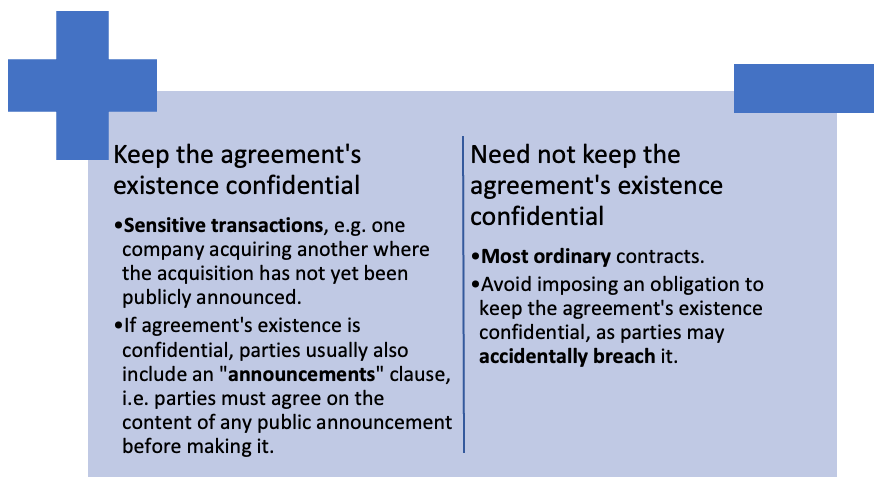
Avoid stating by default that the agreement’s existence is confidential
Some confidentiality clauses define “confidential information” to include the agreement’s existence:
“[Confidential Information means] [t]he existence and subject matter of this agreement…”2VIMA 2.0 subscription agreement. (emphasis added)
Consider if you need to keep the agreement’s existence confidential. This may be more appropriate only for sensitive transactions as elaborated below. Including this for routine transactions increases the risk that parties accidentally breach this obligation.
Avoid requiring parties to mark information “confidential”
Exercise caution before requiring parties to comply with formalities before they can designate information as confidential. For example, that parties must mark the information “confidential” or that they must record oral information in writing. Imposing such formalities is risky, since a party who forgets to comply may be unable to claim its information is confidential.

Setting Out Obligations as to Confidential Information
Restrict the use of confidential information, not just its disclosure
Many confidentiality clauses restrict only the recipient’s disclosure of confidential information but not how the recipient uses it. This may be risky because even without disclosing the information, a recipient could misuse the confidential information to (for example) develop a competing product.
Thus, always ensure your confidentiality clause includes a line similar to this:
“The recipient shall use the Confidential Information only for the purpose of this project.”
Add a time limit for your confidentiality obligations
Many confidentiality clauses lack time limits, so the information exchanged remains confidential forever. While it is theoretically possible to draft such clauses, in practice it may be better to draft clauses with realistic time limits as the Court is more likely to uphold them.
Practical Law cautions that the Court will consider whether a confidentiality clause’s duration is reasonable before deciding whether to uphold it. Specifically, the Court examines whether the information still retains its confidential nature: commercial information goes out of date quickly (especially if it relates to a fast-moving industry), whereas technical information could stay valuable for much longer.3Practical Law, “Confidentiality” standard clause at “Long form clause – duration of the confidentiality obligation” (accessed 8 Aug 2024). However Practical Law does not cite any cases where the court struck down a confidentiality obligation for having too long a duration.
Moreover, the Court could potentially also rule that a confidentiality clause constitutes a restraint of trade (more likely in an employment context), in which case the clause will be struck down if its duration is unreasonable.4Ibid. Hence Practical Law recommends setting a realistic time frame for the confidentiality clause. They propose:
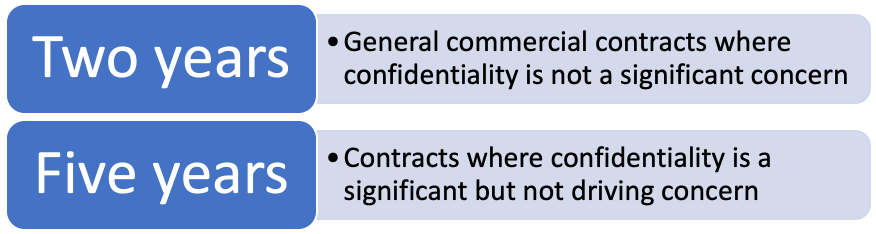
However, Practical Law cautions that you should adjust these durations based on the type of agreement and nature of the confidential information (e.g. commercial or technical information).5See endnote 2.
Also remember to state a specific duration for the clause, since vague formulations like “for as long as the information remains confidential” could cause a dispute.
Lastly, also consider if the confidentiality clause should survive the agreement’s termination. If so, amend the termination clause accordingly:
- In most agreements, the confidentiality clause is framed as surviving “X years from the termination of this agreement”.
- However, some agreements could survive for a long time, such as shareholders’ agreements. For a shareholders’ agreement, consider instead drafting the confidentiality clause to survive for X years with respect to a particular shareholder, starting from the time that shareholder ceases to hold shares.
In summary, avoid drafting confidentiality clauses with no time limit. Instead, set a reasonable duration based on the nature of the confidential information.
Avoid redundant words, e.g. “shall not disclose and shall keep confidential”
Contracts commonly contain extra words that mean the same thing, such as “indemnify and hold harmless” or “acknowledge and agree”. However, this contradicts a principle of good drafting: avoid redundant words. This is because redundant words may cause a court to interpret the contract in a way the parties did not intend, as the Court presumes that every word in a contract has a meaning.6Zurich Insurance (Singapore) Pte Ltd v B-Gold Interior Design & Construction Pte Ltd (2008) 3 SLR(R) 1029 at (65).
In the context of confidentiality clauses, I suggest that “shall not disclose” and “shall keep confidential” also mean the same thing, hence it may be better to avoid using both phrases in the same agreement. The risk is that the Court reads a new meaning into one phrase so as to avoid finding that it is redundant. That is, even if parties intended “shall not disclose” and “shall keep confidential” to mean the same thing, the Court may give a new meaning to “shall keep confidential” so as to avoid holding that it simply repeats “shall not disclose”.
The risk of the Court reading unintended meanings into either phrase may be higher because there has not yet been case law explaining how “shall not disclose” differs from “shall keep confidential”. Given that lawyers also seem to hold divergent views on what “shall keep confidential” means (based on an informal Twitter poll by contract drafting expert Ken Adams on the similar phrase “maintain in confidence”), I suggest using only “shall not disclose” since it is clearer.
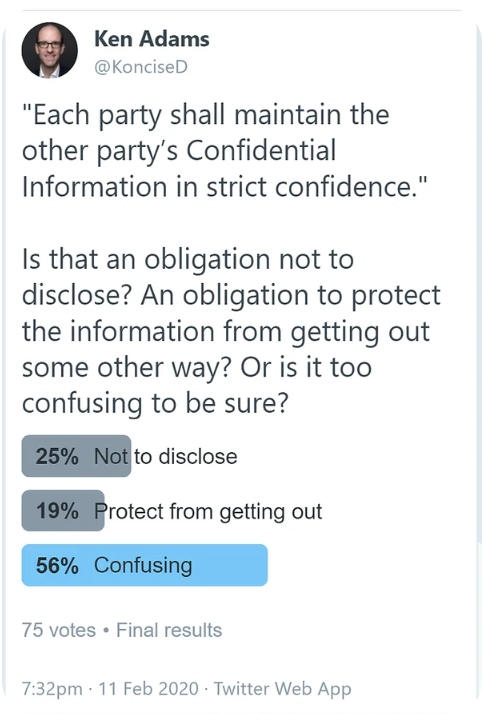
Lawyers have different views on what “maintain in confidence” means
An alternative view is that “shall keep confidential” has a different meaning from “shall not disclose”, and so can be retained in the clause since it is not redundant. 19% of lawyers in the above Twitter poll thought so – that “shall keep confidential” imposed an obligation to protect the information (perhaps from being hacked).

A possible interpretation of “keep confidential” which gives it a different meaning from “do not disclose”
However, if this is parties’ intended meaning, it may be better to expressly state what steps the recipient must take to protect the information rather than only using the phrase “shall keep confidential”. You could for example add a clause like this (sample clause from contract drafting expert Ken Adams):7Ken Adams, “The obligation not to disclose versus the obligation to keep confidential” <https://www.legalsifter.com/post/the-obligation-not-to-disclose-versus-the-obligation-to-keep-confidential> (accessed 10 Sep 2024).
“The Recipient shall take precautions to prevent disclosure or use of Confidential Information other than as authorized in this agreement. Those precautions must be at least as effective as those taken by the Recipient to protect its own Confidential Information or those that would be taken by a reasonable person in the position of the Recipient, whichever are more effective.” (emphases added)
In summary, consider avoiding using both “shall keep confidential” and “shall not disclose” in your agreement as they likely mean the same thing. Consider using only “shall not disclose”, which is clearer.
Avoid redundant words, e.g. must not “copy or reproduce”
Following from the above point, check for and remove other potentially redundant words in the confidentiality obligation. For example, “not copy or reproduce” in the clause below is potentially redundant:
“[The recipient must] hold Confidential Information in confidence; not copy or reproduce it; [and] not disclose it to any person”8LawNet mutual NDA.
“Not copy or reproduce” likely cannot be interpreted literally, since it would prohibit even photocopying a document. It more likely means that the recipient cannot give copies to an unauthorised third party. Thus it means the same thing as “do not disclose”, and can be removed as redundant. Thus we could shorten the clause to:
“[The recipient must] not disclose Confidential Information to any person.”
As discussed above, we remove redundant words to avoid the risk that the Court may read new meanings into them to justify their inclusion. So check if your confidentiality clause has any other potentially redundant words and remove them.
Exceptions to Confidentiality
Watch out for vague permitted disclosures
Sometimes you may come across a permitted disclosure which is worded generally, like this:
“[The recipient may disclose the confidential information if] the Confidential Information is required to be disclosed so that the Receiving Party can fulfil its obligations under this Agreement.”9LawNet subscription agreement (accessed 10 Sep 2024).
While likely intended as a catch-all, such a clause could be overly broad. The recipient could arguably disclose information to anyone, so long as in its opinion it needs to do so to fulfil its obligations.
You could instead consider:
- specifying categories of people (e.g. professional advisers) to whom the recipient can disclose confidential information without the discloser’s prior written consent, and
- adding a catch-all that disclosing to any other person will require the disclosing party’s prior written consent. (Also consider specifying a timeframe within which the discloser must respond to a request for its consent.)
Check for defined terms that could widen the scope of allowed recipients
Every contract uses defined terms. Unfortunately, defined terms can also unintentionally widen the scope of who is allowed to receive confidential information. Consider this example:
“Any Party may disclose confidential information to its related companies or Affiliates.” (emphasis added)
“Affiliates” might be defined broadly because it is also used elsewhere in the agreement. If so, that would also inadvertently widen the scope of who can receive confidential information.
If your confidentiality clause includes any defined terms when it states who can receive confidential information, check who is included under those definitions. If those defined terms are too broad, consider using a separate defined term for the confidentiality clause – perhaps “Confidential Information Recipients”.
Ensure that someone is liable for third-party information recipients
Confidentiality clauses usually allow the recipient to disclose information to specified third parties, such as its professional advisers or related companies. Check how your confidentiality clause protects information which a recipient discloses to such third parties.

Check that your clause adequately protects information which the recipient discloses to third parties
Consider stating, at the minimum, that the recipient will be liable to the discloser if a third party it disclosed information to breaches confidentiality, as though the recipient had itself breached confidentiality. The table below discusses this and other common safeguards.
| Safeguard | Remarks |
|---|---|
| Recipient will be liable to discloser for third party’s breaches10Ken Adams, “An alternative to indemnification language” <https://www.adamsdrafting.com/an-alternative-to-indemnification-language/> (accessed 10 Sep 2024). | A must-have – makes explicit who is liable for third party’s breaches. |
| Recipient must inform third party that the information is confidential11LawNet mutual NDA. | Good to include, however does not go far enough by itself. The recipient could argue that its only obligation was to inform the third party that the information is confidential.
Consider also adding the above clause that the recipient is liable for the third party’s breaches. |
| Third party must acknowledge that it is subject to a duty of confidentiality12LawNet mutual NDA, similar clause in VIMA 2.0 subscription agreement and shareholders’ agreement. | Unclear whom the third party owes this duty to – the discloser or recipient? Wording may not be satisfactory either way:
Consider instead imposing a duty on the recipient to ensure the third party’s compliance, which is clearer. (Sample clause suggested below.) |
Here is a potential sample clause that addresses the issues above, partly based on contract drafting expert Ken Adams’ solution to the above issues:13Ken Adams, “An alternative to indemnification language” <https://www.adamsdrafting.com/an-alternative-to-indemnification-language/> (accessed 10 Sep 2024).
“Before disclosing confidential information to a third party under clause X, the recipient shall inform the third party of the terms of this confidentiality clause. The recipient shall ensure their compliance with it, and will be liable for their breach to the same extent as if it had breached the confidentiality clause itself.”
Consider if information is non-confidential or confidential but disclosable in some situations
Some information parties to an NDA share may not in fact be confidential, such as publicly-available information. Other information may be confidential, but can nevertheless be shared to third parties such as the parties’ agents. Check that you correctly categorise information which is not confidential, as compared to confidential information that may be shared under certain circumstances.
What happens if you fail to correctly distinguish the two? This could cause unintended consequences depending on how the rest of your agreement is drafted.
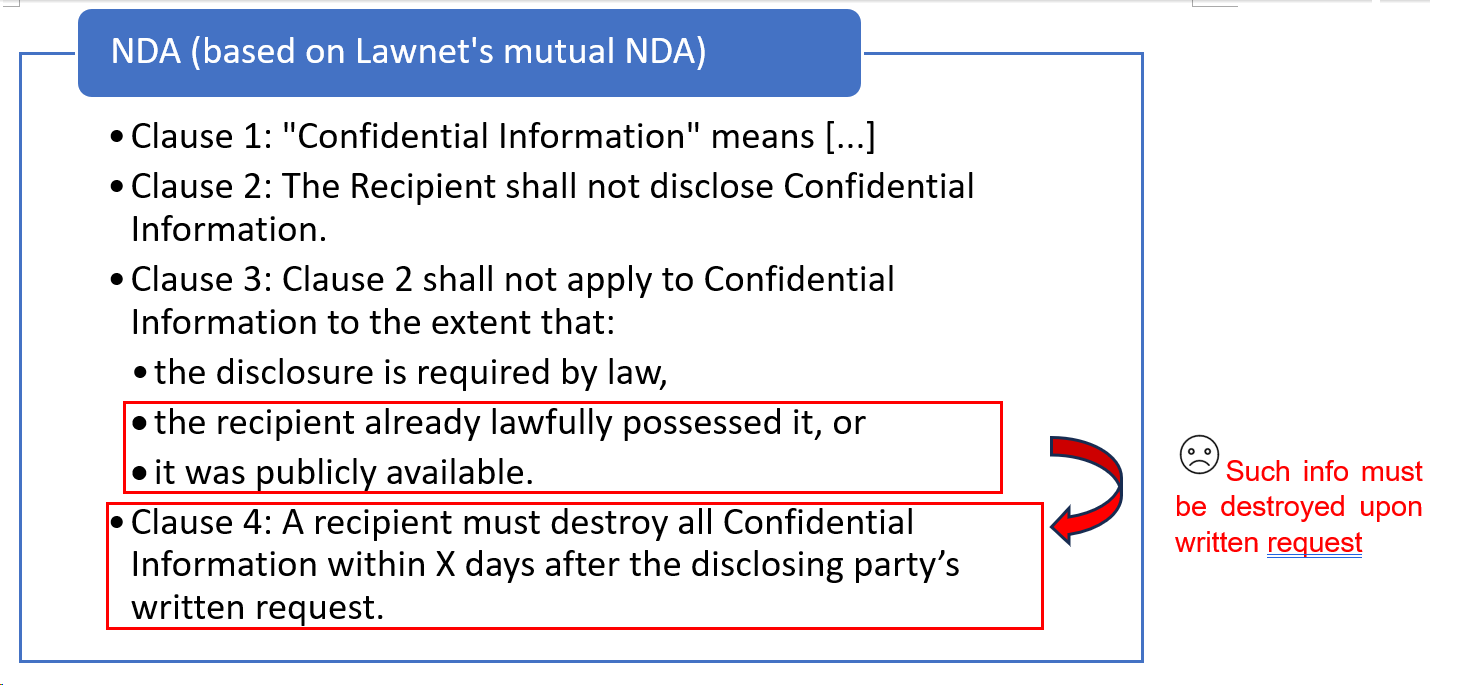
Consider the sample NDA below. Clause 3 incorrectly categorises these two types of information:
- information which the recipient already possessed before signing the NDA, and
- information which is publicly available:
Such information should be regarded as non-confidential, since the recipient could already access it before entering into the NDA. But the sample NDA below instead states that it is confidential information that can be disclosed.

The consequences of this mis-categorisation become clear if you look at the NDA’s clause 4 below. Because publicly-available information is categorised as confidential information, and clause 4 applies to confidential information, a recipient must destroy publicly-available information it has if the discloser so requests in writing. This is likely not what the parties intended.
 One could avoid this problem by correctly categorising “information which the recipient already possessed” and “publicly available information” as exceptions to confidential information. Below shows the NDA re-drafted to move those categories into clause 1 under non-confidential information.
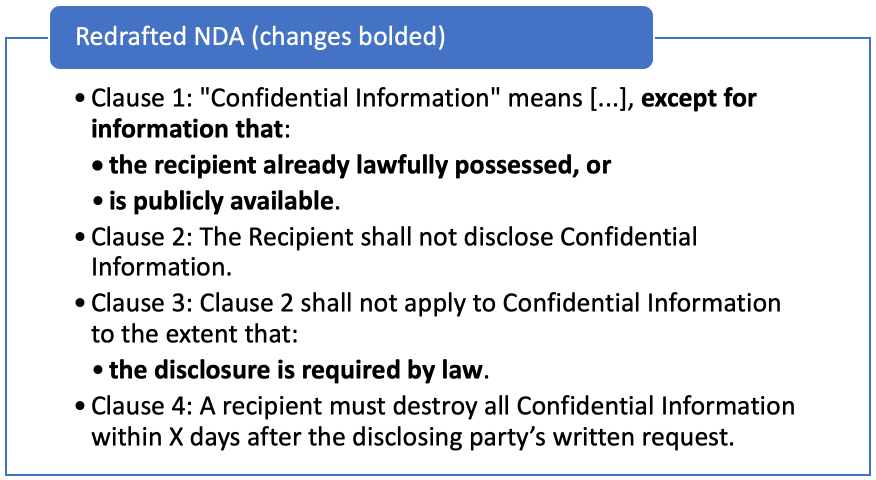
With this re-drafting, lawfully-possessed or publicly available information no longer qualify as confidential information. Now none of the confidentiality obligations in the agreement apply to such information – not the “non-disclosure” obligation in clause 2 nor the “must destroy” obligation in clause 4. Hence the recipient may:
- freely disclose information which it already lawfully possessed or which is publicly available, and
- retain such information after a request to destroy confidential information.
This is more likely to be your desired outcome.
In summary, categorise the exceptions in your NDA as non-confidential information or confidential information that can be disclosed in certain situations, and put them in the appropriate place in the agreement. To categorise the exceptions, consider the rationale behind allowing each disclosure:
- Is the disclosure allowed because the information is generally not secret in nature?
- Or is it because there are good reasons in that situation to allow disclosure?
Here is how I suggest categorising common exceptions:
| Non-confidential information | Permitted disclosure |
|---|---|
|
|
Bonus: Check for Ambiguous Sentence Structures
Although this article focuses on confidentiality clauses, this final tip applies generally to all clauses.
As lawyers, we are so used to reading lengthy contract clauses that we no longer notice that such clauses are often ambiguous. I will focus on one type of ambiguity called “syntactic ambiguity”, meaning ambiguity caused by the syntax or sentence structure. Consider this example:
“Confidential Information may be disclosed to all Parties, their related companies, or their Affiliates.”
The bolded phrase “or their Affiliates” is ambiguous because of its placement in the sentence. Does it apply to “all Parties”, to “their related companies”, or both?

This clause could be interpreted in various ways. As shown below, the clause could allow disclosing information to (i) the parties’ affiliates, (ii) the related companies’ affiliates, or (iii) both groups of affiliates.

Below are possible ways to rephrase the clause to clarify the correct interpretation.
“Confidential Information may be disclosed to:
- all Parties, their related companies, and Affiliates of either of the foregoing.” (includes affiliates of the related companies)
- all Parties, Parties’ Affiliates, and Parties’ related companies.” (excludes affiliates of the related companies)
Thus syntactic ambiguity arises when it is ambiguous which part of a sentence a phrase modifies.14Ken Adams, “Litigating the meaning of contract language? Consider retaining an expert” <https://www.adamsdrafting.com/wp-content/uploads/2021/08/Litigating-the-Meaning-of-Contract-Language-2016.pdf> (accessed 10 Sep 2024). Syntactic ambiguity is more likely to occur in contracts with long run-on sentences – which is, unfortunately, most contracts.
Once you learn to see it, you will start seeing syntactic ambiguity everywhere in your agreements. Here is a short quiz to test yourself – are the following clauses ambiguous or not? (And if you think so, how would you amend it?)
“The company may supply only approved products and services.”
Q1: Is this ambiguous?
- Yes
- No
“The company shall not incur any debt or make any capital expenditure in excess of $500,000.”
Q2: Is this ambiguous?
- Yes
- No
“Upon occurrence of a Change in Law or Force Majeure Event that adversely affects a Party’s performance under this agreement, the affected Party must immediately notify the other.”
Q3: Is this ambiguous?
- Yes
- No
Take some time to answer the quiz before scrolling down to see my thoughts on these clauses.
For Q1, the word “approved” is ambiguous as it could apply to “products” only or both “products” and “services”, as shown below. That is, it is ambiguous whether “services” must also be approved.
Example 1: Must the services a company supplies be approved?

For Q2, because “in excess of $500,000” is placed at the sentence’s end, it is unclear whether this restriction applies to capital expenditure only or also to debt. Can the company incur a debt below $500,000?
Example 2: How much debt can the company incur?

Q3 similarly puts the phrase “that adversely affects a Party’s performance” at a sentence’s end, making it unclear whether the phrase refers to a change in law, a force majeure event, or both. Will a non-adverse change of law trigger the clause?
Example 3: What kind of change of law triggers this clause?
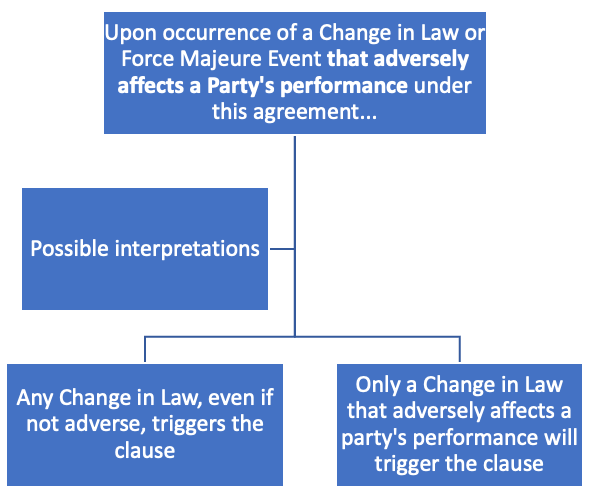
Hence all three examples are ambiguous,15The above examples of syntactic ambiguity are taken from or based on examples in Kenneth A Adams, A Manual of Style for Contract Drafting (American Bar Association, 4th Ed, 2017). “Approved services” example based on his “children’s footwear” example at pg 291, “debt” example based on his pg 292, and “force majeure” example based on his pg 305. and could be redrafted for clarity.
Before moving on, we could address a potential objection: even if a clause is ambiguous, couldn’t a reader derive the intended interpretation from the context? While context may sometimes help, drafting to avoid ambiguity altogether is still preferable, since any ambiguity could give a disgruntled party grounds to raise a dispute.16In fact, contract drafting expert Ken Adams opines that syntactic ambiguity causes more litigation than any other kind of ambiguity. Ken Adams, “Another steaming helping of syntactic ambiguity”, <https://www.adamsdrafting.com/another-steaming-helping-of-syntactic-ambiguity/> (accessed 10 Sep 2024). Disputes often go to court based on contract interpretations that seem unsupported by the context; clear drafting would help avoid such lengthy and costly trials.
Fortunately, syntactic ambiguity is easily fixed. Recognising that a clause is ambiguous takes practice, but redrafting it is usually more straightforward. Below are simple ways to resolve such ambiguity, such as by adding punctuation, numbers or re-arranging the phrases.17A Manual of Style for Contract Drafting (4th ed) at chapter 12 “Syntactic ambiguity”.
How to fix syntactic ambiguity: Simple solutions
 Ambiguous syntax: “The company shall not incur any debt or make any capital expenditure in excess of $500,000.”
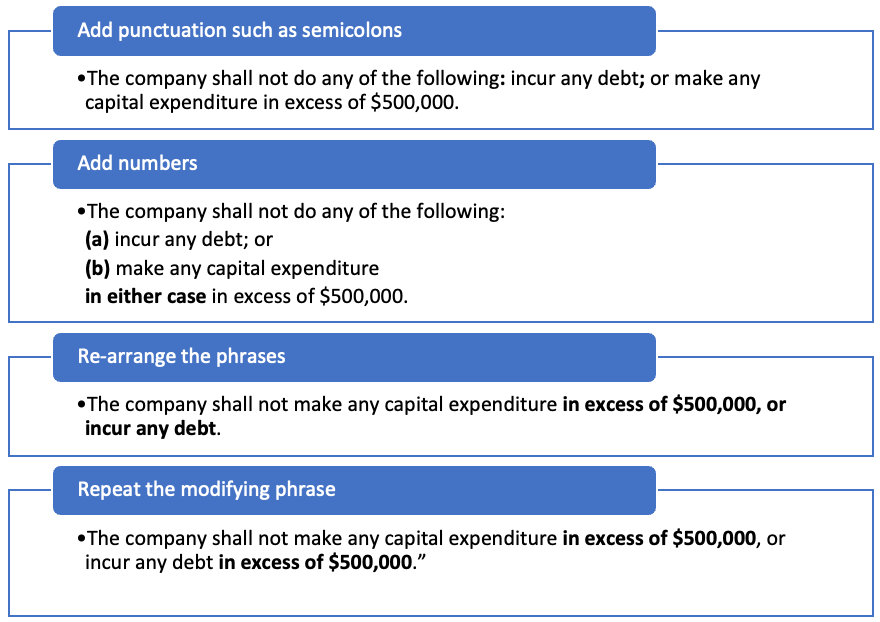
Sometimes, rather than the above solutions, you may need to rephrase the whole clause.18A Manual of Style for Contract Drafting (4th ed) at pg 305. For example, it is unclear whether any change of law triggers the clause below, or only an adverse change of law:
“Upon occurrence of a Change in Law or Force Majeure Event that adversely affects a Party’s performance under this agreement…”
Lawyers usually intend such a clause to cover only a) adverse changes of law and b) adverse force majeure events. If so, consider rephrasing the clause as follows:
“If a Change in Law or Force Majeure Event adversely affects a Party’s performance under this agreement…”
This clarifies that either a change of law or force majeure event must adversely affect a party’s performance, thus removing the ambiguity.
In summary, consider practising your ability to spot and fix syntactic ambiguity in your contracts.
I am grateful to Deborah Joy Ong, James Wong Weiming, Lu Ouyuan, Lye Yuan Jun, and R Saravanan for their help reviewing this series of articles. All errors remain my own.
Endnotes
| ↑1 | While I reviewed these three LawNet precedents only, the LawNet precedent agreements generally use substantially similar boilerplate clauses. Note that LawNet has also published an “SAL Clause Bank” of boilerplate clauses in early 2024, however I refer to them minimally as I had written most of this article before they were published. |
|---|---|
| ↑2 | VIMA 2.0 subscription agreement. |
| ↑3 | Practical Law, “Confidentiality” standard clause at “Long form clause – duration of the confidentiality obligation” (accessed 8 Aug 2024). However Practical Law does not cite any cases where the court struck down a confidentiality obligation for having too long a duration. |
| ↑4 | Ibid. |
| ↑5 | See endnote 2. |
| ↑6 | Zurich Insurance (Singapore) Pte Ltd v B-Gold Interior Design & Construction Pte Ltd (2008) 3 SLR(R) 1029 at (65). |
| ↑7 | Ken Adams, “The obligation not to disclose versus the obligation to keep confidential” <https://www.legalsifter.com/post/the-obligation-not-to-disclose-versus-the-obligation-to-keep-confidential> (accessed 10 Sep 2024). |
| ↑8 | LawNet mutual NDA. |
| ↑9 | LawNet subscription agreement (accessed 10 Sep 2024). |
| ↑10 | Ken Adams, “An alternative to indemnification language” <https://www.adamsdrafting.com/an-alternative-to-indemnification-language/> (accessed 10 Sep 2024). |
| ↑11 | LawNet mutual NDA. |
| ↑12 | LawNet mutual NDA, similar clause in VIMA 2.0 subscription agreement and shareholders’ agreement. |
| ↑13 | Ken Adams, “An alternative to indemnification language” <https://www.adamsdrafting.com/an-alternative-to-indemnification-language/> (accessed 10 Sep 2024). |
| ↑14 | Ken Adams, “Litigating the meaning of contract language? Consider retaining an expert” <https://www.adamsdrafting.com/wp-content/uploads/2021/08/Litigating-the-Meaning-of-Contract-Language-2016.pdf> (accessed 10 Sep 2024). |
| ↑15 | The above examples of syntactic ambiguity are taken from or based on examples in Kenneth A Adams, A Manual of Style for Contract Drafting (American Bar Association, 4th Ed, 2017). “Approved services” example based on his “children’s footwear” example at pg 291, “debt” example based on his pg 292, and “force majeure” example based on his pg 305. |
| ↑16 | In fact, contract drafting expert Ken Adams opines that syntactic ambiguity causes more litigation than any other kind of ambiguity. Ken Adams, “Another steaming helping of syntactic ambiguity”, <https://www.adamsdrafting.com/another-steaming-helping-of-syntactic-ambiguity/> (accessed 10 Sep 2024). |
| ↑17 | A Manual of Style for Contract Drafting (4th ed) at chapter 12 “Syntactic ambiguity”. |
| ↑18 | A Manual of Style for Contract Drafting (4th ed) at pg 305. |