


Don’t Skip the Boilerplate: A Guide to Review (Part 4)
This is the fourth and final part of a four-part series on how to review boilerplate clauses, focusing generally on lesser-known risks. The previous parts one, two and three respectively covered confidentiality clauses, clauses from A to En, and clauses from Ex to N.
Contents
- Severance
- Termination
- Third party rights
- Variation
- How to enforce an oral variation if “variation must be in writing”
- How to enforce “variations must be in writing”
- Consider whether to exclude oral rescission or termination
- Check that both sides have given consideration to vary the agreement
- Consider removing phrases that un-varied clauses remain in effect
- Consider requiring less-than-unanimous consent to vary shareholders’ agreements
- Consider stating that the agreement can be varied without third parties’ consent
- Waiver
Severance
Consider omitting this clause for succinctness
Strictly, a severance clause is unnecessary since severance is a common law right. To recap, the common law on severance is that an invalid provision in a contract will be deleted with the other provisions surviving, if:
- public policy allows it,
- nothing is added or rewritten (i.e. the court will not rewrite the contract to make it reasonable) and
- the contract’s nature is unchanged.1Practical Law, “Boilerplate: Do I really need this clause and why?” practice note at “Severance” (accessed 26 Jul 2024).
Most severance clauses merely restate the common law, and so could be omitted without affecting the parties’ rights.

Consider removing statements that an invalid clause will be “modified”
As discussed earlier, the common law on severance allows an invalid clause to be deleted but not rewritten. Hence a clause which purports to amend an invalid clause goes beyond what common law provides and could potentially be ineffective. For example:
“If … any provision of this Agreement is … invalid… but would be valid, binding and enforceable if some part of the provision were deleted or amended, then the provision shall apply with the minimum modifications necessary to make it valid, binding and enforceable…” (emphasis added, LawNet subscription agreement)
It is unclear whether parties can contractually override the common law on severance.2Practical Law, “Boilerplate: Do I really need this clause and why?” practice note at “Severance” drafting notes (accessed 26 Jul 2024). Practical Law notes that “[a] clause that expressly tried to agree a formula for substituting a valid provision was interpreted as adding nothing to the common law.”3Practical Law, “Boilerplate: Do I really need this clause and why?” practice note at “Severance”, citing Francotyp-Postalia Ltd v Whitehead (2011) EWHC 367 (accessed 26 Jul 2024).
A potential solution might be to amend the severance clause to align it with the common law position on severance:
“If … any provision of this Agreement is … invalid… but would be valid, binding and enforceable if some part of the provision were deleted, then the invalid part of the provision will be deleted.” (emphasis added, suggested amendment to above clause)
Consider adding that parties will negotiate to amend an invalid provision
Another way to “amend” an invalid provision might be to provide that parties will negotiate in good faith to do so. Here is a sample clause based on LawNet’s precedent clause (amended for succinctness):
“If any provision is found to be invalid, the Parties shall negotiate in good faith to replace it with a valid provision that would as far as possible achieve the originally-intended commercial effect.” (emphasis added, based on LawNet’s subscription agreement)
Such clauses are likely enforceable: the Singapore court has previously said that it looks favourably on “good faith negotiation” clauses since these promote consensus.4HSBC Institutional Trust Services (Singapore) Ltd (trustee of Starhill Global Real Estate Investment Trust) v Toshin Development Singapore Pte Ltd (2012) SGCA 48 at [45].
Avoid drafting clauses intended to exploit the severance rule
Avoid intentionally drafting a clause with multiple parts so that the court can decide which part is valid then sever the invalid parts. Such clauses are known as “cascading”, “waterfall” or “step-down” clauses, which the court frowns upon. For example:
“The employee must not compete with the company for 3 years, except that if this is found to be invalid the restricted period will be 2 years, except that if this is found to be invalid the restricted period will be 1 year.” (emphasis added, based on a real clause that was found unenforceable)5For a discussion of a similar cascading clause, see https://www.adamsdrafting.com/step-down-provisions-no-thanks/.
Drafting such a clause may seem superficially attractive if you act for the employer, since you could potentially impose a three-year non-compete period on your employees, with two years and one year as backups if the longer periods are found invalid. However, the above clause creates uncertainty for the employee as to how long their non-compete period is. Hence the court has noted (in an employment context) such clauses are against public policy,6Lek Gwee Noi v Humming Flowers & Gifts Pte Ltd (2014) SGHC 64 at [197]. so rather than severing the invalid part, the court will likely find the entire clause is invalid.
Note also that cascading clauses in practice are not always as clear-cut as the earlier example. Here is a non-solicit clause which the court held was a cascading clause in Lek Gwee Noi v Humming Flowers & Gifts Pte Ltd:7Lek Gwee Noi at [23].
“[The Employee] shall not … canvass or solicit orders from … any person …
(a) who [was] at any time during … the Employee’s employment … a customer or customers of the relevant Company
(b) & for any cause whatever … any customers or clients who have been customers or clients of the relevant company”. (numbers and emphasis added)
The court held this non-solicit clause was cascading because the second limb – covering all customers regardless of when they had been customers – overlapped with and was wider than the first limb, which covered only customers who had been customers when the employee was employed. The court concluded that the clause had been drafted to “invite blue pencil severance”8Lek Gwee Noi at [197]. and refused to enforce the whole clause.
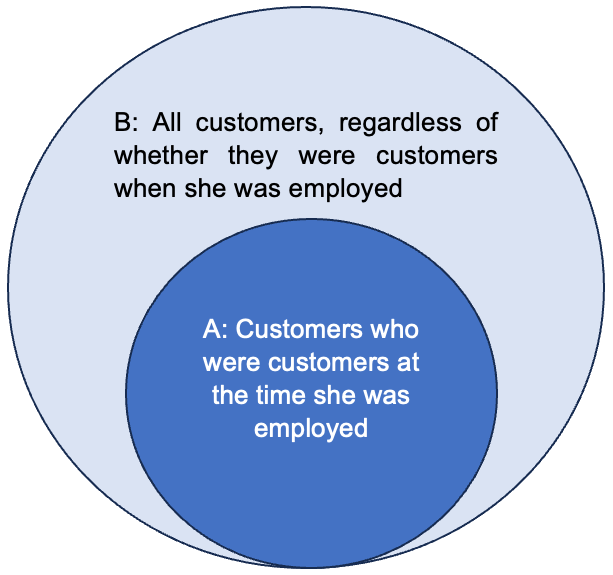
The clause’s overlapping limbs led the court to believe it was drafted to invite severance
Hence check the catch-all clauses in your contract, especially non-compete clauses or clauses in an employment agreement, to ensure that they are not cascading clauses.
Draft clauses that can be severed
Draft clauses so that they can be severed if needed to allow your agreement to survive. For example, if you need to draft the geographical scope of an employee’s non-compete clause, draft it so that the countries are severable:
| Not severable |  “Southeast Asia” “Southeast Asia” |
| Severable |  “Vietnam, Malaysia, Singapore …” “Vietnam, Malaysia, Singapore …” |
To avoid severable clauses being struck down as cascading clauses (as discussed in section 1.4), ensure that each part of a severable clause can be justified. For instance, only list countries where the employer has a business presence9“Business presence” in a jurisdiction was a factor in determining if a geographical restriction was reasonable in Lek Gwee Noi v Humming Flowers & Gifts Pte Ltd (2014) SGHC 64. so that restricting the employee competing there is justifiable.
Termination
Consider which clauses should survive termination
List out which, if any, clauses should survive termination. This is a non-exhaustive list of common surviving clauses:
- Limitation of liability
- Indemnity
- Restrictive covenants (e.g. non-compete)
- Confidentiality
- Governing law and dispute resolution
- Consequences of termination
As well as listing the usual boilerplates, check if your agreement has any contractual remedies which should survive, e.g. an indemnity or a liquidated damages clause.
Avoid allowing termination for “any breach” of the agreement
Beware of allowing a party to terminate for “any breach” of the agreement. This creates the risk that even a trivial or technical breach could result in termination.
Allowing termination for a “material breach” instead may be better. Note that common law does not define “material breach”, so the court would decide whether a breach is material based on the commercial context.10Practical Law, “Termination” standard clause at “Material breach” (accessed 29 Dec 2023).
You could also consider defining “material breach” contractually. A simple way to do so is to define it as a breach of specified clauses of the contract.11Practical Law, “Termination” standard clause at cl 1.2 drafting notes (accessed 29 Dec 2023). (For example, in a share purchase agreement, the buyer may consider breaches of the non-compete or confidentiality clauses to be material, since such breaches affect the value of the company which it has acquired.)
Avoid restricting the right to terminate to an innocent party
Some termination clauses allow only an innocent party to terminate the agreement; the breaching party cannot do so. However, such clauses may cause deadlock if both parties have breached the agreement such that neither can terminate. For example, the clause below could potentially cause such deadlock:12The risk of deadlock may be higher as this clause seems to be the one of the only termination rights in the LawNet subscription agreement (other than termination for unremedied breach in cl 7.5) as of 31 Jul 2024.
“… if … Completion shall not take place due to any failure to satisfy any or all the conditions precedent … the Party/Parties not in default may:
…
(c) terminate this Agreement …” (LawNet subscription agreement)” (emphasis added)
Such a clause becomes even more onerous if the agreement defines “breach” widely. If a party can lose the right to terminate for “any” breach of its obligations, not just material breaches, it becomes more likely that both parties may end up breaching the agreement.
A better approach might be to allow any party to terminate the agreement. However if necessary, specify contractual remedies if the breaching party chooses to do so. For example, you could require the breaching party to pay liquidated damages, or to forfeit a deposit or past payments made under the contract. These contractual remedies are optional as they add on to whatever common law remedies (e.g. damages) the innocent party has for the previous breach.
Third party rights
Consider if third parties should be able to enforce the contract
Avoid unthinkingly including a “third parties cannot enforce this agreement” clause. Could you in fact have a third party who needs to enforce the contract? Some potential scenarios are listed below.
- Indemnity
| Scenario | Party A indemnifies Party B and its affiliates and related companies from all claims relating to the transaction brought by third parties. |
| Potential third party right to preserve | Consider if Party B’s affiliates/related companies should have the right to directly claim Party A’s indemnity, or if Party B must do so on their behalf. |
- Limit on liability
| Scenario | Party A limits its liability to Party B to a certain capped amount.
This cap includes the liability of Party A’s employees and contractors to Party B. |
| Potential third party right to preserve | Consider if Party A’s employees and contractors should be able to enforce this limitation of liability against Party B.13Practical Law, “Contracts: privity and third party rights and obligations” practice note at “Exclusions that benefit a third party”. |
- Confidentiality and non-compete obligations
| Scenario | Party A is acquiring a company (Party B).
Party B’s exiting shareholders agree in the share purchase agreement to keep confidential the terms of the sale and not to compete with Party B after they exit. |
| Potential third party right to preserve | Consider if Party A’s affiliates or related companies should be able to enforce the confidentiality and non-compete obligations in the share purchase agreement against Party B’s exiting shareholders. |
If you have such a third party, and parties want that third party to be able to enforce the agreement, amend the relevant substantive clause accordingly to state that that third party can enforce it. Also amend the third party rights clause to carve out the relevant substantive clause:
“A third party will not have the right to enforce this agreement, except as stated in clause X.” (based on Practical Law’s standard third party rights clause)
However, also note that some contracts cannot be enforced by third parties, according to s 7 of the Contracts (Rights of Third Parties) Act.14Contracts (Rights of Third Parties) Act 2001 (2020 Rev Ed). In particular, a third party cannot enforce an employment contract against the employee.15s 7(3) Contracts (Rights of Third Parties) Act. So if an employee’s employment contract contains confidentiality or non-compete obligations which benefit the employer’s affiliates (e.g. related companies), the employer must itself enforce the contract.
State that the contract can be varied without third parties’ consent
Following from the above, if you want to allow a third party to enforce the contract, consider if you want to be able to rescind or vary the contract without their consent. The default position under s 3(1) of the Contracts (Rights of Third Parties) Act is that if a third party is allowed to enforce the contract, then the parties usually also need that third party’s consent to rescind the contract or to vary that term.16s 3(1) of the Contracts (Rights of Third Parties) Act. Contracting parties need a third party’s consent to rescind or vary the contract if any of these three conditions are fulfilled: the third party has expressly assented to the term allowing him to enforce the contract; the promisor knows the third party has relied on the term that allows him to enforce the contract; or the promisor could reasonably foresee that the third party would rely on the term and the third party has in fact relied on it.
Since needing to get the third party’s consent could inconvenience the parties, they may wish to contractually exclude s 3(1). s 3(3) states that parties can indeed do so. Hence consider including a clause that:
“The Parties may rescind or vary this Agreement without any third party’s consent.”17Practical Law’s standard “third party rights” clause has similar wording.
Variation
How to enforce an oral variation if “variation must be in writing”
Contracts commonly provide that “any variation must be in writing”. However, parties could sometimes vary contracts orally – usually to accommodate an urgent situation or because they forgot that a variation had to be in writing. If you are acting for a party who wants to enforce an oral variation, a “variation must be in writing” clause is not necessarily fatal.
There are two main ways to uphold an oral variation. The first is by proving this variation via “compelling evidence”: the Court of Appeal has noted that it would uphold an oral variation regardless of a “variation must be in writing” clause, if there was compelling evidence to prove such variation.18Charles Lim Teng Siang & Anor v Hong Choon Hua & Anor (2021) 2 SLR 153 at [56]. Note also that the UK takes a much stricter approach to enforcing “variation must be in writing” clauses compared to Singapore – see Rock Advertising Limited v MWB Business Exchange Centres Limited (2018) 4 All ER 21. However, such “compelling evidence” has been found in only one case so far since the Court of Appeal ruled on this point in 2021.19Turms Advisors APAC Pte Ltd v Steppe Gold Ltd (2024) SGHC 174 at [96]-[110].
The second avenue is via promissory estoppel. If a party has relied on the counterparty’s oral variation to their own detriment, the counterparty would be estopped from denying the variation. Promissory estoppel may be a more established way to enforce an oral variation, having been successfully argued before.20See e.g. Charles Lim.
How to enforce “variations must be in writing”
Conversely, you may find yourself advising a client who wants to strictly enforce the “variations must be in writing” clause. There are several benefits to strictly enforcing such a clause, such as ensuring certainty of contractual terms and preventing unauthorised employees from varying the contract.21The Court of Appeal noted these benefits in Charles Lim at (4).
As discussed above, in Singapore, a person could circumvent a “variations must be in writing” clause if they have compelling evidence to prove the oral variation. One way to prevent this is to require that the variation be signed by specific people from each party (e.g. a director-level person or named individuals). However, note that if the pool of authorised signatories is too small, that may slow down the process of varying the agreement.22Suggestion and caution from Practical Law, “Variation” standard clause (accessed 26 Jul 2024). Also, since specifying named individuals may result in difficulties if there is staff turnover, it may be better to specify the roles which can sign the variation (e.g. directors or someone from the legal team).
Another solution is to require the variation to be in a specific form, and attach the form to the agreement.
Consider whether to exclude oral rescission or termination
A “variation must be in writing” clause may not prevent oral rescission. The court has previously held that a clause which prohibited oral “variation, supplement, deletion or replacement of or from this Agreement” did not prevent oral rescission.23Charles Lim.
Hence if you also want to prevent oral termination or rescission, consider drafting the clause to expressly prohibit these.24Rajah & Tann Asia client update, “Be very specific with ‘no oral modification’ clause” <https://eoasis.rajahtann.com/eoasis/lu/pdf/2021-06_Drafting-Cautionary-Be-Very-Specific.pdf> (accessed 10 Oct 2024).
Check that both sides have given consideration to vary the agreement
If acting for a party who wants to vary an agreement, check that both sides have given consideration for the variation, since variation must also be supported by consideration.25Ma Hong Jin v SCP Holdings Pte Ltd (2020) SGCA 106, court’s summary available at https://www.judiciary.gov.sg/docs/default-source/judgments-docs/ma-hongjin-v-scp-holdings-pte-ltd.pdf?sfvrsn=809e2b15_2#:~:text=Following%20a%20dispute%20based%20on,for%20variations%20on%20their%20contract.
The risk that one party has not given consideration may be higher in an investment or loan situation, where one party has already fully disbursed its loan or investment, then later makes additional demands of the party it invested in. If the investor also does not take on any new obligations under the varied agreement, the court may find that the variation is not supported by consideration.
(This was the factual matrix in Ma Hongjin,26Ibid. the landmark case cited above where the Court of Appeal held that variation must be supported by consideration.)
Consider removing phrases that un-varied clauses remain in effect
Some variation clauses expressly state that un-varied clauses remain in effect, or that variation does not affect any party’s liabilities that have already accrued pre-variation.27See e.g. LawNet’s precedent subscription agreement: “(variation) shall not constitute a general waiver of any provisions of this Agreement; … shall not affect any rights, obligations or liabilities under this Agreement that have already accrued up to the date of variation; and the rights and obligations of the Parties under this Agreement shall remain in force, except as, and only to the extent that, they are varied.” Such clauses are not strictly necessary as they restate the common law. Consider removing such clauses for succinctness; for standard cases a variation clause such as the below should be enough.
“No variation will be effective unless it is in writing and signed by both parties.”
Practical Law28Practical Law, “Variation” standard clause. and the LawNet precedents29LawNet subscription agreement. both contain template variation clauses which are substantially similar to the above clause.
Consider requiring less-than-unanimous consent to vary shareholders’ agreements
If your variation clause is part of a shareholders’ agreement, instead of requiring unanimous shareholders’ consent to vary the agreement, consider allowing variation with the consent of a certain percentage of shareholders (or shareholders of each class). Otherwise it may be difficult to vary the agreement.
The VIMA shareholders’ agreement takes this approach. Here is a sample clause based on the VIMA shareholders’ agreement (edited for succinctness):
“No variation of this agreement will be effective unless the following parties give their prior written consent:
- The Company; and
- [●]% of the shareholders [of [class] of shares].
However if a change imposes any new obligations on a Party, varies a Party’s express contractual right under this Agreement, or increases a Party’s existing obligation, that Party’s prior written consent will also be required.” (emphasis added)
Consider stating that the agreement can be varied without third parties’ consent
If your contract can be enforced by third parties, consider stating that third parties’ consent is not needed to vary the agreement. For more on this, see section 3.2 under “third party rights”.
Waiver
Understand the limits of no-waiver clauses
Waiver clauses usually state that a party’s delay or failure to act will not be deemed to be a waiver, and that any waiver must be in writing. However, note that waiver clauses are not foolproof. A party may nevertheless be found to have waived its right, usually because:
- The court finds that the party has affirmed the contract, e.g. because it continued with the contract for an extended period without protest or reserving its rights, or
- The party is estopped from denying that it has waived its right. I.e. the innocent party has represented to the other that it will not insist on its legal right, and the counterparty has detrimentally relied on this promise.30https://www.singaporelawwatch.sg/About-Singapore-Law/Commercial-Law.
Since waiver clauses are not foolproof, Practical Law suggests that the innocent party should always consider sending a letter reserving its rights as soon as it knows of a breach.31Practical Law, “Waiver” standard clause at “effectiveness of no waiver clauses” (accessed 29 Jul 24).
Consider adding that a waived right is waived only for that instance
Most waiver clauses will state that a waiver will be effective only if given in writing. Another safeguard to consider adding is that even if a waiver is found, the party is waiving its right only for that instance and not for future instances.
That is, consider including the second half of this waiver clause from Practical Law.32Practical Law, “Waiver” short form standard clause (accessed 18 Jul 2024). (Practical Law suggests that including it is optional, however I suggest that it will generally be prudent to include it:)
“A waiver of any right or remedy is only effective if given in writing [and will not be deemed a waiver of any subsequent right or remedy].” (emphasis added)33Ibid.
A clause similar to the above helped protect a party’s rights from being waived in a real case. A telco service provider sold telco traffic to a customer. The contract stated that the telco would bill the customer for a minimum commitment amount, but the telco in fact billed the customer for its actual traffic, which fell below the minimum commitment amount.
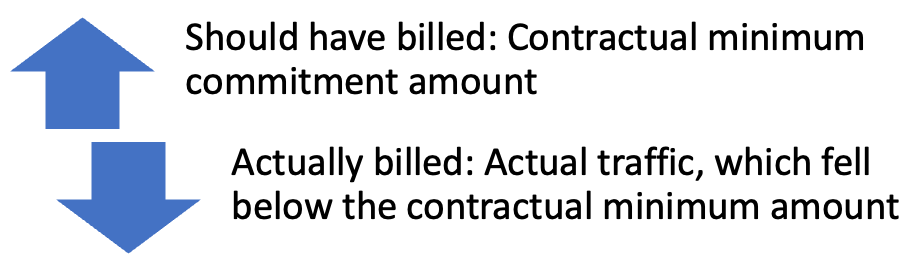
The telco later sued the customer to claim for the difference between the amount it had billed and the amount it should have billed under the contract. It highlighted that the contract had a clause stating that any waiver would be effective only:
“(a) if confirmed in writing by such Party and shall not … be implied from… conduct …;
…
(c) in the instance and for the purpose for which it is given.” (emphasis added)
The “waiver must be in writing” clause did not help because the court found that the telco had indeed given a written waiver. By issuing monthly bills based on the customer’s actual traffic, the telco had waived in writing its right to bill for the contractual minimum amounts. Hence the threshold for the court to find a written waiver is relatively low – a bill showing the actual billed amount was enough, and it was not necessary for the telco to expressly waive its right.
Fortunately for the telco, the “waiver effective only for that instance” clause allowed it to resume billing for the higher amount in the future. Hence consider including a similar clause in your agreements.
I am grateful to Deborah Joy Ong, James Wong Weiming, Lu Ouyuan, Lye Yuan Jun, and R Saravanan for their help reviewing this series of articles, and to adjunct associate professor Rachel Tan from NUS in whose class on mergers & acquisitions I first came across some of the materials cited. All errors remain my own.
Endnotes
| ↑1 | Practical Law, “Boilerplate: Do I really need this clause and why?” practice note at “Severance” (accessed 26 Jul 2024). |
|---|---|
| ↑2 | Practical Law, “Boilerplate: Do I really need this clause and why?” practice note at “Severance” drafting notes (accessed 26 Jul 2024). |
| ↑3 | Practical Law, “Boilerplate: Do I really need this clause and why?” practice note at “Severance”, citing Francotyp-Postalia Ltd v Whitehead (2011) EWHC 367 (accessed 26 Jul 2024). |
| ↑4 | HSBC Institutional Trust Services (Singapore) Ltd (trustee of Starhill Global Real Estate Investment Trust) v Toshin Development Singapore Pte Ltd (2012) SGCA 48 at [45]. |
| ↑5 | For a discussion of a similar cascading clause, see https://www.adamsdrafting.com/step-down-provisions-no-thanks/. |
| ↑6 | Lek Gwee Noi v Humming Flowers & Gifts Pte Ltd (2014) SGHC 64 at [197]. |
| ↑7 | Lek Gwee Noi at [23]. |
| ↑8 | Lek Gwee Noi at [197]. |
| ↑9 | “Business presence” in a jurisdiction was a factor in determining if a geographical restriction was reasonable in Lek Gwee Noi v Humming Flowers & Gifts Pte Ltd (2014) SGHC 64. |
| ↑10 | Practical Law, “Termination” standard clause at “Material breach” (accessed 29 Dec 2023). |
| ↑11 | Practical Law, “Termination” standard clause at cl 1.2 drafting notes (accessed 29 Dec 2023). |
| ↑12 | The risk of deadlock may be higher as this clause seems to be the one of the only termination rights in the LawNet subscription agreement (other than termination for unremedied breach in cl 7.5) as of 31 Jul 2024. |
| ↑13 | Practical Law, “Contracts: privity and third party rights and obligations” practice note at “Exclusions that benefit a third party”. |
| ↑14 | Contracts (Rights of Third Parties) Act 2001 (2020 Rev Ed). |
| ↑15 | s 7(3) Contracts (Rights of Third Parties) Act. |
| ↑16 | s 3(1) of the Contracts (Rights of Third Parties) Act. Contracting parties need a third party’s consent to rescind or vary the contract if any of these three conditions are fulfilled: the third party has expressly assented to the term allowing him to enforce the contract; the promisor knows the third party has relied on the term that allows him to enforce the contract; or the promisor could reasonably foresee that the third party would rely on the term and the third party has in fact relied on it. |
| ↑17 | Practical Law’s standard “third party rights” clause has similar wording. |
| ↑18 | Charles Lim Teng Siang & Anor v Hong Choon Hua & Anor (2021) 2 SLR 153 at [56]. Note also that the UK takes a much stricter approach to enforcing “variation must be in writing” clauses compared to Singapore – see Rock Advertising Limited v MWB Business Exchange Centres Limited (2018) 4 All ER 21. |
| ↑19 | Turms Advisors APAC Pte Ltd v Steppe Gold Ltd (2024) SGHC 174 at [96]-[110]. |
| ↑20 | See e.g. Charles Lim. |
| ↑21 | The Court of Appeal noted these benefits in Charles Lim at (4). |
| ↑22 | Suggestion and caution from Practical Law, “Variation” standard clause (accessed 26 Jul 2024). |
| ↑23 | Charles Lim. |
| ↑24 | Rajah & Tann Asia client update, “Be very specific with ‘no oral modification’ clause” <https://eoasis.rajahtann.com/eoasis/lu/pdf/2021-06_Drafting-Cautionary-Be-Very-Specific.pdf> (accessed 10 Oct 2024). |
| ↑25 | Ma Hong Jin v SCP Holdings Pte Ltd (2020) SGCA 106, court’s summary available at https://www.judiciary.gov.sg/docs/default-source/judgments-docs/ma-hongjin-v-scp-holdings-pte-ltd.pdf?sfvrsn=809e2b15_2#:~:text=Following%20a%20dispute%20based%20on,for%20variations%20on%20their%20contract. |
| ↑26 | Ibid. |
| ↑27 | See e.g. LawNet’s precedent subscription agreement: “(variation) shall not constitute a general waiver of any provisions of this Agreement; … shall not affect any rights, obligations or liabilities under this Agreement that have already accrued up to the date of variation; and the rights and obligations of the Parties under this Agreement shall remain in force, except as, and only to the extent that, they are varied.” |
| ↑28 | Practical Law, “Variation” standard clause. |
| ↑29 | LawNet subscription agreement. |
| ↑30 | https://www.singaporelawwatch.sg/About-Singapore-Law/Commercial-Law. |
| ↑31 | Practical Law, “Waiver” standard clause at “effectiveness of no waiver clauses” (accessed 29 Jul 24). |
| ↑32 | Practical Law, “Waiver” short form standard clause (accessed 18 Jul 2024). |
| ↑33 | Ibid. |