

Voices of Women in the Industry: Women in Tax
This is the next article in our series on Voices for Women in the Industry, published by the Women in Practice Committee. For this session, I had the opportunity to speak with and receive insights from two leading women in Tax Law: Valerie Wu, Partner and Head of Tax & Private Wealth Asia at Pinsent Masons LLP and Barbara Voskamp, Partner at DLA Piper Singapore Pte Ltd. As I discovered, both fell into tax law by accident!
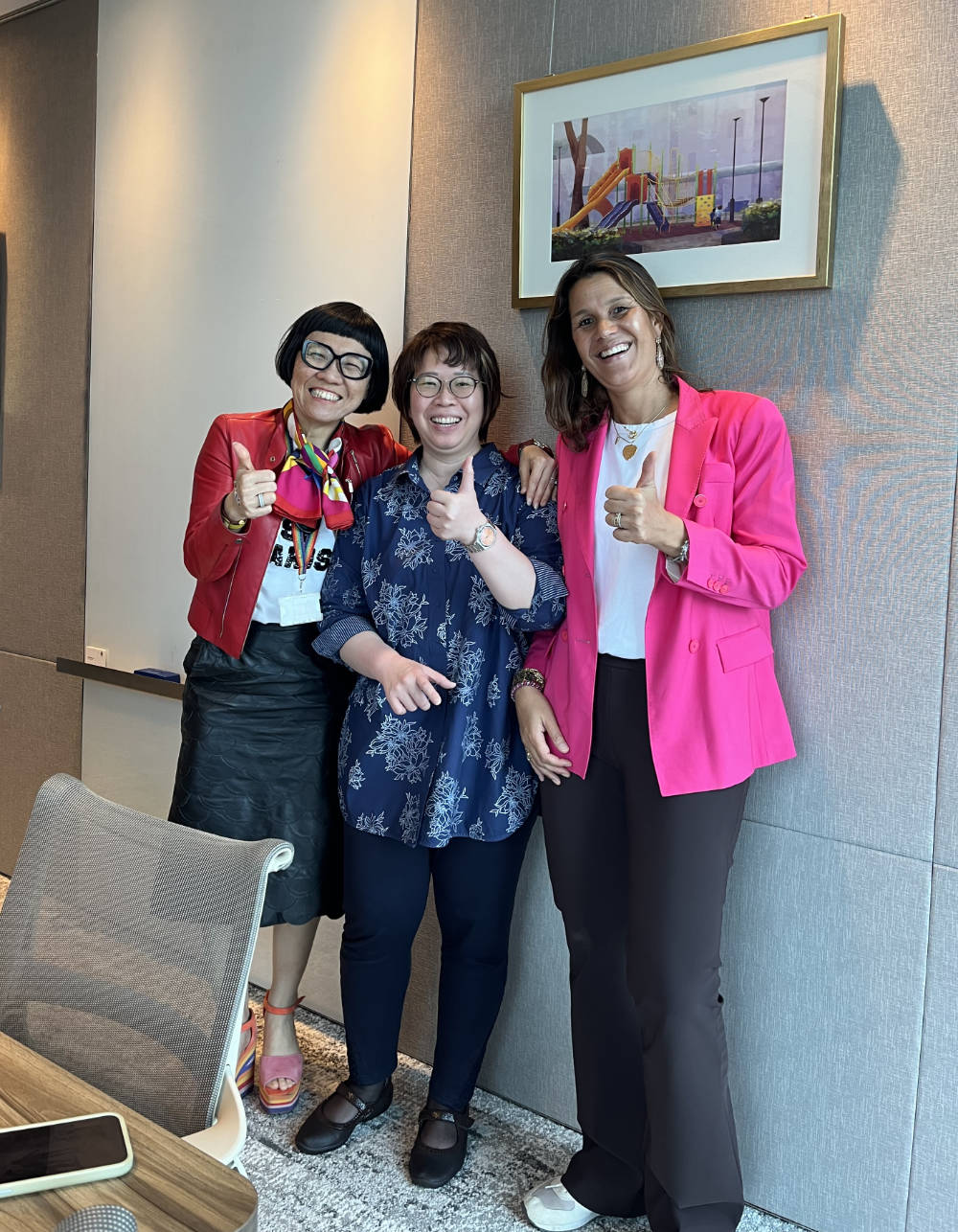
Left to right: Valerie Wu, Partner and Head of Tax & Private Wealth Asia at Pinsent Masons LLP; Dawn Tan, Managing Director of Ashurst ADTLaw LLC; and Barbara Voskamp, Partner at DLA Piper Singapore Pte Ltd
Dawn: How did you decide that tax practice is the right area for you?
Valerie: It was by chance. After three years of practice in everything from litigation to corporate, I was debating whether to stay in practice when I responded to an ad to start all over again in a start-up boutique tax firm.
Barbara: I truly discovered tax law by accident. I was studying Economics and Business, when a great law professor convinced me to do law as well. In my first year in law school there was one subject – an introduction to tax law – which I absolutely loved: true love at first sight. I further specialised, did my LL.M. in tax law and joined the tax practice of one of the biggest Dutch law firms straight after. We worked side by side with our M&A team making sure the tax implications of the deals were properly addressed. It was crazy, into the deep waters, stressful and such a steep learning curve but such excitement and so much fun!

Dawn: Have you ever felt like giving up?
Valerie: Yes, many times. From the first law firm I joined which disbanded due to key man risk (the managing partner passed away), to the next firm with positive key man risk (the managing partner became a judge), to my brother’s passing in the year I was getting married, to many other obstacles and curveballs which life throws over two decades, each time I have had to pick myself up to show up – this is only possible with love and support from my family, my husband, my friends, and finally God. I remain immensely grateful.
Barbara: There have definitely been times in my life that I was desperate to sleep or to have a less hectic life, but then I realised that that would also mean that I would miss the buzz, the dynamics, the privilege to meet crazy, smart and inspiring people every day, that I would make sure that I would go back to the zone. For me the best way to find my way back to the zone is to run, spend time in nature, listen to the birds, to spend sufficient time with loved ones and to sing in the car.
Dawn: What does sustainability mean to you?
Valerie: Having the grit and resilience in the mind to work through difficulties, and having the support to help you pick yourself up when you fail. And to pay it forward by helping the next generation so they hopefully don’t make the same mistakes, or at least know what to expect when they do.
In this regard, I feel strongly that we need to provide the sustainability not just for women to stay in practice, to be able to achieve what and where their talents can take them. To borrow the concept of ESG – we have improved a lot in the “E” part – have the environment to enable women to work / come back to work, but we have a lot more to do in helping women to excel – and this needs to be through the “S” and the “G” components – the social and the governance aspects.
Barbara: Sustainability means so many things: but for me the most important one is that we have the obligation to take better care of our planet. To be thoughtful on how we use resources. In the broadest sense of the word. And not to be afraid to rethink certain principles and practices. What worked 20 years ago does not necessarily work today. We collectively have the obligation to continue asking ourselves and our environment these uncomfortable questions: why do we do this, can we do better and if so, let’s start today. It is not only about the big legislative challenges but also about all the small steps, the changing of a mindset.
Dawn: How do you balance the demands of legal practice and family life? Have you ever had to make trade-offs between work and family?
Valerie: It is never easy. You can’t have it all – or to put it another way, if you want to have it all, it is not all at the same time – everything has its time and place. When people used to ask us why we have not had kids, I used to joke that it is in God’s time. And indeed it is. I have had to make trade offs – for instance, I took a year off to try to start a family, because it is not a light switch that can just happen.
Barbara: Constantly. You make trade-offs all the time. And it forces you to constantly ask yourself the question: what is truly important. I have four children: the oldest is 16, and the youngest is six. My sisters respectfully refer to my household as the Zoo. It is always hectic and chaotic. Combining a career and a family is challenging but Singapore makes it a lot easier. The amount of help that is available, the luxury of school buses, safe taxis and all-around efficiency: you won’t find that anywhere else in the world.
I think the secret in striking the right balance is identifying your sacred moments, brutally scheduling around it and protecting those moments with your life. I block out dinner time in my calendar, at least three nights a week. I don’t mind doing calls later in the evening, or very early in the morning, but if not absolutely necessary I am not giving up my family dinners. That is the moment when we come together as a family, sharing the day, the highs and the lows: that is truly important to me.
Also, I can’t emphasise enough that despite the need for rigorous and meticulous scheduling you need to be flexible. Family life is dynamic, and so is legal practice. Things are always changing, it is never static, and there should always be a plan B.
Dawn: Have your motivations or inspirations in practice changed over time? If so, how/in what way?
Valerie: Yes – I found that as my practice evolved, it is not just about the hard letter of the law, although that forms the basis of our advice.
In working with all the different clients over the past two decades and counting, from estate duty planning pre-15 February 2008 (before it was abolished), to re-structuring trusts to enable powers of investment to be reserved to settlors (post-2004 after major trust law reform), to structuring trusts and family offices to leverage on tax incentives, and now thinking about and designing family governance to align with succession plans – whether business succession or wealth succession, one thing that cut across all cultures is the gestation period for the decision-making process to distill. To provide more strategic and rounded advice to clients, I realised I was providing the safe space for clients to talk about what really matters to them in structuring the trusts, and designing the family governance – so as to safeguard the values and the strategic fruits of the family businesses.
I found resonance in these thoughts after being inducted as the first Singapore International Fellow of the American College of Trust and Estate Counsel. I took up two specialist Psychology Counselling diplomas during the Covid period to better understand the mindsets across the different generations, to provide strategic advice to clients through succession planning.
Barbara: Yes and no. When starting as a young lawyer I just wanted to be part of a high achieving, high energy, creative thinking, successful team. Now I want to build and lead those teams. Creating a safe environment to learn, to excel, exchange and challenge ideas and design solutions.
Dawn: How do you think we can encourage women lawyers to stay in practice?
Valerie: What I said earlier about sustainability is also applicable to encouraging women lawyers to stay in practice. From ensuring gender equity, to having the right governance frameworks to address current gaps, and most of all, to encourage everyone to pay it forward – men and women.
I also think both mentoring and peer support will go some way to help. To achieve this, we need to consciously encourage the more senior practitioners to pay it forward – to help, to guide, to support, to mentor – starting with those in our team. To lead by example, to have more role models of diverse backgrounds. To recognise what it is that we lack as a profession. To provide support groups to talk about what matters and what does not work. To have regular gatherings so that we can form our village support.
Barbara: Flexibility is probably one of the key words. I think that has been one of the positive side effects of Covid. It is no longer frowned upon when you work flexible hours and one or two days from home.
But also, women lawyers need other women lawyers. The sisterhood is so important. Looking out for one another, stepping up for one another, speaking out for one another. It is not easy: between the age of 30 and 40 everything requires your immediate attention. It can be overwhelming. It is so important for women lawyers to find other women lawyers. It has been my mantra for years: behind every successful woman is a tribe of other successful women who have her back. We should encourage and empower our women lawyers to find and build their tribe.
Dawn: What are some of the ways you have advocated for/protected your team’s welfare and well-being?
Valerie: I happen to have a team of ladies – purely by chance. So I have to work very hard to ensure that their work is duly recognised when it comes to increments and promotions, and that when there are challenging behaviours towards them (or ourselves as a team of ladies) due to gender bias, I find that I have to speak up to make sure it is duly flagged, escalated, called out, and addressed.
I always encourage my team to get married sooner for those who are not married, have more kids for those who are (like 10), take time out for their kid/s for those who are single parents, and generally ensure that they take time out for self-care. We eat a lot together too.
The nature of our tax practice may also not fit naturally to the billable hour – if we propose to bill USD25,000 for tax advice which achieves the outcome for a client, we may not necessarily have to clock the number of hours to “fill” this number. I have to make sure that the metrics that my team are measured against duly takes this into account.
Barbara: I try to practise what I preach, providing for flexible work. But also, to have open discussions on life, challenges and that it is ok not to be ok. We all have our off days, and that is totally fine. Take your space, find your own rhythm, your own zone, your own ways of getting back into your zone. And accept that you can’t have a rainbow without a little rain.
Dawn: What are your thoughts about diversity in legal practice?
Valerie: We have improved a lot, but there is still some way to go in being more diverse (which requires us to be more inclusive), as that has to be the way given how small our population is, and therefore how small our profession is. I think of diversity not just in the gender sense, and even that is still very much a work in progress – as that starts with the mindset.
Barbara: I think we are making progress, but we still have a long way to go. Also, I think the practice as a whole has embraced the concept of diversity, but we still don’t really breathe and live it. We want diversity for different opinions, but then when different opinions are brought to the table, do we really appreciate it? Do we really value it the way we should or do we secretly think why are you making things so complicated. I think there is still a fair bit of education to do: for folks to really listen to the other voices that diversity brings to the table, how to address that, incorporate that, appreciate that and find different, other solutions. Now I see diversity hires being modelled into a same same but different version of the voice and sound we already know. We not only need to embrace diversity, we also need to empower diversity to continue to speak up. Breathe and live it.
Dawn: What, if anything, would you have done differently if you could turn back the clock?
Valerie: I think it would have been good for me to stay in litigation a little longer – it really hones and sharpens the mind. My second boss who became a judge always reminded us to write as if it will be read out in court – this gives you the discipline to distill your thoughts and remove the emotions. I have the utmost respect for litigators!
Barbara: Probably that I would have appreciated the journey more. My eyes and focus were always on the horizon: what’s next, where to now, and in that drill I may not have appreciated the little things I encountered on my journey getting there. But is it never too late to change, and even when not turning back the clock I remind myself now and then to look up and look around. What a beautiful world we live in.