


Don’t Skip the Boilerplate: A Guide to Review (Part 2)
This is part two of a four-part series on how to review boilerplate clauses, focusing generally on lesser-known risks. Part one covered confidentiality clauses, and this part two discusses boilerplate clauses from A to En. Parts three and four have been published.
Contents
Assignment
Note that parties can assign their rights if the contract is silent
Assignment is a common law right. Hence if the contract lacks an assignment clause, either party can still freely assign its rights under the contract.1Practical Law, “Assignment” standard clause at “Assignment and other dealings permitted” drafting note (accessed 1 Aug 2024).
Generally parties include an assignment clause to restrict one or both parties’ right to assign, except with the counterparty’s consent. Such “no assignment” clauses have several benefits, e.g. reducing the risk of a party having to:2Practical Law, “Boilerplate: Do I really need this clause and why?” practice note at “Assignment” (accessed 26 Jul 2024).

- work with anyone other than its contractual counterparty,
- deliver its work to a competitor, or
- work with someone it would rather not be associated with.
Consider protecting the party who needs the other’s consent to assign
If you act for the party who may need the other’s consent to assign, consider stating that the counterparty must not unreasonably withhold its consent for your party to assign its rights.
Consider removing references to “transferring an obligation”
Some no-assignment clauses not only prevent parties from assigning their rights, but also from transferring their obligations. However, this is not strictly necessary, because transferring one’s obligations (i.e. novation) always requires all parties’ consent under common law. Hence if you come across such a clause, consider amending it as such for succinctness:
“[A] Party may not assign
or transferall or part of its rightsor obligationsunder this Agreement without the prior written consent of the other Parties.” (suggested amendment, clause based on VIMA 2.0 subscription agreement)
Consider expressly prohibiting sub-contracting
Even if a contract prohibits “transferring obligations”, note that parties can usually still sub-contract their obligations to a third party. This is because sub-contracting differs from novation: a party which sub-contracts its obligations to a third party still remains liable to its counterparty and so does not need the counterparty’s consent to sub-contract. (Consider renovating a house: the main contractor is still liable to the owner if its sub-contractors do a poor job.) However, a party which novates its obligations is no longer liable to the counterparty, hence novation needs all parties’ consent.3Ibid.
If you do not want your counterparty to sub-contract its obligations, you should still expressly state this in the agreement. Below is a sample clause:
“Except with the prior written consent of the other Party, neither Party may sub-contract the performance of any of its obligations under this Agreement.” (LawNet subscription agreement)
Counterparts and Signatures
Ensure that non-compliance with formalities will not affect the agreement’s validity
Some counterparts clauses may stipulate additional formalities that parties must comply with when signing in counterparts. For example, it may require parties who sign electronically to later exchange signed hardcopies.
If your counterparts clause has such formalities, ensure you provide that failing to comply with them will not affect the agreement’s validity, such as in the sample clause below.
“A Party who signs the agreement electronically shall subsequently deliver a signed hardcopy to the other Party (but failure to deliver this will not affect this Agreement’s validity).”
Cumulative Remedies
Check if there are any contractual remedies intended to be exclusive
A “cumulative remedies” clause states that any remedies the contract provides will add on to, rather than replace, available common law remedies. Beware of unthinkingly including such a clause, because sometimes parties want the contractual remedy to be the only remedy for that problem. If parties so intend, then the drafter adding a “cumulative remedies” clause would result in the opposite outcome.
This very problem occurred in Ebony Ritz v Sumatec4(2017) SGHC 282 at (92). – a party was able to claim a remedy outside the listed contractual remedies, partly because there was a cumulative remedies clause. The diagram below summarises the case:
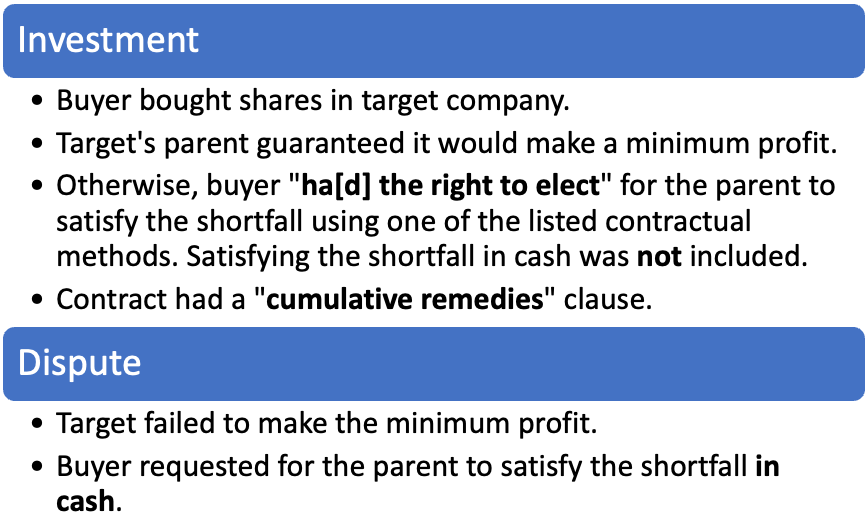
Given that the listed contractual remedies were specific and that they did not include the buyer claiming for its shortfall in cash, the parties likely had not originally intended that the buyer could do so. However, the court nevertheless allowed the buyer to claim for the shortfall in cash. The court held:
- The phrase that the buyer “ha[d] the right to elect” a method to satisfy the shortfall was “permissive and not restrictive”, so the listed contractual methods were not exhaustive (at [94]).
- Also, the contract had a cumulative remedies clause ([96]). (The clause was worded similarly to commonly-seen cumulative remedies clauses today, i.e. “no single or partial exercise of any right or remedy [shall] preclude…the exercise of any other right or remedy … [the] rights provided in this Agreement are cumulative and not exclusive of any rights or remedies provided by law.” However nothing turned on this phrasing, as the court decided based on the clause’s inclusion rather than its phrasing.)
Hence this case shows how including a cumulative remedies clause could cause an outcome opposite to what parties intended.
The takeaway? Before adding this clause, consider if it is appropriate for your transaction. In particular, check if the contract contains any remedies intended to be exclusive. Remedies that parties usually want to be exclusive include:
- Indemnities with a capped amount.5Practical Law, “Contracts: indemnities” practice note at “Will a cap on liability protect the paying party?” (accessed 27 Dec 2023). A capped indemnity would be useless if the indemnified party could pursue additional remedies (e.g. damages) on top of the capped amount.
- Any special dispute resolution mechanism other than litigation/arbitration – for example, expert valuation of shares. Parties may want such a mechanism to be the only remedy for such disputes, e.g. that share valuation should be decided finally by an expert without recourse to litigation or arbitration (further discussed at section 4.4 under “dispute resolution”).
If you have any remedies intended to be exclusive, consider stating that that remedy is exclusive as well as carving out an exception to the “cumulative remedies” clause. The diagram below suggests wording illustrating how you could do this.

Consider omitting this clause as it restates the law
If the contract is silent, contractual remedies add on to rather than replace a party’s remedies available at common law.6Practical Law, “Boilerplate: Do I really need this clause and why?” practice note at “Rights and remedies” (accessed 26 Jul 2024). In that sense, you do not need to include a “cumulative remedies” clause because common law already provides for remedies to be cumulative. Hence consider omitting this clause for succinctness. (Omitting the clause could also be safer since as explained in the tip above, there are risks with unthinkingly including this clause in every agreement.)
Dispute Resolution
Avoid referring to disputes arising “out of” the contract
Watch out for dispute resolution clauses that narrowly specify the disputes subject to the chosen resolution method. While “disputes arising out of or in connection with” is commonly-used and sufficiently broad, the less-common “disputes arising out of” (without “in connection with”) may be too narrow and risky.
The court has previously narrowly interpreted the phrase “arising out of” when used by itself in a dispute resolution clause.7Sabah Shipyard (Pakistan) Ltd v Government of the Islamic Republic of Pakistan (2004) 3 SLR(R) 184 at (18), citing Getreide-Import-Gesellschaft M.B.H. v.Contimar S.A. Compania Industrial Comercial Y Maritima (1953) 1 WLR 793. For example, where parties arbitrated a dispute arising out of their contract and one party later appealed the arbitral award, the court held that the latter dispute related to the arbitral award and did not arise “out of” the contract.8Getreide-Import-Gesellschaft M.B.H. v.Contimar S.A. Compania Industrial Comercial Y Maritima (1953) 1 WLR 793.

In most cases, parties would likely want their dispute resolution clause to be broad. Since they have agreed on a dispute resolution clause to provide certainty, it would defeat this purpose to have the clause apply narrowly – since it would then remain unclear how to resolve disputes falling outside of the clause.
Instead of the narrow “disputes arising out of” the contract, consider using “disputes arising in connection with” the contract for most agreements, as discussed below.
Consider referring to disputes arising “in connection with” the contract” instead
Most dispute resolution clauses define the scope of the clause as disputes “arising out of or in connection with” the agreement. Although this phrasing is found in several widely-available precedents,9The SIAC and SMC model clauses, VIMA 2.0 documents and LawNet precedents all use this phrase. I suggest that this phrasing could be simplified even further to simply “arising in connection with”.
This is because the court has interpreted “arising out of” to have a more limited meaning than “arising in connection with” – the former requires a more direct connection between the dispute and the contract compared to the latter.10Sabah Shipyard at (18). Since “in connection with” is already broader than “out of”, the latter is arguably redundant. So consider simply stating “disputes arising in connection with” the agreement for succinctness.
Consider rephrasing references to rules “for the time being in force”
Dispute resolution clauses commonly use the phrase “for the time being in force”. For example, both the Singapore Mediation Centre (SMC)’s and Singapore International Arbitration Centre (SIAC)’s model clauses state that a dispute will be resolved “in accordance with [the institution’s rules] for the time being in force”. However, does “for the time being in force” mean the rules existing at the time:
- when the contract was formed? Or
- when the dispute was submitted to the institution?
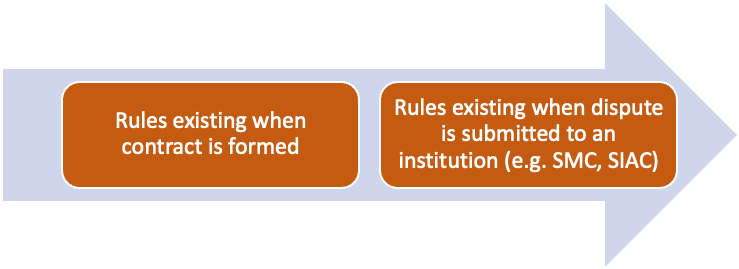
What does “rules for the time being in force” refer to?
The difference between these two sets of rules becomes important if the institution’s rules have changed between the time the contract was formed and the time the dispute was submitted. This was indeed the case in a High Court matter where parties litigated this issue. The case concerned an arbitration clause substantially similar to the SIAC’s model arbitration clause, which stated that:11Car & Cars Pte Ltd v Volkswagen AG and another (2010) 1 SLR 625 at (15).
“Any disputes arising out of or in connection with this agreement herein shall be referred to arbitration in the Singapore International Arbitration Centre in accordance with the Rules of the Singapore International Arbitration Centre for the time being in force.” (emphasis added)
The High Court ruled that “for the time being in force” meant the rules existing at the time the dispute was submitted to the SIAC. This was because:
- “For the time being in force” suggested rules that could not yet be identified. If the parties had intended to use the rules existing at the time they entered the contract, they could have identified those rules by name,12Car & Cars at (25). e.g. “the SIAC Rules 1997”.
- Previous case law suggested that generally the applicable rules were those at the time of the dispute, especially if the rules were mainly procedural.13Car & Cars at (26). (In contrast, if a tribunal’s rules were mainly substantive, the court would usually infer that the rules at the time of entering the contract applied.14Car & Cars at (30).)
Hence for clarity, consider amending the phrase “for the time being in force” to “at the time the arbitration/mediation is commenced”. Although case law has clarified what “for the time being in force” usually eans, it may still be safer to expressly state it in the contract, as this prevents a dispute if one or both parties do not know of the case law and avoids the risk of the above case being overruled or distinguished.
Check if your agreement has any non-traditional dispute resolution mechanisms
This tip applies to agreements that contain non-traditional dispute resolution mechanisms. For example, in a share purchase agreement, parties may engage a third-party expert to value the shares if parties cannot agree on the price.
Clarify the relationship between the “main” dispute resolution method (e.g. litigation, arbitration) and the non-traditional one. Parties may intend to carve out a certain type of dispute to be resolved only by the non-traditional mechanism, e.g. all share price disputes should be finally resolved by expert valuation with no recourse to litigation:
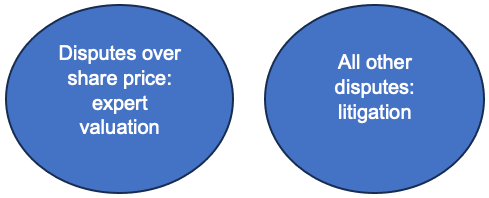
Alternatively, parties could intend for the non-traditional method to be only the first port of call, and plan to move on to traditional dispute resolution if it fails:
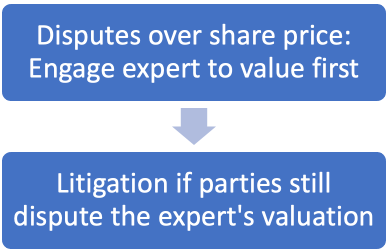
So first confirm how the two dispute resolution methods will interact, then draft the clauses accordingly to make this clear. The sample clauses below suggest a way to modify such clauses.
If non-traditional clause is the exclusive remedy for disputes under its scope
“5. Disputes over share price adjustment
If the parties are unable to agree on the adjusted share price, they shall appoint an expert valuer…
This clause 5 will be the parties’ exclusive remedy for all disputes regarding the adjusted share price.
15. Dispute resolution
Except for disputes under clause 5, any dispute in connection with this agreement will be submitted to the Singapore court…” (emphasis added)
If non-traditional clause is the first remedy, however parties can continue to use traditional dispute resolution afterwards
“5. Disputes over share price adjustment
If the parties are unable to agree on the adjusted share price, they shall appoint an expert valuer…
For all disputes regarding the adjusted share price, parties shall first attempt to resolve the dispute under this clause 5.
15. Dispute resolution
Subject to clause 5, any dispute in connection with this agreement will be submitted to the Singapore court…” (emphasis added)
Thus, remember to clarify the relationship between the multiple dispute resolution mechanisms to avoid a dispute over which mechanism applies.
Entire Agreement
Check which documents contain the parties’ entire agreement
Beware of unthinkingly including an entire agreement clause. Before adding one, ensure that you have a comprehensive list of surviving agreements. Other than the agreement containing the entire agreement clause, what other documents contain the parties’ agreement? For example:
- Was there a previous NDA?
- Was there a previous contract/deed containing non-compete or non-solicit clauses?
If so, consider if those documents should be part of the “entire agreement”.
A third key question is: Have both parties given consideration under the current agreement? If not, make sure that the agreement under which both parties have given consideration survives.
Failing to consider this question led to tragic results in Encus v Tenacious.15(2016) SGHC 50. Tenacious was an investor in Encus. It entered into a series of agreements under which Tenacious disbursed its loan to Encus and received security for the loan in return, as summarised below.

The dispute involved Encus’s obligation to transfer shares in a third party to Tenacious and other investors as security for their loan. The term sheet indicated this obligation but was overridden by the convertible loan agreement’s “entire agreement” clause, leaving Encus’s share transfer obligation unsupported by consideration. A later agreement (the CSTA) expanded the conditions which would trigger Encus’s share transfer, but was also unenforceable because the investors did not provide any new consideration as they had already disbursed the loan. So when Encus later became insolvent, the liquidator successfully argued that Encus did not have to transfer any shares as security for the investors’ loan. Since this obligation was unsupported by consideration in any of the surviving agreements, it was unenforceable.

The investors had not given consideration for Encus’s obligation to transfer shares
Hence before including an entire agreement clause, it is good practice to check if there are any prior agreements that should survive, and that all parties have given consideration under the surviving agreements.
Define “Transaction Documents” clearly
A contract can define “Transaction Documents” in several ways. You may want to check that the definition is sufficiently clear – for example that it specifically names the transaction documents, or else describes them as “documents referred to in this agreement”. Below I examine two recommended ways of defining “Transaction Documents” and one I suggest avoiding.
Recommended approaches
| Approach | Specify the transaction documents individually | Describe a category of documents (narrow drafting) |
|---|---|---|
| Example definition of “Transaction Documents” | “this agreement and the shareholders’ agreement” | “documents referred to in this agreement” |
| Precedents adopting this approach | LawNet subscription agreement
VIMA subscription agreement Practical Law LawNet boilerplate “entire agreement” clause (documents are listed in the schedules) |
Practical Law |
| Remarks | Recommended. Both approaches are specific enough to identify the surviving documents. | |
Approach I suggest avoiding
| Approach | Describe a category of documents (broad drafting) |
|---|---|
| Example definition of “Transaction Documents” | “documents entered into in connection with this agreement”
“documents entered into for the purpose of this agreement” |
| Precedents adopting this approach | None (LawNet’s precedents and boilerplate clause bank, VIMA’s and Practical Law’s precedents all do not take this approach.) |
| Remarks | Not recommended. This phrasing is vague and could cause a dispute over which documents survive.
While such phrasing likely appeals because in some complex transactions it may be hard to exhaustively list down all the transaction documents, none of the surveyed precedents use such a broad phrasing. Such phrasing could still help in a limited way by making clear that all oral agreements are superseded, even if it remains vague which written documents survive. |
I am grateful to Deborah Joy Ong, James Wong Weiming, Lu Ouyuan, Lye Yuan Jun, and R Saravanan for their help reviewing this series of articles, and to adjunct associate professor Rachel Tan from NUS in whose class on mergers & acquisitions I first came across some of the materials cited. All errors remain my own.
Endnotes
| ↑1 | Practical Law, “Assignment” standard clause at “Assignment and other dealings permitted” drafting note (accessed 1 Aug 2024). |
|---|---|
| ↑2 | Practical Law, “Boilerplate: Do I really need this clause and why?” practice note at “Assignment” (accessed 26 Jul 2024). |
| ↑3 | Ibid. |
| ↑4 | (2017) SGHC 282 at (92). |
| ↑5 | Practical Law, “Contracts: indemnities” practice note at “Will a cap on liability protect the paying party?” (accessed 27 Dec 2023). |
| ↑6 | Practical Law, “Boilerplate: Do I really need this clause and why?” practice note at “Rights and remedies” (accessed 26 Jul 2024). |
| ↑7 | Sabah Shipyard (Pakistan) Ltd v Government of the Islamic Republic of Pakistan (2004) 3 SLR(R) 184 at (18), citing Getreide-Import-Gesellschaft M.B.H. v.Contimar S.A. Compania Industrial Comercial Y Maritima (1953) 1 WLR 793. |
| ↑8 | Getreide-Import-Gesellschaft M.B.H. v.Contimar S.A. Compania Industrial Comercial Y Maritima (1953) 1 WLR 793. |
| ↑9 | The SIAC and SMC model clauses, VIMA 2.0 documents and LawNet precedents all use this phrase. |
| ↑10 | Sabah Shipyard at (18). |
| ↑11 | Car & Cars Pte Ltd v Volkswagen AG and another (2010) 1 SLR 625 at (15). |
| ↑12 | Car & Cars at (25). |
| ↑13 | Car & Cars at (26). |
| ↑14 | Car & Cars at (30). |
| ↑15 | (2016) SGHC 50. |